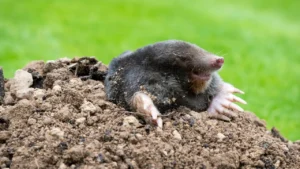
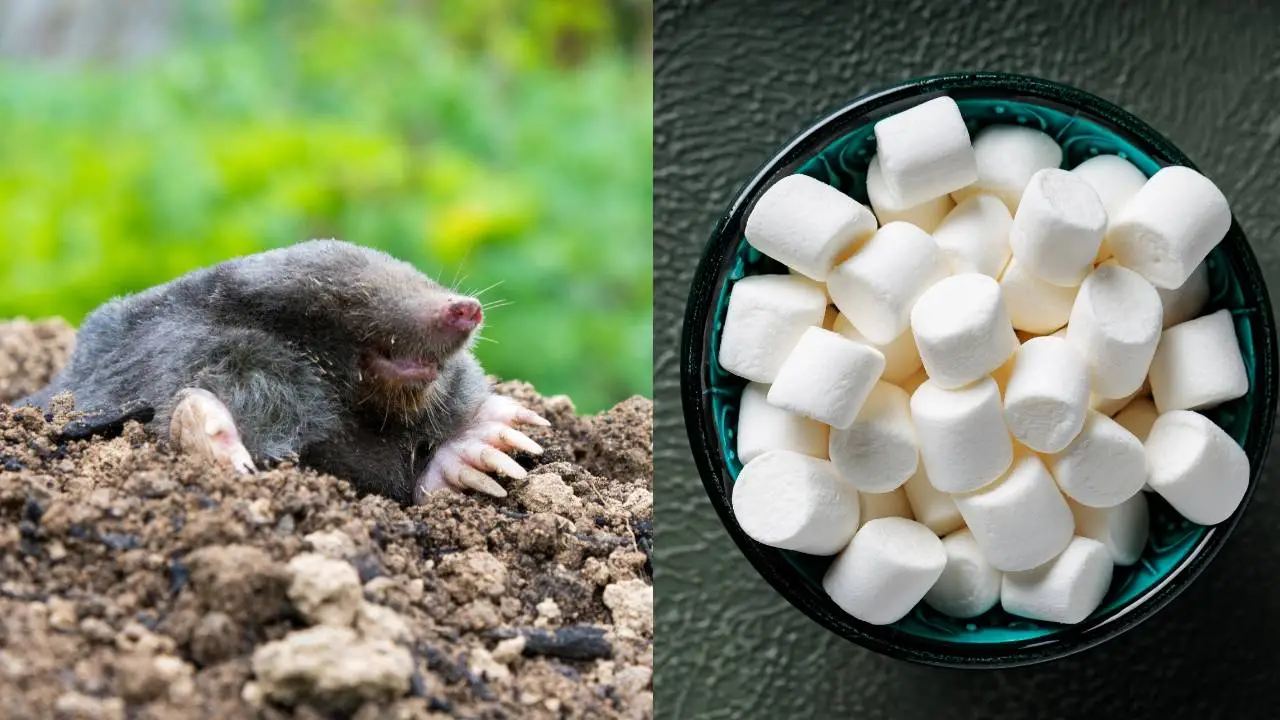
If you’ve noticed volcano-like mounds and raised ridges spreading across your lawn, you’re dealing with a problem many homeowners face: moles. While moles don’t eat grass, their tunneling can uproot roots, dry out turf, and quickly turn a well-kept yard into a patchy mess.
Over the years, one question comes up again and again from frustrated homeowners: does killing moles with marshmallows actually work? The idea sounds appealing. Marshmallows are cheap, easy to find, and seem harmless compared to traps or poisons. The common belief is that stuffing marshmallows into mole tunnels will either block the animal underground or harm it through unusual ingredients.
In real-world pest control work, though, the reality is more complicated. Killing moles with marshmallows is based largely on anecdotal success rather than proven science. In some limited situations, visible mole activity may slow down, but the method is inconsistent, labor-intensive, and rarely works as a stand-alone solution. There are also downsides and ethical considerations homeowners should understand before relying on it.
In this article, I’ll break down how the marshmallow method is supposed to work, walk through a practical step-by-step approach if you decide to try it, explain the risks and limitations, and—most importantly—cover more effective, proven alternatives you can use alongside it. The goal is to give you a realistic, experience-based guide so you can make a practical decision for your lawn.
Also Read: Spadepestcontrol blog
Is Killing Moles with Marshmallows Possible?
Short answer: sometimes — but rarely, and not in a dependable way.
In practical field work, there’s no consistent evidence that marshmallows reliably kill moles. Most success stories are anecdotal and difficult to verify. In a few narrow situations — a single mole, shallow active tunnels, and daily monitoring — activity may drop. But for ongoing or multi-mole problems, university extension services and wildlife professionals still point to trapping and habitat modification as the only repeatable, controllable solutions.
Quick visual guide: How long different mole control methods take to show results.
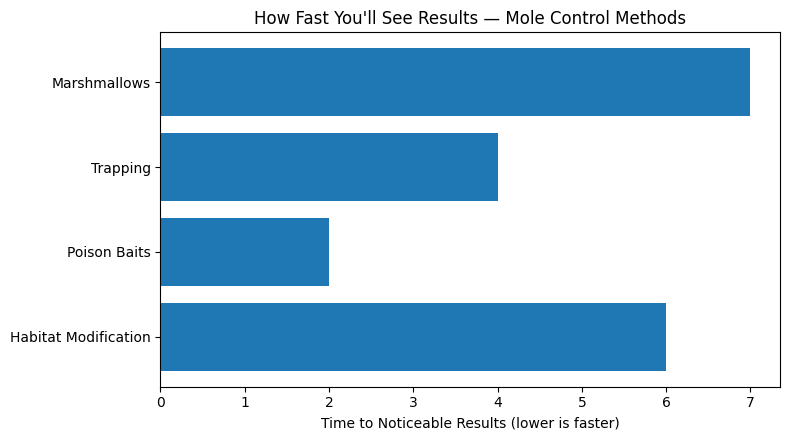
How To Use Marshmallows to Kill Moles (Step-by-Step Process)
If you want to try marshmallows as part of an integrated plan (not your only plan), here’s a clear, practical process someone with years in the field would follow.
1. Clean Up Your Yard and Locate Entry and Exit Points
Start by making the job visible. Rake up that debris, mow to a uniform length, and clear vegetation that hides mole activity.
When the yard is tidy, you’ll easily spot the small holes and molehills. The best results from any control method come from treating the correct tunnels — the ones the mole actually uses every day.
Main runs are generally straighter and show frequent, fresh soil pushed to the surface. Focus on those runs for marshmallow plugging or for placing traps. This mapping step is simple but it matters — you’ll avoid wasting marshmallows on abandoned tunnels.
2. Remove Sources of Food
Moles are insectivores: their diet is almost entirely worms, grubs, and soil insects. If a yard is producing lots of earthworms and grubs, it’s naturally attractive to moles.
You can reduce attractiveness by addressing grub populations (if they exist) and avoiding overfertilizing or heavy organic debris that attracts insects. Be careful: earthworms are also beneficial for soil health.
If you choose a grub treatment, pick products carefully and follow label instructions — and know that removing food alone doesn’t instantly remove moles, but it reduces the long-term pull.
3. Water Your Lawn Less Often
Moles prefer loose, moist soil because it’s easier to dig in and it concentrates worms near the surface.
Reducing irrigation frequency — water deeply but less often — makes your lawn less worm-friendly and, over time, less appealing to moles.
Don’t eradicate watering if you need a healthy lawn; instead cut back to a schedule that meets turf needs without creating a worm magnet. This is a low-cost, low-risk habit that helps other control methods work better.
3. Bring Out the Marshmallows
When you’ve done the prep, bring out the marshmallows. Use full-size ones, push a few into each identified main opening, and loosely seal. Check daily. Replace missing marshmallows and re-plug fresh openings.
Keep pets and children away while you’re treating. If you get no visual results within a couple of weeks, don’t assume total failure — moles can move — but consider switching to trapping or calling a pro.
Remember: marshmallows are inexpensive and safe around humans, but they’re a high-maintenance option.
4. Marshmallow Ingredients
Store marshmallows are mostly sugar, corn syrup, gelatin or plant gums, and small additives such as carrageenan or phosphates (for texture and shelf life). Two ingredients often mentioned in the “marshmallow kills mole” story are carrageenan and tetrasodium pyrophosphate.
In theory, these substances could be indigestible or irritating to a mole’s gut; in practice there’s no robust evidence showing they reliably kill moles. Food additives like carrageenan are regulated and generally regarded as safe for human food at typical levels, though they have been studied for effects at very high doses.
The key point is: marshmallows contain ingredients that might be harmful to a small insectivore in large or unusual doses, but that is not the same as controlled proof that marshmallows are an effective, humane mole killer. If you worry about ingredients, making your own marshmallows at home or choosing simple recipes changes the mix, but it also changes any hypothetical effect on the mole.
The Downsides of Killing Moles with Marshmallows
There are several important downsides to the marshmallow method:
1. It’s anecdotal and unpredictable. No solid scientific trials prove consistent success. You might reduce visible activity. You might not. You may never see a dead mole, which makes evaluation difficult.
2. It’s labor-intensive. Daily checks, replacing missing marshmallows, and continuous monitoring are required for any chance of success. That’s not practical for many homeowners.
Quick visual guide: Effectiveness versus effort required to show results.
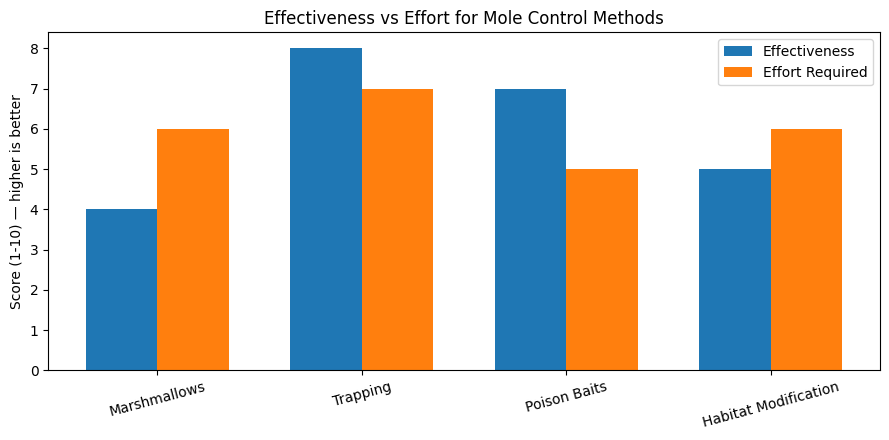
3. It may be inhumane. Plugging tunnels can cause slow suffocation or a slow death by starvation; many people find that ethically troubling. If you prefer a humane approach, trapping and prompt dispatch by a professional are better than leaving an animal to suffer. Extension services usually emphasize quick, targeted control (traps) over techniques that may prolong suffering. From a professional pest-control standpoint, properly placed traps in active runs are generally considered more humane than methods that may cause slow suffocation or prolonged starvation. Quick, targeted control reduces unnecessary suffering and allows the homeowner to clearly confirm results rather than guessing whether the animal has died.
4. It can attract other critters. The scent of marshmallows and sugar can lure ants, rodents, raccoons, or dogs to the tunnels — creating new problems or exposing pets to hazards.
5. It’s not a long-term management plan. Even if you remove a mole or two, more will move into good habitat unless you change the underlying conditions.
Expert tip
If you try marshmallows, do it as a short-term experiment and pair it with trapping and habitat changes. Use marshmallows only on a few targeted main runs and keep careful notes. If after two weeks you don’t see a steady drop in activity, switch tactics. Trapping remains the most reliable method for control; marshmallows are a low-cost, low-toxicity test but not a substitute for proven methods.
Better Alternatives
If you want a plan with predictable results, university extension services such as the University of Minnesota, UConn IPM, and the University of Nebraska consistently recommend the following approaches:
Pairing one or two of these with light, targeted marshmallowing (if you choose it) gives you the best practical chance at reducing damage without relying on one unproven trick.
Also Read: How To Get Rid of Moles in Your Yard Before They Destroy Your Lawn
Legal and Wildlife Considerations
Mole control laws and permitted methods can vary by state or municipality. Before using lethal control methods, check local wildlife regulations and follow all applicable guidelines to avoid unintended legal or environmental issues.
Frequently Asked Questions About Killing Moles with Marshmallows
Conclusion
Killing moles with marshmallows sits squarely in the “maybe” category. It’s cheap, non-toxic to humans, and easy to try — but it’s slow, unpredictable, and can be ethically questionable if left to cause a slow death.
Use marshmallows only as a small experiment within a broader plan: map runs, reduce food sources and excess watering, and use trapping or professional help if the problem persists.
If you want guaranteed, repeatable results, trapping and proven habitat changes recommended by university extension services are still the best path. Think of marshmallows as a backyard experiment, not a replacement for tried methods.