If you own a home with any wood on it — a deck, porch, siding, or old furniture — you’re playing a little game with time and bugs. Most of those wood-eating or wood-boring insects don’t announce themselves loudly. They prefer the slow, quiet approach: a tunnel here, some powder there, a door that suddenly sticks.
I’ve spent the better part of two decades pulling apart wall cavities, checking attics, and explaining to worried homeowners what those tiny holes and dusty piles really mean. Knowing which wood pests to fear and how to spot them early is the difference between a quick fix and a bill that makes you swallow hard.
In this article I’ll walk you through the five wood-boring insects that cause the most headaches: termites, carpenter ants, carpenter bees, powderpost beetles, and bark beetles/wood borers. For each one I’ll explain how to identify them, what their “calling cards” look like, why they’re dangerous, and practical, field-tested steps to reduce risk.
Also Read: Spadepestcontrol Blog
Quick Answer: What Are the Most Damaging Wood-Boring Insects?
The most destructive wood-boring insects for homeowners are termites, carpenter ants, carpenter bees, powderpost beetles, and bark beetles. Termites cause the most structural damage, while beetles and bees weaken wood over time. Early identification and moisture control are the most effective prevention steps.
What Are Wood-Boring Insects?
Wood-boring insects are pests that tunnel into wood to eat it, lay eggs, or create nesting galleries. Some species consume the wood itself (like termites and certain beetle larvae), while others excavate it and push it out as debris (like carpenter ants and carpenter bees).
Why Wood-Boring Insects Are a Serious Structural Risk
Wood-boring insects aren’t all the same. Some actually eat wood (termites and some beetle larvae), others excavate it for nests (carpenter ants and carpenter bees). Some prefer damp, decaying wood; others will go after finished or stored lumber. What unites them is the damage pattern: hidden, steady, and often underestimated until it’s serious.
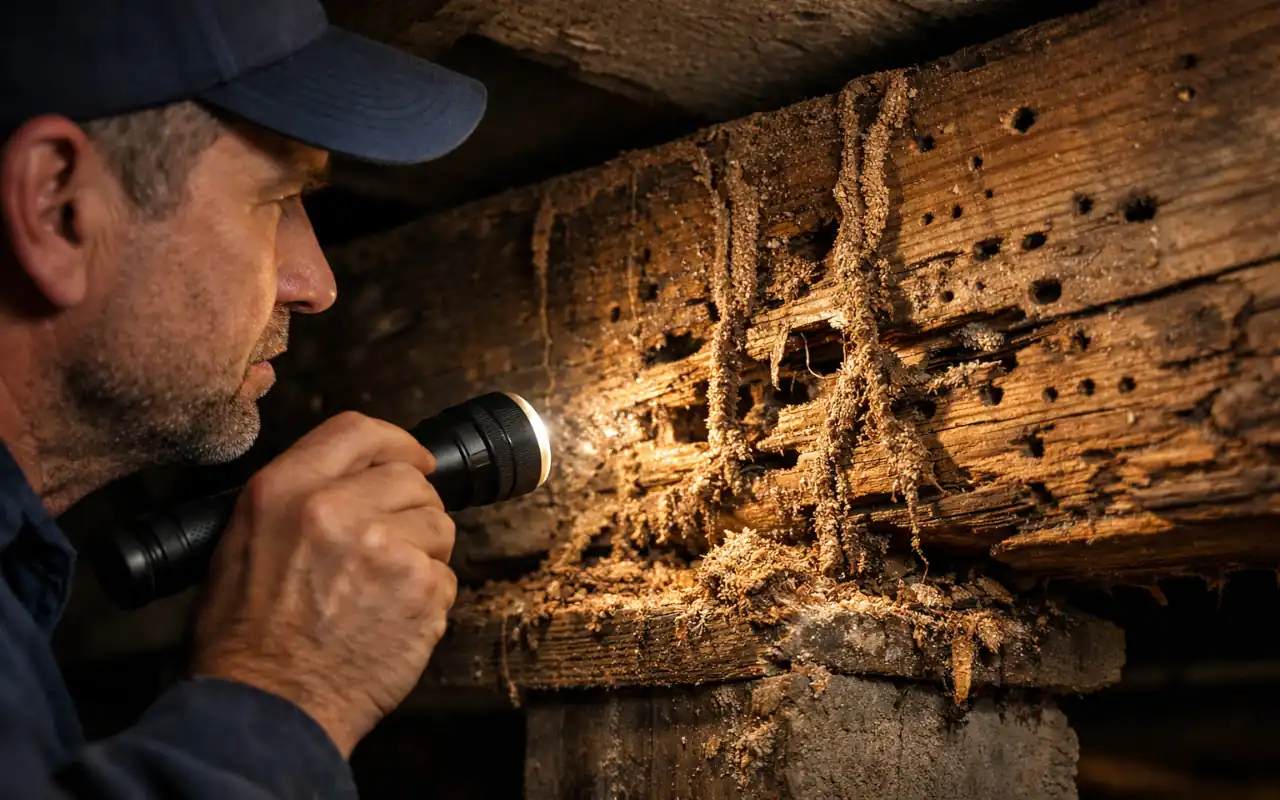
A hollow joist, a sagging deck board, or a wall that sounds “empty” when you knock usually means months or years of tunneling beneath the surface.
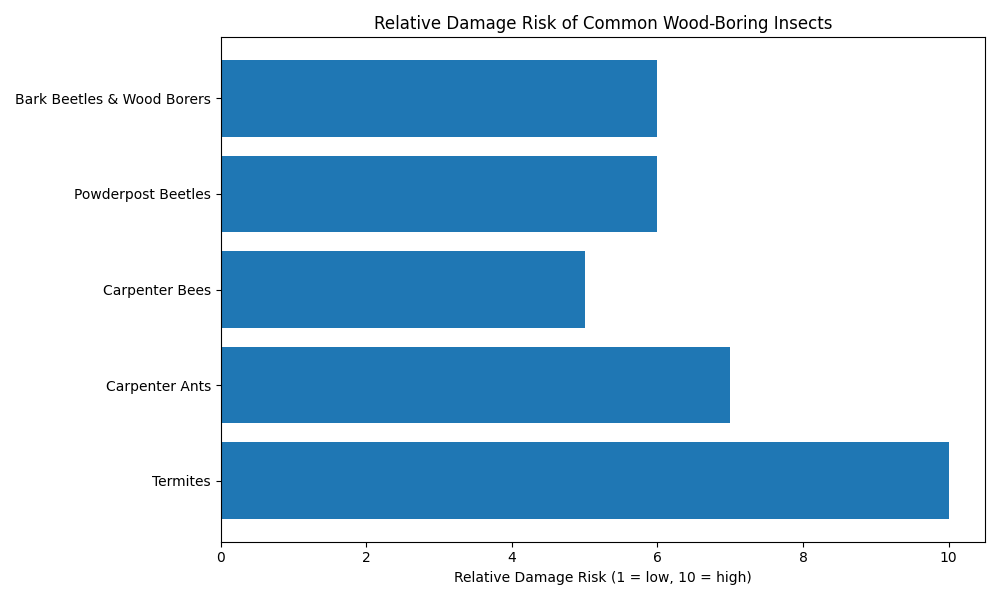
Termite damage alone causes billions of dollars in property damage annually in the United States, and most homeowner insurance policies do not cover insect-related structural damage. That makes early detection especially important. Below I cover the five insects you should know, how to spot them, and what to do.
Let’s start with the wood-boring insect that causes the most structural damage in North America.
1. Termites (The Most Destructive Wood-Boring Insects)
Identification & Appearance
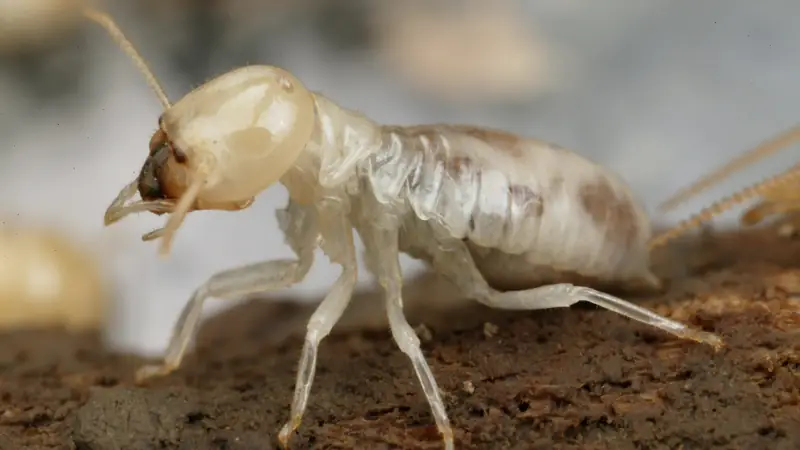
Termites are social insects that live in colonies. The ones homeowners most commonly run into are subterranean termites and drywood termites. Worker termites are usually pale, cream to tan in color, and soft-bodied. Soldiers have more prominent, darker heads. One easy confusion is between termite swarmers (winged reproductives) and flying ants. Swarmers have straight antennae and equal-length wings, while ants have elbowed antennae and uneven wing sizes.
You’ll rarely see a full colony unless you open walls or dig into the soil. What you might see are winged swarmers in springtime or piles of discarded wings by windows and light fixtures after a swarming event. Swarmers are designed to leave the parent colony, mate, and start new colonies — which is how infestations spread.
Subterranean termites are the most common structural species in most of the United States, especially in the Southeast, Midwest, and parts of the West. Drywood termites are more common in southern coastal and warmer regions.
Key point: subterranean termites live in the soil and build mud tubes up foundations and into wood. Drywood termites live entirely inside wood and don’t need contact with soil. Both can damage housing components from inside out.
Signs
Termites give a few reliable signs if you know what to look for. Mud tubes running up a foundation wall, hollow-sounding wood when you tap it, sagging floors or doors that stick from internal damage, and small piles of pellets or fecal material in some drywood species. Discarded wings near windows or light sources are a classic sign of a recent swarming event. In severe cases, you’ll see visible galleries or tunnels inside exposed wood.
Because subterranean termites often feed from the inside, the outer surface of the wood may still look intact while internal cavities grow. That’s why a hollow thud when you knock on a beam is a red flag; termites eat from the inside, leaving a thin shell.
According to Mississippi State University Extension, common early warning signs of termite activity include mud tubes, discarded wings, and hollow-sounding wood.
Practical house check: look around foundations, crawl spaces, and any wood touching soil; inspect eaves, attics, and attic vents for swarmers and discarded wings; and listen for hollow sounds in structural members.
Why Termites Are Especially Worrying
Termites cause widespread, expensive structural damage because they are numerous, hidden, and persistent. They can operate for years before drawing attention. Subterranean termites in particular can access a house through even small contact points with soil and then feast on foundation timbers and subflooring. Termite damage repairs and control are a major part of the pest control industry’s workload. For these reasons homeowners should prioritize prevention and inspection.
Real-world example:
A few years ago, I inspected a home where the owner thought a sticking back door was just humidity. When I tapped the adjacent wall framing, it sounded hollow. We opened a small section and found extensive subterranean termite galleries running up from a mulch bed that had been piled against the siding for years. The exterior looked fine. Inside, the sill plate was nearly paper-thin. That job could have been a minor soil treatment if caught earlier — instead it required structural repair.
Lesson: termites rarely show themselves until damage is advanced.
Field-Tested Homeowner Advice
If I could tell homeowners just three things about termites it would be this: keep wood away from soil, manage moisture, and inspect often. Don’t pile mulch or firewood against the house; that creates a moist, sheltered bridge. Fix plumbing leaks promptly and ensure gutters and downspouts divert water away from foundations.
If your house has untreated wood in contact with soil, consider replacing it or adding a physical barrier. If you suspect activity, don’t try to “DIY” a full termite treatment unless you have the training and equipment; a licensed pro can assess colony extent and recommend baits, termiticides, or targeted local treatments. For many homes, a combination of baiting systems plus targeted soil treatments works best.
For a readable guide on recognizing termite signs and deciding when to call a pro, state extension services and university resources offer excellent checklists and photos.
2. Carpenter Ants
Identification & Appearance
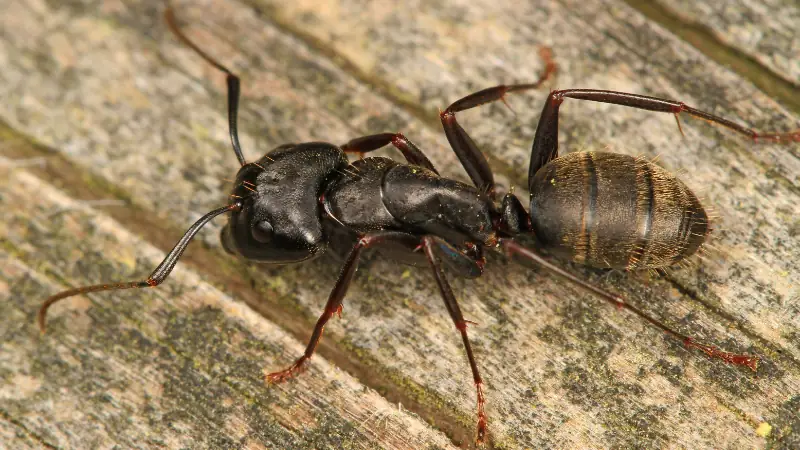
Carpenter ants are among the most common wood-boring insects homeowners encounter, and they are large ants, often black or dark red, typically half an inch or longer; queens can be larger. Unlike termites, carpenter ants have a constricted waist and elbowed antennae, which makes them look more “ant-like.”
They chew wood to create nest galleries, but they don’t eat wood cellulose the way termites do. Instead, they remove wood fibers and push them out of their tunnels.
Carpenter ant colonies can be inside structural timbers, wall voids, or even in furniture. They usually prefer moist or decayed wood, so leaks, water damage, and rot are a common precursor to carpenter ant infestations.
Signs
Look for smooth, well-defined tunnels inside wood, and small piles of coarse, wood-colored sawdust at entry points. Unlike termite frass or beetle powder, carpenter ant frass tends to include bits of wood and dead ant parts; it looks more like sawdust mixed with insect fragments. Ant trails leading to and from wood can be visible inside or outside the home. You might also spot winged reproductives during swarming season.
Common early sign is increased ant activity inside the home or around windowsills and doorways. If you inspect and find galleries within wooden beams or trim, it’s time to act.
Why They Matter
Carpenter ants can weaken wooden structures over time, especially when colonies expand into multiple wall voids or structural beams. Because they prefer moist wood, their presence often signals another problem: water intrusion. Fix the moisture source first — that will reduce suitability for the ants — and then address the colony. Treating only the visible workers without locating the nest will often fail; these colonies can have satellite nests and multiple entry points.
Field-Tested Homeowner Advice
Inspect and repair water leaks, roof flashing, and guttering. Remove or replace decayed wood where possible. For active infestations, locate the parent nest if you can (attic, wall void, stump) and apply targeted treatment. Many professionals use baiting combined with spot liquid or dust treatments in galleries. Don’t rely solely on sprays that kill workers at the surface — you need to reach the colony. If you’re doing any wood repairs, remove galleries and replace compromised structural members.
3. Carpenter Bees
Identification & Appearance
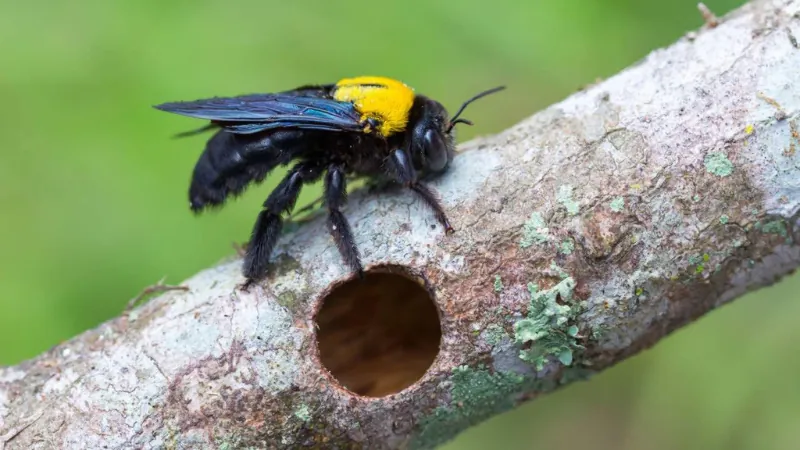
Carpenter bees are solitary wood-boring insects that look a lot like bumblebees, but there’s a key difference: carpenter bees have a mostly hairless, shiny black abdomen. They’re bulky and robust, often around half an inch to an inch long. Males can be territorial and hover in front of nest sites but can’t sting; females can sting but don’t do it unless handled.
They bore perfectly round entrance holes, about the diameter of a pencil or a pinky finger, into unpainted or weathered wood. The tunnels are generally shallow at first but can branch into internal galleries.
Signs
The most obvious sign is a neat, round hole in wood with wood shavings beneath it. You’ll also see bees hovering near eaves, decks, fences, or porch railings as they come and go. If you notice multiple holes in beams or decking, it indicates repeated nesting over multiple seasons. Another sign is sawdust or frass below the holes and faint yellowish stains from droppings.
Carpenter bees usually prefer untreated, unpainted wood, so painting or sealing wood is an inexpensive deterrent. For existing holes, treating with an appropriate insecticide into the gallery and then plugging the hole will help discourage re-use.
Why They Matter
A single season with one or two holes won’t ruin a beam. But when females from multiple generations repeatedly drill new holes in the same beam or in neighboring boards, they can weaken railings, fascia boards, and shallow boards over time. Also, carpenter bee galleries invite water, rot, and secondary pests.
Field-Tested Homeowner Advice
Paint or stain exposed wood; carpenters prefer bare wood. For an active problem, treat galleries with an appropriate residual dust or aerosol labeled for carpenter bees, then plug and paint the hole to discourage reuse. For platforms that are structural (like railings), remove and replace compromised pieces. If you’re allergic or uncomfortable working near the bees, hire a professional to treat the galleries and then seal the holes.
4. Powderpost Beetles
Identification & Appearance
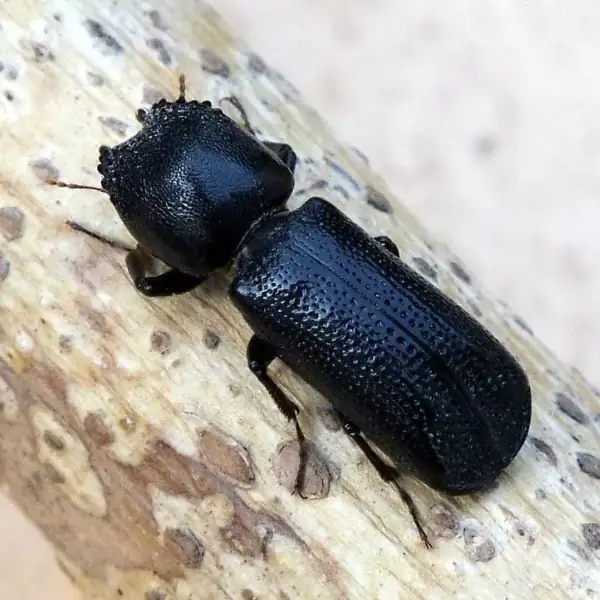
Powderpost beetles are small wood-boring insects, usually less than 1/4 inch long, and slender with reddish-brown bodies. The family includes a few kinds of beetles that attack finished wood and wooden products. The larvae are the real wood-destroyers: tiny, white grubs that tunnel inside wood for months or years before pupating and emerging as adults through small round “shot holes.”
A key identification trait is the fine, flour-like frass (powder) left behind. That powder keeps the shape of the wood when you push it with a finger, but it’s not solid — it crumbles easily.
Signs
The telltale sign is the tiny round exit holes on wood surfaces and fine, talc-like frass in and around these holes. You might also notice that the wood sounds hollow or that thin boards crumble under pressure. Powderpost beetles can infest hardwood floors, furniture, and even tool handles. Because larvae develop inside the wood for extended periods, an infestation can be active but invisible until adults begin emerging.
For older homes and antique furniture, watch for clusters of tiny holes in concentrated areas. If you find exit holes, inspect surrounding wood for crumbling under pressure or fresh frass. University of California IPM notes that powderpost beetle frass is very fine and flour-like, and fresh powder near exit holes usually signals active infestation.
Why They Matter
Powderpost beetles specialize in dry, finished wood, meaning they can infest furniture, flooring, and trim long after construction. Their slow development cycle makes them tricky: you might treat a piece, see activity stop, and then have another round a year later if some larvae were untouched. For historic or valuable woodwork, fumigation or heat treatments done by professionals may be the only practical way to eliminate deeply embedded infestations.
Field-Tested Homeowner Advice
If the infestation is confined to a removable item (chair, chest), consider freezing, heat-treating, or professionally fumigating it. For built-in wood, surface treatments and borate-based injections can help with low-level infestations, but the most reliable fix for major infestations is professional treatment. Preventive step: use kiln-dried, well-seasoned wood and apply finishes; many powderpost species prefer unfinished wood.
5. Bark Beetles and Other Wood Borers
Identification & Appearance
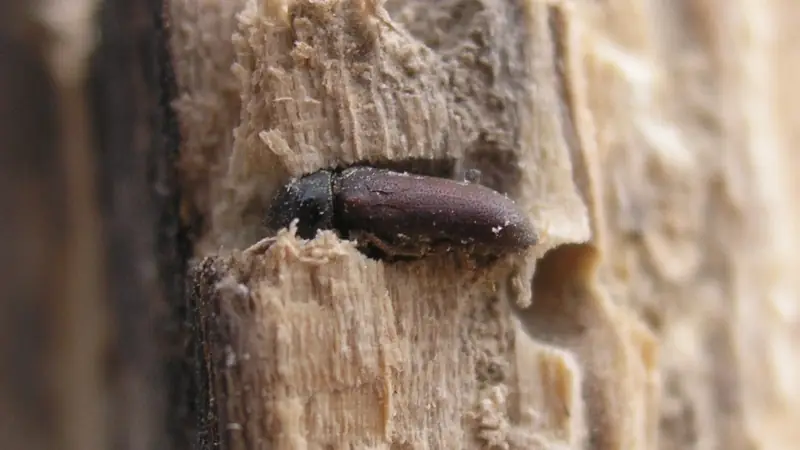
This category covers several wood-boring insects that attack living trees and freshly cut wood, including bark beetles, ambrosia beetles, longhorn beetles (roundheaded borers), and flatheaded borers. These species vary widely in size and appearance: bark beetles are tiny, whereas longhorn beetles can be large and dramatic. Many bore into living trees, weakening them and often introducing fungal pathogens, which in turn accelerates tree decline.
While not always directly attacking structural lumber inside homes, their role in killing or weakening trees near houses matters. Dead or dying trees become sources of wood-boring beetles, which can then move into stored logs, firewood, or recently cut timbers.
Signs
For trees, signs include exit holes, bore dust (frass) in bark crevices, sawdust at the base of the trunk, thinning foliage, and pitch tubes (in conifers). On freshly cut lumber, look for round holes and tunnels near the surface. For homeowners, the key sign is finding emerging adults from firewood or noticing a sudden increase in beetle activity near stored logs.
Bark beetles often vector fungal pathogens that further damage trees, which can lead to whole-tree decline. That’s why arborists and forest health services monitor these beetles: an outbreak can decimate a stand of trees quickly. Keep dead or dying wood away from houses and burn or properly store firewood at least 20 feet from structures.
Why They Matter
A dying tree in your yard is not just a hazard for falling branches; it’s a reservoir of wood-boring pests. If you bring infested wood into your home or store it near your house, you’re inviting beetles to complete their life cycle and potentially move onto untreated structural wood. Also, some wood borers prefer recently cut wood, so homeowners who mill or store lumber must be vigilant.
Field-Tested Homeowner Advice
Inspect and remove or professionally treat dead and dying trees. Don’t store unseasoned or infested firewood next to the house. If you cut lumber, allow it to cure and be alert for fresh exit holes. When in doubt, contact an arborist to assess tree health and a pest pro to advise on wood storage and treatment.
Homeowner Inspection Checklist for Wood-Boring Insects
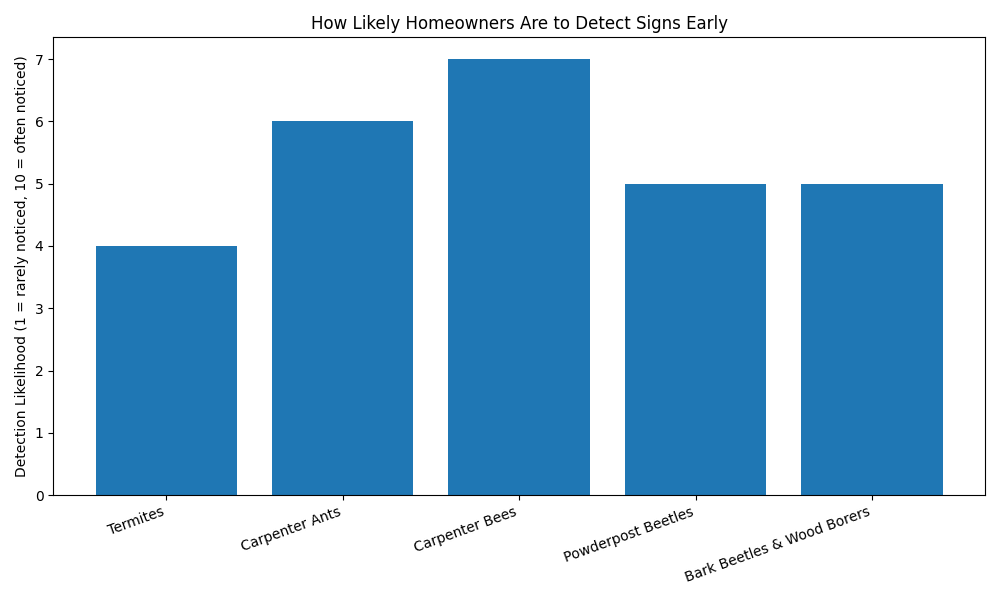
Walk around your home and do a slow, methodical inspection. Look under decks, inside crawl spaces, along the foundation, and up into eaves and attic spaces. Tap suspect timbers; a hollow sound is a clear flag. Check for mud tubes, tiny shot holes, round bee holes, piles of frass or sawdust, and discarded wings near lights. If you find issues, take photos, date them, and preserve any specimens (careful with live stingers). For suspected termites or widespread carpenter ant galleries, call a licensed inspector.
When you find moisture-damaged wood, treat or replace it. Fix any plumbing leaks or gutter problems immediately. Store firewood off the ground and well away from the house. Paint or stain unprotected wood, and use pressure-treated or rot-resistant wood for ground-contact areas.
When to Call a Professional for Wood-Boring Insects
A lot of homeowners try patch-and-spray fixes, and sometimes that works. But wood-boring pests are tricky: colonies and larvae live inside wood and can be spread over multiple spots. A professional inspection will tell you the species, colony size, and the right treatment approach — whether that’s bait stations and soil termiticides for subterranean termites, localized dusts and hole plugging for carpenter bees, or fumigation or heat treatment for severe powderpost beetle infestations.
In many states, termite treatments require specific licensing and regulated termiticides that are not available to the general public.
A licensed pro also evaluates the structural risk and safety needs for repairs.
University extension services and USDA forest health pages are excellent for learning the signs, but an on-site pro has the practical tools and permits to carry out major treatments safely.
Wood-Boring Insect Prevention That Actually Works
There are a few ideas that get repeated but don’t work long-term. Spraying the surface of a beam may kill exposed insects, but it rarely reaches larvae in galleries. Foggers and “bug bombs” are almost always ineffective for wood-borers hidden inside wood. Borate treatments, moisture control, and physical exclusion — those are the durable, effective measures.
Simple, reliable things you can do right now: move mulch and firewood away from the foundation; correct roof and plumbing leaks quickly; ventilate crawl spaces to reduce humidity; and paint, stain, or seal exposed wood. If you’re building or replacing decks and steps, choose pressure-treated lumber or naturally rot-resistant species and ensure proper clearance from soil.
For active infestations, match treatment to pest: baits and soil barriers for subterranean termites, gallery dusting or structural repairs for carpenter ants and bees, and fumigation or heat for severe beetle problems where larvae are deep in the wood.
Common Mistakes Homeowners Make with Wood-Boring Insects
One of the biggest mistakes I see is surface spraying and assuming the problem is solved. Most wood-boring insects live inside the wood, not on it. Killing visible insects rarely eliminates the colony or larvae.
Another common error is ignoring moisture problems. Carpenter ants and termites often follow leaks and damp wood. If you treat the insect but leave the water source, the infestation often returns.
Finally, storing firewood against the house is one of the fastest ways to invite termites and beetles close to structural wood.
Correcting conditions is just as important as killing pests.
A Practical Field-Proven Approach to Controlling Wood-Boring Insects
Over 18 years I’ve found homeowners benefit most from a combined approach: remove what invites pests, protect what’s vulnerable, and monitor regularly.
- First, remove high-risk conditions: moist wood, untreated lumber against or near soil, piles of debris, and stacked firewood next to structures.
- Second, protect the house: ensure drainage, seal cracks, and maintain a gap between soil and wooden siding.
- Third, monitor: check attics and crawl spaces seasonally for signs and keep dated photos.
- Fourth, treat smart: use targeted baits and soil treatments for termites, borate or surface treatments for low-level beetle attacks, and replacement for structurally compromised wood.
- Finally, hire a trusted, licensed pro for major infestations — particularly termites and repeated beetle problems.
This approach reduces both the chance of infestation and the need for heavy pesticide use. It’s practical, less disruptive, and long-term effective.
Also Read:
Safety Considerations When Treating Wood-Boring Insects
Always follow label instructions when using insecticides. Many treatments require protective equipment and proper ventilation. Termiticides and fumigants are restricted-use products in many states and must be applied by licensed professionals. Never treat inside wall voids without understanding electrical or structural risks. When in doubt, consult a licensed pest professional.
Frequently Asked Questions About Wood-Boring Insects
Final Thoughts on Protecting Your Home from Wood-Boring Insects
Wood-boring insects don’t make headlines until your floor sags or a beam collapses. Most of the time these pests are patient: they tunnel slowly, hide behind paint or inside beams, and only announce themselves after a lot of damage is already done. But you don’t have to be surprised by them. Regular inspections, moisture control, smart wood choices, and targeted professional help will keep most problems small and manageable.
The difference between minor repair and major reconstruction often comes down to early recognition. If you understand how wood-boring insects behave — where they enter, what signs they leave, and what conditions attract them — you dramatically reduce your risk. Routine inspection, moisture control, and smart wood management remain the most reliable long-term defense.
Quick Recap
- Termites are the most destructive wood-boring insects and often go unnoticed for years.
- Moisture problems are a major trigger for carpenter ants and beetles.
- Regular inspections and early intervention prevent expensive structural repairs.