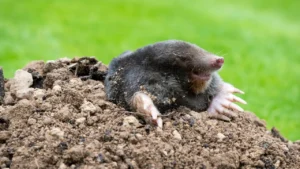
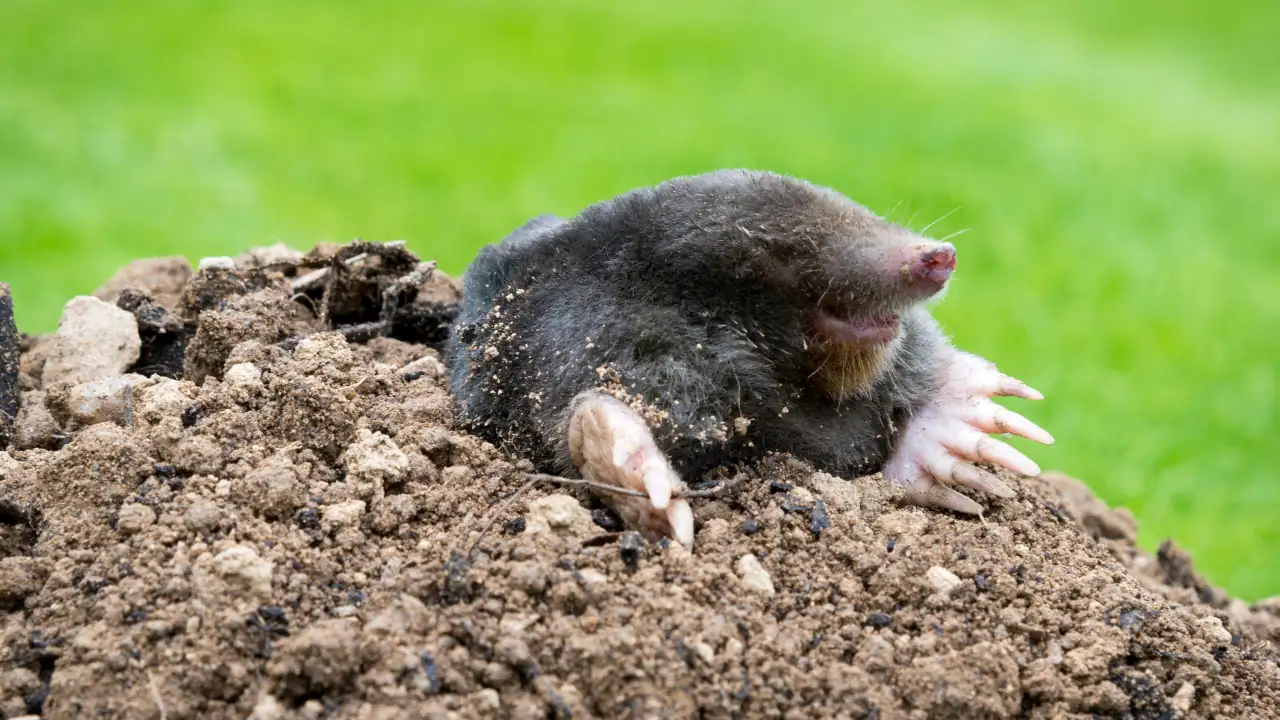
How To Get Rid of Moles in Your Yard is one of those lawn problems that can feel small at first, then suddenly turn into a full-blown headache. One day the grass looks normal. A day or two later, you’re stepping over raised tunnels, fresh molehills, and the kind of mole damage that makes the whole lawn feel unstable under your feet. Most homeowners assume the moles are eating the grass, but that’s not what’s happening. In almost every real yard situation, moles are there because the soil is full of food and easy to dig through.
That matters because the best fix is not just “kill the mole and move on.” You need to understand how moles travel, what actually attracts them, and which methods have a real track record in residential lawns. In my experience, homeowners waste the most time on gimmicks, random repellents, and internet folklore while the mole keeps reopening the same active runways underneath the yard.
The good news is that you do not need a dozen tricks to solve this. The most reliable approach is to find the active tunnels, use a proven control method in the right place, and make the lawn less attractive so the next mole is less likely to move in.
Also Read: Killing Moles With Marshmallows Explained: Myth vs. Reality
Quick Answer: How To Get Rid of Moles in Your Yard
The fastest and most reliable way to get rid of moles in your yard is to identify active tunnels, then place a mole trap or a labeled worm-shaped mole bait directly in those active runways. Repellents and grub control can help in some yards, but they rarely solve an active mole problem by themselves.
What Actually Works First in Most Yards
If I’m dealing with a typical residential mole problem, this is the order I would follow:
- Flatten or step down suspicious tunnels and check them again in 24 to 48 hours.
- Focus only on active runways that reopen quickly.
- Set traps first in the main travel tunnels if you want the fastest DIY results.
- Use mole-specific worm bait only when trapping is difficult or when tunnels stay active deeper underground.
- Reduce overwatering and fix soggy areas so the lawn stays less inviting.
- Treat for grubs only if you actually confirm a grub issue, not just because you see mole damage.
- Skip gimmicks like sonic stakes, mothballs, or random home remedies unless you are testing them as a backup, not a primary plan.
If you want the shortest path to stopping fresh lawn damage, trapping active runways is still the most dependable DIY method in most residential yards.
For most homeowners, this is the most practical DIY mole control sequence because it focuses on active tunnels instead of guesswork.
If you are wondering what the best mole killer really is, the honest answer is usually a properly placed trap or a labeled worm-shaped mole bait used in an active runway.
Common Mistakes Homeowners Make with Mole Control
The most common mole-control mistakes are treating inactive tunnels, assuming every mole problem is caused by grubs, relying too heavily on sonic stakes, and using the wrong bait. In most yards, the failure is not the trap or the product. It is targeting the wrong tunnel, using the wrong method for the way the mole is actually moving, or expecting a weak repellent to solve a heavy infestation by itself.
If you avoid those mistakes and focus on active runways first, your odds of solving the problem go up fast.
Best Ways to Get Rid of Moles in Your Yard
If you want the full breakdown, these are the best ways to get rid of moles in your yard based on what actually works in real residential lawns. Some methods are stronger than others, and the best results usually come from using the right tactic in the right tunnel instead of trying every product on the shelf.
The list below starts with methods that can reduce attraction, then moves into the most effective direct-control options like trapping, baiting, and exclusion. If your goal is to stop fresh tunneling fast, pay extra attention to the sections on active tunnel identification, trap placement, and bait use in confirmed runways.
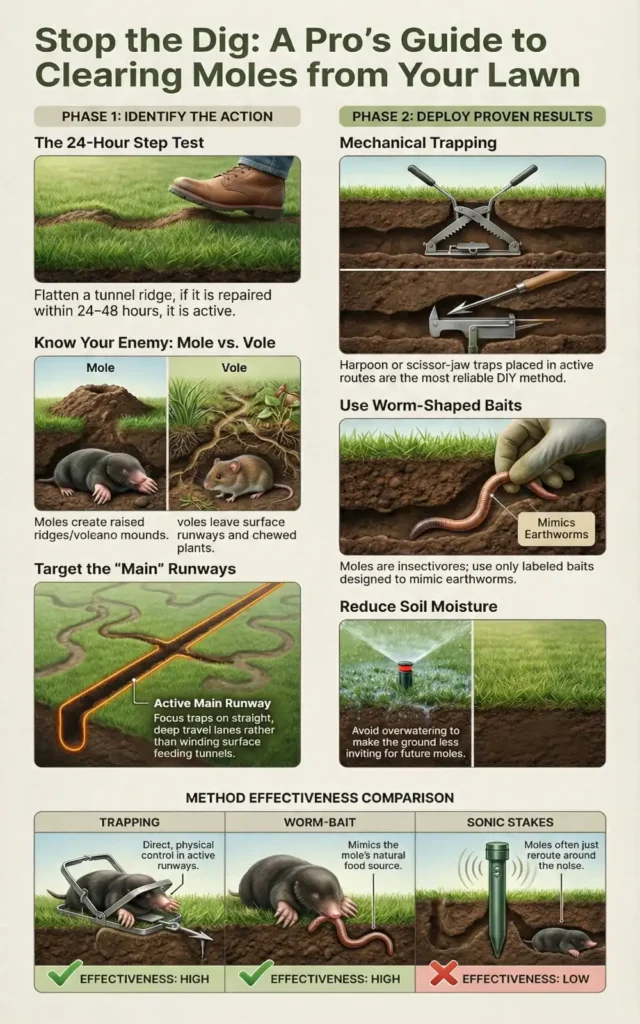
The visual below shows the mole-control sequence that tends to work best in real lawns before you move into the full breakdown.
1. Remove Their Food Source Through Grub Control
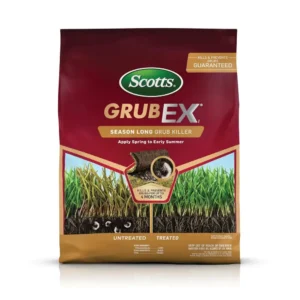
If you want to make your yard less attractive to moles, start by looking at the food supply. Grubs can be part of that picture, but they are not the whole story. If you are wondering what moles eat, the answer is usually earthworms, grubs, beetle larvae, ants, and other soil insects, which is why killing grubs alone does not always make moles leave.
That is why experts keep warning homeowners not to assume that a mole problem automatically means a grub problem. In real lawns, mole damage alone is not enough reason to treat for grubs. You should confirm grub pressure first before treating the whole yard.
That said, grub control still matters when grubs are present in meaningful numbers. If you confirm a grub issue, treating it can reduce one important food source and make the lawn less appealing over time. The smarter move is to inspect first, then treat only when the pest load justifies it. A few grubs in the soil do not mean you need to spray the whole yard. If you do use a grub product, follow the label and match the treatment to the pest you actually found.
In real yards, I’ve seen plenty of homeowners spend money on grub control first, only to find the mole activity keeps going because the lawn still has worms, moist soil, and active runways. That is why I treat grub control as support, not as the main answer unless the soil inspection clearly shows a real grub problem.
2. Use Castor Oil Based Repellents
Castor oil based repellents are one of the most common mole repellent options, but the results are usually modest and inconsistent. The University of Nebraska-Lincoln’s mole management guide notes that castor oil products have shown minor effectiveness and work best when they are thoroughly watered into the lawn.
The key detail most homeowners miss is soil penetration. If the product stays on the surface, it usually underperforms. Repellents tend to work best when the soil is pre-moistened and the treatment is watered in enough to reach the active tunnel zone.
I treat castor oil as a pressure tactic, not a knockout punch. It can help with light activity or as a follow-up after trapping, but in heavily tunneled yards it usually works best when paired with trapping or exclusion.
3. Install Physical Underground Barriers
For small, high-value areas, underground barriers are one of the cleanest long-term defenses. If you have a vegetable bed, flower border, or a small patch of turf you want to protect, a buried barrier can stop moles from entering that space in the first place. The University of Florida IFAS mole guide recommends small-mesh galvanized hardware cloth, brick, or concrete for exclusion barriers and notes that barriers should extend above grade and well below the soil line.
The downside is labor. Barriers take digging, planning, and materials, so they make the most sense for small protected zones, not entire lawns. If your goal is to protect one prized bed or a narrow landscape strip, this is often a better long-term play than repeated repellent applications.
4. Set Harpoon Traps
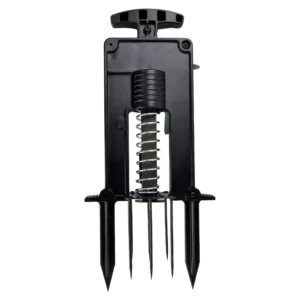
If you want the most direct do-it-yourself answer to how to get rid of moles in your yard, trapping is usually the first place to start. University extension sources consistently say trapping is among the most effective approaches when it is done correctly. Harpoon traps are the classic option. They sit over a collapsed tunnel, and when the mole repairs the tunnel and pushes up, the trap fires into the runway. The trap has to be set on an active route, not just any random ridge.
The biggest reason people fail with harpoon traps is bad placement. If the tunnel is not active, the trap can sit there forever. A better way to confirm a real travel lane is to step down the tunnel, wait for it to reopen, and then set the trap where the mole repairs it. Trapping also tends to work best in spring and fall, when activity is closer to the surface and active runways are easier to confirm.
You are not trying to catch the mole anywhere underground. You are trying to intercept it on a runway it actually uses. Once you start viewing the yard that way, trap success usually improves. Harpoon traps can be very effective, but they reward patience, not guesswork.
If you have kids or pets using the lawn regularly, mark every trap location clearly and avoid setting traps in active play areas. A good trap is useful only if it is placed safely and checked consistently.
If you are wondering what the best mole trap is, the real answer depends less on brand and more on whether the trap is sitting in a confirmed active runway.
5. Deploy Scissor Jaw Traps
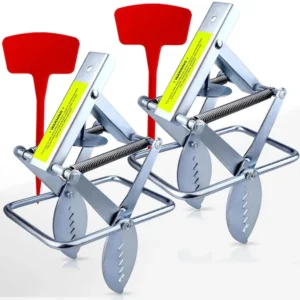
Scissor jaw traps work on the same basic idea as harpoon traps, but the mechanism is different. Instead of spikes coming down into the tunnel, the jaws close around the mole when the trigger is disturbed. Scissor or pinch-style traps are one of the standard commercial trap designs, and they follow the same rule as every other mole trap: set them in active tunnels and move them if that runway goes cold.
I like scissor jaw traps for homeowners who want a reusable, targeted tool and do not mind learning the setup. They can be very effective, but they are unforgiving if you place them on a dead tunnel or set them loosely. The tunnel should be partially collapsed so the mole has a reason to repair it, and the trap must sit cleanly in the path. If the mole can angle around it, the trap becomes a decoration.
You do not need dozens of them scattered around the yard. You need a few in the right spots, checked often, then moved when a tunnel goes cold.
For many homeowners, scissor-style traps are a little easier to learn than choker loop traps, but the real difference is still tunnel selection. A perfectly set trap in a dead tunnel will fail every time.
6. Use Choker Loop Traps
Choker loop traps are another serious option for homeowners who want direct control. They are a legitimate mole-control method, but active tunnels matter more than trap style. The trap works by squeezing the mole as it moves through the burrow, so placement has to be exact.
Compared with a harpoon trap, a choker loop trap usually takes more confidence to set properly. If you are off by too much, the mole will ignore it or bypass it. That makes this a better fit for homeowners who are comfortable learning the setup carefully.
A well-placed choker loop trap can be very effective on a route that keeps reopening after you flatten it. As with all trapping, check it regularly and move it if the activity shifts.
7. Apply Poison Baits That Look Like Worms
This is the one place where bait can make sense, but only if you use the right kind. Traditional grain baits do not work well because moles are not eating seeds or nuts. They are insectivores. The reason worm-shaped mole baits exist is simple: they are designed to look and feel like the food moles actually eat. EPA labeling for Talpirid, a registered mole bait, says the product is designed to mimic a mole’s natural food source and that moles may consume a lethal dose in a single feeding.
That last part matters a lot. Bait is not a scatter-and-wait method. It has to go into active tunnels, and you need to know which tunnels are actually being used. The label makes it clear that bait belongs in active underground runways, not on the surface. In other words, this is a labeled pesticide application, not a casual backyard trick.
Important: use only a bait that is specifically labeled for moles, place it only in active underground runways, and keep children and pets away from treated areas. This is one of the few times bait can make sense for moles, but it only works when the product matches the animal and the placement matches the tunnel activity.
Here is the honest truth. Mole bait can work, but it is still not the first method I reach for in every yard. If I can catch the mole with a trap in a very active tunnel, that is often the cleaner route. Bait is useful when trapping is difficult, when you have repeated activity in deep tunnels, or when a homeowner prefers a labeled toxicant over ongoing trap checks. Just do not confuse mole-specific worm bait with random rodent poison. They are not the same thing, and the wrong product wastes money fast.
8. Reduce Soil Moisture and Attractiveness
One of the simplest ways to make your yard less appealing is to stop making the soil so easy to dig through. Moles prefer moist, loose soil where worms and insects are easier to find and the ground is easier to push through.
That does not mean your lawn should be bone-dry. The goal is to avoid overwatering, improve drainage where possible, and keep the soil from staying constantly soggy. In wet weather or after rain, moles are often more active near the surface, which is why fresh ridges tend to show up more clearly.
Think “less inviting,” not “desert conditions.” This works best as a prevention step after trapping or baiting because it lowers the odds of the next mole moving in.
If you are trying to figure out how to keep moles away after trapping one, reducing excess moisture and improving drainage is one of the few prevention steps that can actually help.
9. Try Ultrasonic or Sonic Repellent Devices
Sonic, ultrasonic, vibrating, and electromagnetic mole devices have a weak track record. In real lawns, they often fail because moles simply reroute around the disturbance instead of leaving the property.
That does not mean every device fails in every situation, but it does mean you should not build your control plan around one. If you want to test one, treat it like a small experiment, not the main solution.
For most homeowners, I rank sonic devices near the bottom of the list. Spend your money on tools with a better track record first, especially trapping and targeted baiting.
10. Create Live Capture Systems
Live capture systems are for homeowners who do not want to kill the mole. They can work, but they are slower and usually more labor-intensive than standard trapping. A common live-capture setup is a pitfall-style trap, where a container is buried in an active tunnel so the mole falls in and can later be released.
Two cautions matter here: check the trap often, and confirm local wildlife relocation rules before moving any animal. Even when relocation is allowed, released moles often struggle in unfamiliar territory.
I would put live capture in the “possible, but not my first recommendation” category. It can satisfy someone who wants a nonlethal option, but it is usually slower and less reliable than a properly set kill trap or a labeled mole bait in an active runway.
11. Apply Natural Plant Based Deterrents
Natural plant based deterrents get a lot of attention because people want a softer solution, but the evidence is weak. If you like marigolds, daffodils, or other plants often mentioned in mole discussions, plant them because they fit your landscape, not because they will rescue a badly tunneled lawn.
These methods should be treated as minor helpers, not main control tools. At best, they may add a little nuisance value to the yard. They do not replace trapping, baiting, or accurate tunnel identification.
12. Hire Professional Mole Control Services
Sometimes the most effective move is to stop fighting the problem alone. If the yard is large, the damage keeps spreading, or you have already tried the main DIY tools without success, professional mole removal can save a lot of time.
Professional help makes the most sense when mole activity is near foundations, prized beds, sports turf, or other areas where every fresh ridge matters. A trained technician can identify the real tunnels faster and combine trapping, baiting, and habitat adjustment more efficiently than most homeowners.
This is also the safest route if you are not comfortable handling traps or labeled pesticides.
Methods To Avoid
A lot of mole advice on the internet sounds clever and usually fails in the real world. Sonic, ultrasonic, vibrating, and electromagnetic devices all have a weak track record, and the same goes for common folklore fixes like mothballs, odor tricks, and other “drop it in the tunnel” remedies.
That same warning applies to popular internet myths that keep circulating every spring. One example is the old myth about killing moles with marshmallows, which keeps resurfacing because it sounds simple, harmless, and cheap. But it does not line up with how moles actually feed. Moles are insectivores, so random sweet foods and kitchen-cabinet tricks are usually just another distraction from proven methods like active-tunnel trapping and properly placed mole bait.
The same caution applies to grain baits, peanut baits, and other rodent poisons. Moles are insectivores, not seed eaters, so the wrong bait usually wastes money.
I would also skip flood-the-tunnels tactics as a primary plan. Flooding may force a mole to the surface once in a while, but it is unreliable, messy, and especially weak in deeper or sandy soils. That is a good reminder that not every dramatic-looking trick is actually useful. The better play is still to use active tunnel trapping, baiting, or exclusion instead of hoping the mole will conveniently cooperate.
If a mole control method sounds easier than learning the tunnel pattern, it is usually because it is selling convenience, not results. In most real lawns, the boring methods with the best track record are still the ones that work.
Make Sure You’re Dealing with Moles and Not Voles
A lot of homeowners use the words mole and vole interchangeably, but they are not the same pest and they do not cause the same kind of damage. Moles usually leave raised surface ridges, soft tunnels, and volcano-shaped mounds because they are pushing through the soil underground. Voles, on the other hand, usually leave surface runways, small entry holes, chewed plant roots, gnawed bark, and damage around ornamental plants.
That distinction matters because a vole treatment plan is very different from a mole treatment plan. If you are seeing raised ridges and fresh tunneling in moist soil, you are usually dealing with moles. If you are seeing chewed plants, visible runways through grass, or bark damage near shrubs and trees, take a closer look before using mole traps or mole bait.
Identifying Active Tunnels for Better Results
This is the part that separates successful mole control from frustrating guesswork. You can have the best trap or bait on the market and still fail if you use it in the wrong tunnel. This is one of the few mole-control details that stays true no matter which method you use. Step down a tunnel, mark it, and check whether it gets repaired within about 24 to 48 hours. If it does, that tunnel is active and worth your attention.
Main runways are usually straighter, deeper, and more consistent than the winding surface feeding tunnels. That is where you want to focus traps and bait. Active main tunnels are the ones most likely to produce results quickly, often within a day or two when a trap is set correctly. If you set equipment in a dead-end route, the mole may never come back to that spot.
Think of tunnel identification as the scouting phase. You are mapping the mole’s traffic pattern. Once you know where the mole is actually traveling, every other method becomes more efficient. That is why experienced control work often looks less dramatic at first and more decisive later.
A Real-World Mole Job That Mirrors What Homeowners Usually See
One of the most common mole situations I’ve seen is a soft, well-watered lawn along a fence line, wooded edge, or low area that stays damp after rain. The homeowner usually notices raised ridges first and assumes the grass roots are being eaten, or that the whole yard must be loaded with grubs. But once you check the soil and map the tunnel pattern, the real issue is usually simpler: the mole has found a few reliable travel lanes in moist, easy-to-dig ground.
In yards like that, the fastest results usually come from stepping down several tunnels, waiting to see which ones reopen, and then setting two or three traps only in those active main runways. That approach consistently works better than treating the whole lawn blindly. I’ve also seen homeowners waste days trying sonic stakes, castor oil alone, or random home remedies while the same active tunnel keeps getting rebuilt. Once you focus on the active route instead of the visible damage, mole control becomes much more predictable.
Timing Your Mole Control Efforts
Timing matters more than most people realize. Spring and fall are usually the best times to trap because the ground is softer, mole activity stays closer to the surface, and fresh tunnels are easier to confirm after rain.
If you want a quick seasonal reference, the chart below shows when surface activity is usually easiest to target.
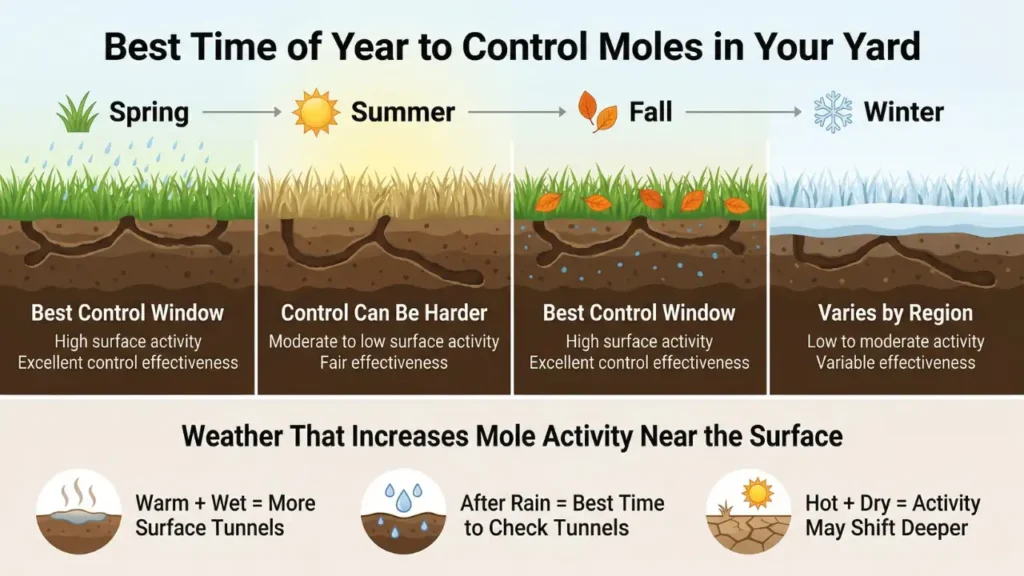
During warm, wet periods, fresh tunnels are easier to spot and better to target. During extreme heat, cold, or drought, moles may move deeper, which makes control harder. If the ground is soft after rain, trapping and baiting usually become much easier.
Safety Notes Before You Trap or Use Mole Bait
Before you start trapping or using any mole bait, keep safety in mind. Mole traps can injure curious pets or children if they are set in open areas without care, so always mark the trap locations and keep people away from active sets. If you use mole bait, use only an EPA-registered product labeled specifically for moles, and place it only in active underground runways exactly as the label directs.
If you are unsure whether a product is approved for moles, check the label, target pest, and placement instructions before you use it.
Never substitute rodent bait, grain bait, or homemade poison for mole control. Those products are often ineffective because moles do not feed like rodents, and off-label use creates unnecessary risk. If you are using live traps, check them frequently and confirm your local wildlife relocation rules before moving any animal. It is also smart to avoid digging blindly near sprinkler lines, invisible dog fences, landscape lighting wires, or shallow utility runs, especially in older lawns where systems may not be clearly marked.
Also Read:
Repairing Mole Damage After Success
Getting rid of the mole is only half the job. Once the activity stops, flatten the raised ridges, fill low spots, and patch bare areas with seed or sod. If you leave old tunnels and mounds in place, the lawn stays bumpy and may invite other problems later.
Grass does not always bounce back instantly, especially if roots were disturbed. Water repaired spots appropriately, reduce foot traffic for a bit, and give the turf time to recover.
I also like to recheck the yard after repairs. Collapsed tunnels and soft spots can tell you whether the problem was fully resolved or whether another mole has started using the same old runways.
Conclusion
If you want the shortest honest answer to how to get rid of moles in your yard, here it is: do not chase the damage, chase the activity. Find the active tunnels, use the right trap or labeled bait in the right place, and make the yard less attractive by reducing moisture and food sources.
The best mole control plans are usually simple, careful, and consistent. They are not flashy, and they are not built on myths. The methods with the strongest real-world track record are still active-tunnel trapping and properly placed mole-specific bait.
If I had to give one rule that saves homeowners the most time, it would be this: do not treat random tunnels. Find the active runway first, then match the control method to the way the mole is actually moving.