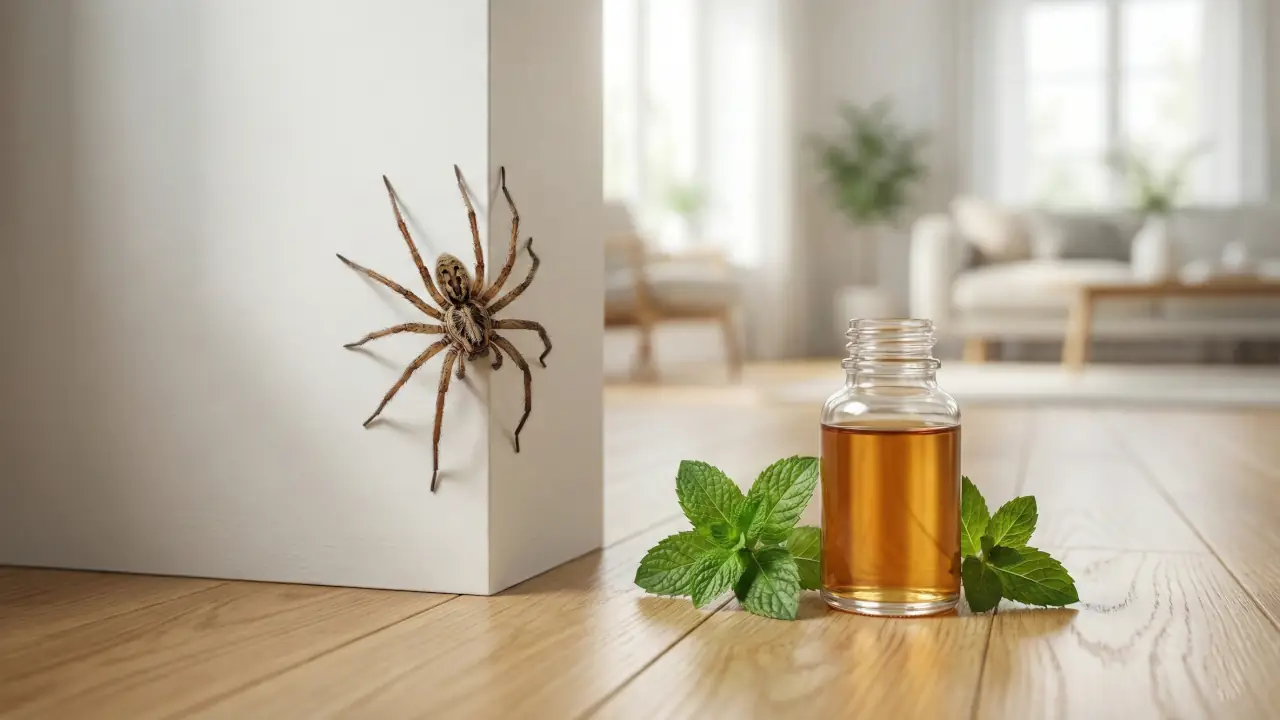
If spiders make your skin crawl and you’d rather not reach for harsh chemicals, peppermint oil probably sounded like an appealing, simple fix. You’ve seen sprays and “home hacks” everywhere: cotton balls soaked in oil on windowsills, DIY sprays that promise to send spiders packing, and a dozen quick tips from friends.
I’ve been in pest control for 18 years, and I’ve walked into homes that tried everything from dryer sheets to citrus peels. Here’s the short truth: peppermint oil can help deter some spiders — sometimes quite effectively — but it is not a guaranteed, one-and-done solution for every species or every situation.
In the Midwest and Northeast especially, I get this question most often in late summer and early fall when spiders start moving indoors to escape dropping temperatures. In warmer southern states, it comes up more during rainy stretches when insect activity spikes. Timing matters, because spider pressure is often seasonal — and no spray works the same way year-round.
In this article I’ll explain what the science actually says, how to use peppermint oil safely and sensibly, when it might fail, and how to fold it into a practical, long-term plan so you stop living on edge every time you open a closet. Read this like advice from a friend with a toolbox and a cup of coffee — honest, practical, and based on real-world pest work. By the end you’ll know when peppermint oil is worth trying, how to do it right, and what to do if it isn’t enough.
For more practical pest control guidance based on real field experience, visit our homepage at Spade Pest Control where we break down common home pest problems step by step.
Also Read: Spadepestcontrol Blog
Quick Answer: Peppermint oil can repel some spiders by creating a scent barrier they prefer to avoid. It works best as a short-term deterrent on entry points like baseboards and window frames. However, it does not reliably eliminate established infestations and must be combined with sealing, cleaning, and moisture control for lasting results.
Does Peppermint Oil Repel Spiders?
Short answer: Yes — for some spiders and in certain situations. The smell of peppermint is strong and can interfere with a spider’s ability to sense its environment. In trials where spiders were given a choice between treated and untreated areas, some species avoided peppermint-treated zones. That avoidance behavior is exactly what we mean by “repel.” But not every spider reacts the same way. Some species show strong avoidance, others only mild avoidance, and a few show no response at all.
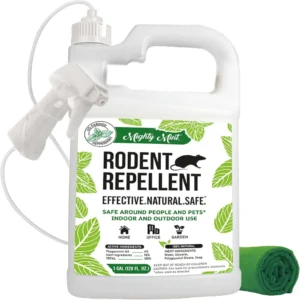
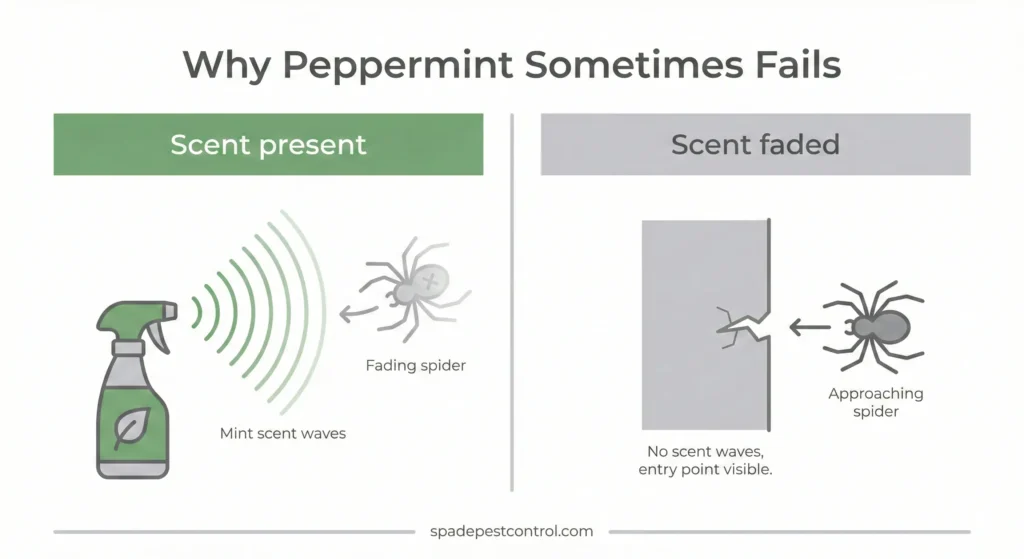
Why the mixed results? Spiders use a mix of senses — touch, vibration, and chemical cues — to navigate. A strong scent can overwhelm or confuse them, but it rarely destroys their ability to survive or stop them from returning once the scent fades. Lab conditions also differ from messy, cluttered homes where spiders find hiding places and microclimates that a spray won’t change.
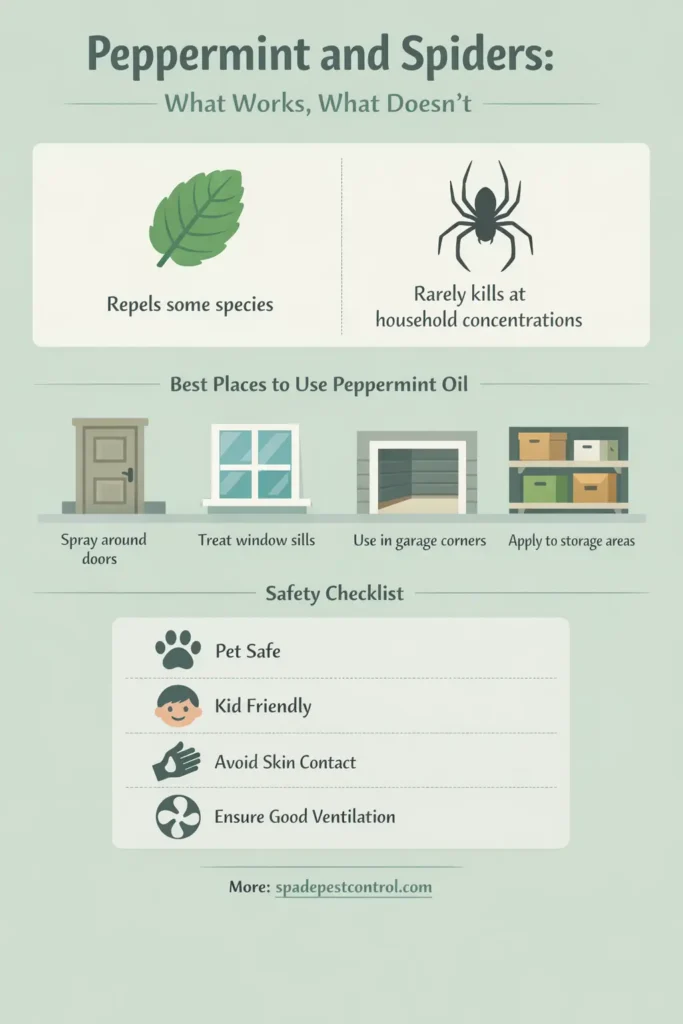
Quick Tip: If you’re trying peppermint oil, treat it like a short-range barrier, not a total cure. Spray it on likely entry points and places you check often (door frames, window sills, baseboards), and reapply every few days until you see fewer spiders.
How To Use Peppermint Oil to Get Rid of Spiders
If you want to try peppermint oil, here’s a practical, user-friendly method I recommend from field experience. This is intended for targeted, small-area use — not for treating an entire house in a single session.
Start with a simple peppermint spray:
- Fill a 16-ounce (about 500 ml) spray bottle with clean water.
- Add 15–20 drops of pure peppermint essential oil. If you want stronger scent, go up to 25 drops, but don’t overdo it around pets.
- Add 1 teaspoon of liquid dish soap or 2 teaspoons of rubbing alcohol. This helps the oil disperse in water so it doesn’t just float.
- Shake well before each use.
Where to spray: door and window frames, baseboards, behind furniture where webs form, in corners of garages and sheds, and around entry points (cracks, pipe penetrations). Avoid saturating surfaces; a light mist is enough. Reapply every 3–7 days depending on scent strength and whether you have open windows or heavy cleaning.
For garages specifically, use that spray on corners, eaves, and along shelving. If you want a garage-specific how-to, see our guide on getting rid of spiders in garages.
Quick Tip: Try cotton balls soaked with 3–5 drops of peppermint oil tucked into attic access points or window ledges. They’re an easy, low-waste option for keeping one room fresher between spray sessions.
Safety and small-scale use notes are below in the Safety Precautions section.
Advantages Of Using Peppermint Oil (An All-Natural Solution)
Peppermint oil has a number of practical advantages that make it attractive as a first step for people who prefer gentler methods.
First, it is an all-natural option and can be part of an eco-friendly, low-toxicity approach to pest control. For homeowners worried about family and pet exposure to conventional insecticides, peppermint spray offers a low-risk alternative when used sensibly. If you want to read more about eco-friendly, low-toxicity methods that pair well with peppermint oil, take a look at this eco-friendly pest control and safe method of pest control overview on our site.
Second, peppermint oil is affordable and widely available in most grocery stores, health shops, and online retailers. You don’t need special gear to start; a spray bottle and a bottle of essential oil are enough to try it out.
Third, peppermint oil is versatile. You can use it in a spray, in cotton balls, in diffusers, or mixed into cleaning solutions for spot treatments. And because the scent is pleasant to many people, it doubles as a mild air freshener for treated areas.
Fourth, using peppermint oil inside a home can improve interior scent, unlike some chemical sprays that leave strong chemical odors. If you prefer a fresh-smelling, less “chemical” approach, peppermint is appealing.
Quick Tip: Combine peppermint spray with other housekeeping steps — sealing cracks, removing clutter, and vacuuming webs — for far better results than spray alone.
(For a balanced assessment of natural repellents and why results vary species to species, see research summaries that review mint volatiles and spider behavior.)
Can Peppermint Oil Kill Spiders?
Short answer: Rarely and only under certain circumstances. Peppermint oil is primarily a repellent, not a reliable insecticide. That said, there is lab evidence that very high concentrations of some essential oils, including mint types, can cause physiological stress or death when spiders come into direct, concentrated contact with the oil. Those are controlled, high-exposure conditions that are not realistic for home spray use. In practical, household concentrations (the kind you’d spray on baseboards), peppermint oil will more likely make a spider avoid the area rather than kill it.
If your goal is to eliminate spiders you see now, physical removal (vacuuming, capturing and relocating) or targeted application of a labeled insecticide by a professional may be needed. Peppermint oil is best used as a deterrent — a way to reduce future settlement and reduce the odds of regular intrusions.
Safety Precautions
Peppermint essential oil is natural, but “natural” does not equal “completely harmless.” Follow these precautions:
Quick Tip: When in doubt, use a lower concentration and reapply more frequently. A weaker solution reduces risk to pets and sensitive people while still providing a scent barrier spiders dislike.
For a plain-language rundown of essential oil safety and usage, see health-reviewed consumer guidance.
Real-world Use: What Works and What Doesn’t
From my years in pest control, peppermint oil is useful as part of a multi-step approach. Homes that rely only on peppermint sprays often see temporary reductions followed by a return of spiders. Homes that pair peppermint use with structural fixes do much better.
Here are the practical steps that actually make a durable difference:
Start by removing the things spiders like: boxes, piles of clothes, and stacks of firewood inside the home. Vacuum webs and egg sacs where you see them. Seal entry points — gaps around doors, windows, foundations, and pipes. Fix ventilation issues that keep corners damp; spiders like humidity and hidden prey (other small insects). Once you’ve handled those basics, use peppermint as a perimeter deterrent.
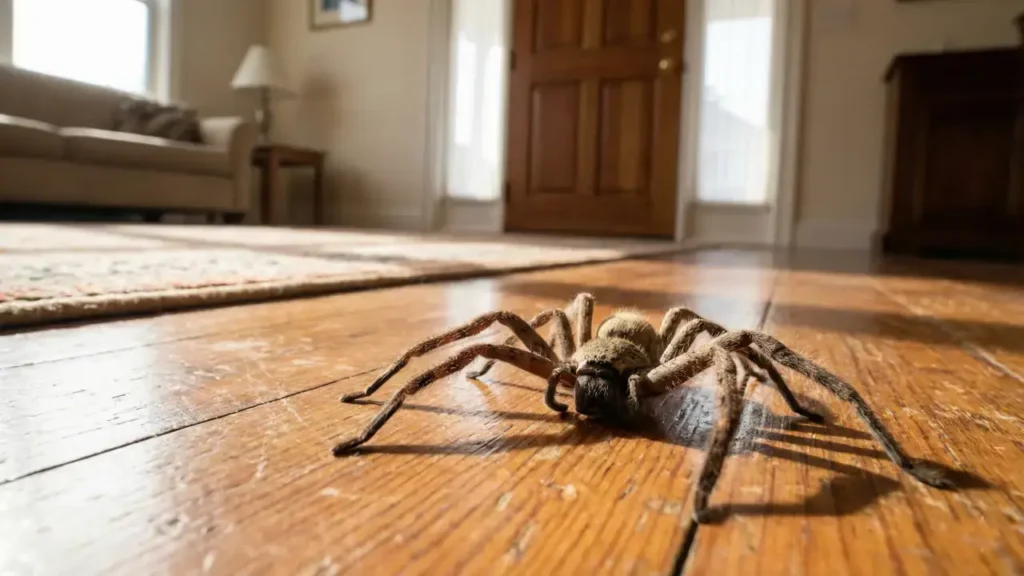
Peppermint sprays work best when you apply them to predictable paths — along baseboards, behind storage shelving, and in garages. Refresh the scent periodically; peppermint is a short-lived barrier and fades after cleaning or heavy airflow.
If you have a heavy infestation or are seeing medically significant species (large venomous spiders), call a professional. Peppermint will not replace a full-service intervention where nests, egg sacs, and heavy structural entry points are involved.
A Real Home Example from the Field
A few years ago, I inspected a garage in Ohio where the homeowner had been spraying peppermint oil twice a week for nearly a month. At first, sightings dropped. Then they came back.
The issue wasn’t the peppermint — it was the environment. The garage had open soffit gaps, stacked cardboard boxes along the walls, and outdoor lights mounted directly above the garage door. Those lights were attracting insects every night, which meant a steady food source for spiders.
Once we sealed the gaps, reduced clutter, and moved the light source farther from the structure, spider activity dropped dramatically. The homeowner kept using peppermint along shelving edges as a maintenance deterrent, and that combination worked.
The lesson: peppermint helps, but structure and sanitation solve the root problem.
Putting Peppermint into a Home Pest Plan
Think of peppermint oil as one friendly tool in a toolbox. Here’s a simple, realistic routine:
- Morning (weekly): Vacuum visible webs and egg sacs in corners and storage areas. Wipe down baseboards.
- Evening (twice weekly for first two weeks): Lightly mist baseboards, window frames, and door thresholds with peppermint spray.
- Ongoing: Keep clutter low, move stored items off the floor, and keep outdoor lights that attract insects away from entry points. Inspect and seal gaps around pipes and vents.
If spiders persist after 3–4 weeks of consistent housekeeping and peppermint application, escalate to professional inspection and treatment.
This routine gives peppermint oil a fair shot while you remove the factors that draw spiders in the first place.
Evidence and Science — What the Studies Say
Several laboratory studies have evaluated how spiders respond to plant-derived volatiles, including mint oils. In controlled “choice chamber” tests — where spiders can move freely between treated and untreated spaces — certain species avoided areas treated with peppermint or chestnut-derived compounds. Some of this work has been published in peer-reviewed entomology and pest management journals within the last decade.
It’s important to understand what that means. These studies measure avoidance behavior under controlled conditions. They do not prove that peppermint oil eliminates spider populations in real homes. Field environments contain clutter, hiding spaces, airflow differences, and insect prey — all variables that lab tests don’t replicate.
That pattern is consistent across research: mint volatiles can trigger avoidance in some spider families, but effectiveness varies by species and environment.
When Peppermint Won’t Work (and why)
If spiders have a good hiding place with stable microclimate and lots of prey — for example inside cluttered garages or storage boxes — a peppermint spray won’t remove those conditions. Also, if the entry point is outside a house (e.g., under eaves or in a crawlspace), interior sprays only shift the problem. Some species simply aren’t bothered by mint volatiles.
When you’re seeing repeated activity, expect to use integrated measures: exclusion (sealing gaps), sanitation (reducing prey insects and hiding spots), and, if necessary, targeted professional treatments.
DIY Recipes and Exact Steps
Here are a few realistic recipes you can use depending on the task.
Light maintenance spray (safe for most homes):
Shake, apply a light mist to baseboards, window sills, and corners. Reapply every 3–7 days.
Stronger short-term barrier (use sparingly, not near pets):
Shake and apply; avoid pet areas. Reapply only as needed.
Cotton-ball sachets (for closets, drawers):
3–5 drops peppermint oil on a cotton ball, placed in a breathable sachet or small jar with holes. Replace every 1–2 weeks.
Quick Tip: Label bottles with date and dilution. Essential oils lose potency over time.
When Peppermint Isn’t Enough
Peppermint oil is not the right tool in every situation. Consider professional inspection if you notice:
In those cases, the issue usually involves structural entry points or established nesting that requires targeted treatment.
Also Read:
Frequently Asked Questions
Conclusion
Peppermint oil is a useful, low-toxicity tool you can add to your routine to help reduce spider presence. It works best when you use it smartly: as a short-range deterrent, reapply regularly, and combine it with basic pest-control housekeeping and exclusion. Science supports peppermint as a deterrent for some species, but results vary.
If you’re seeing ongoing activity or large numbers of spiders, escalate to structural fixes or professional help. Treat peppermint like a friend who helps keep the door propped open a little less often — not a lone warrior that will win the whole battle.