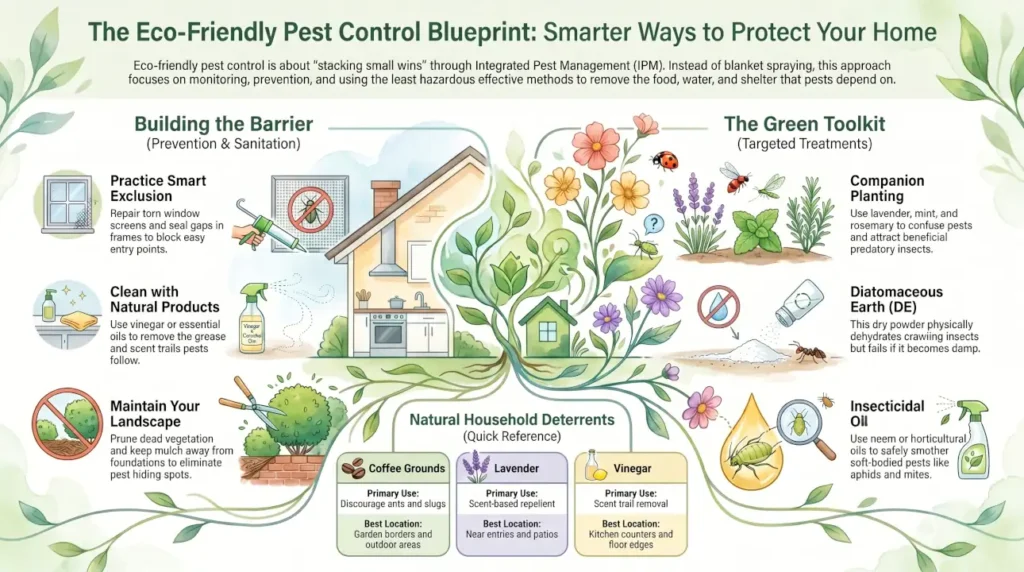
Eco-friendly pest control is not about being softer on pests. It is about being smarter with your timing, your cleanup, and your entry-point control so you get lasting results without creating a bigger mess for people, pets, or the environment. That lines up with Integrated Pest Management, or IPM, which focuses on monitoring, prevention, and using the least hazardous effective methods instead of relying on blanket spraying.
A lot of people think green pest control means “spray some peppermint oil and hope for the best.” That is not how the real world works. The best results usually come from stacking small wins. You remove shelter, cut off food, block access, and then use the lightest treatment that actually fits the pest problem. That is usually what separates temporary relief from long-term control. And once you start looking at it that way, eco-friendly pest control becomes practical, affordable, and surprisingly effective.
Many of the best eco-friendly pest control methods work because they focus on prevention, sanitation, and targeted action rather than relying on heavier treatments.
Also Read: 5 Wood-Boring Insects Every Homeowner Should Watch For (And How to Stop Them)
Quick Answer: What Is Eco-Friendly Pest Control?
Eco-friendly pest control focuses on preventing and reducing pest problems with the least hazardous effective methods. The most effective approach usually combines sanitation, sealing entry points, reducing moisture, removing shelter, and using low-toxicity treatments only when necessary. Long-term control rarely comes from a single product. It usually comes from layering multiple strategies together.
Eco-Friendly Pest Control Methods That Actually Work
Introduce Friendly Plants
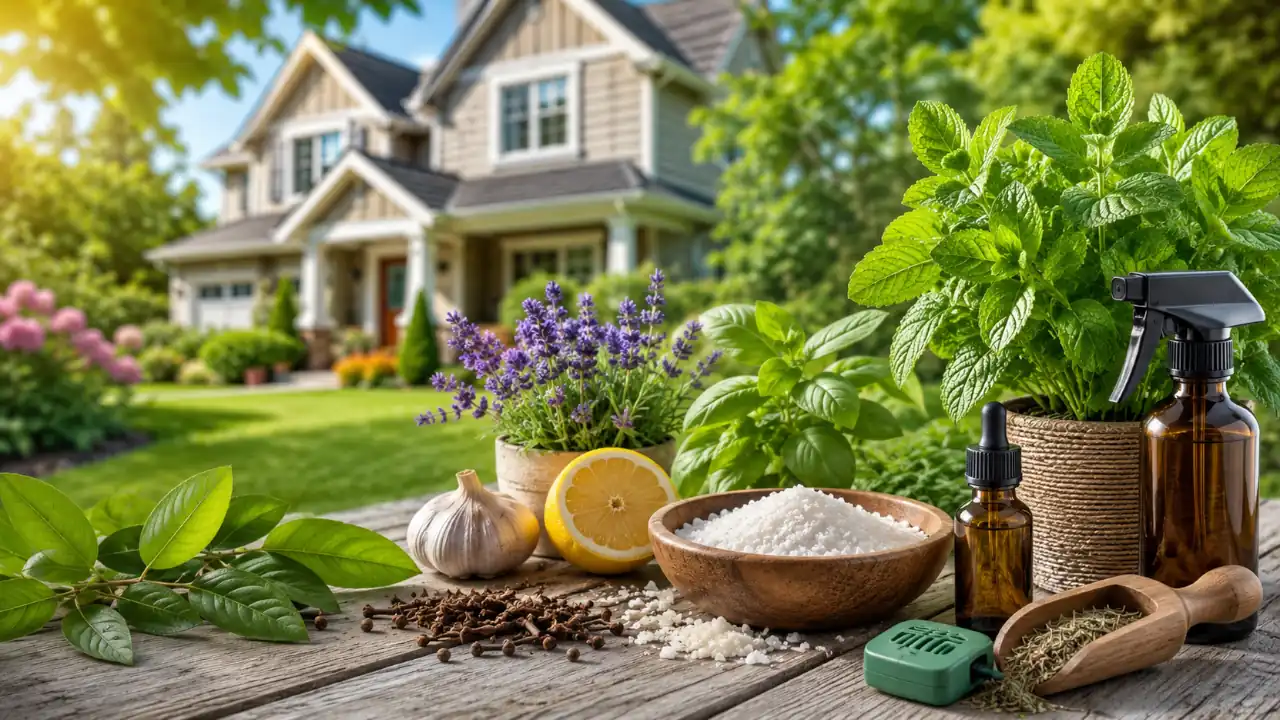
One of the easiest eco-friendly pest control moves is to plant the right things in the right places. Some plants help confuse pests with strong scent, while others attract beneficial insects that naturally keep problem insects in check. This type of layered planting strategy is often called companion planting.
This type of layered planting strategy is often referred to as companion planting. Strategic planting and natural repellents can absolutely play a role in a broader eco-friendly pest plan when they are combined with sanitation and habitat control.
In practical terms, some of the most useful pest-resistant plants include:
- Lavender
- Mint
- Rosemary
- Basil
- Marigold
- Chives
These work best around areas that repeatedly attract insect activity.
I am not saying plants alone will wipe out an infestation. They will not. But they can make a yard less attractive, especially when they are paired with clean borders, trimmed vegetation, and reduced moisture. That is what makes them useful. They help shift the odds in your favor before pests ever become a bigger headache.
Think of friendly plants as an added layer of prevention. They do two jobs at once. First, they make the space more confusing or less appealing to certain insects. Second, they attract beneficial visitors like lady beetles, lacewings, and pollinators, which gives your garden a healthier balance overall. The key is to treat planting like part of your pest plan, not just decoration.
Lavender deserves special mention because it does more than look and smell nice. It can fit nicely into a perimeter planting strategy. If deer are also becoming a nuisance around garden beds or landscaping, using coffee grounds to repel deer can sometimes help reinforce the same kind of perimeter-focused approach. That kind of layering matters. Single treatments rarely solve long-term pest problems. Layered prevention usually works better.
Call For Reinforcements
Professionals rarely talk about this the way they should, but good pest control is rarely a one-person job. Sometimes the smartest move is to bring in reinforcements, and by that I mean beneficial insects, targeted products, or a professional who uses an IPM approach instead of carpet-bombing a property. Integrated pest management works best as a combined strategy, not a single magic fix.
This matters because a lot of infestations are bigger than they look from the outside. You might be seeing a few ants in the kitchen, but the real issue could be moisture, a food source, a hidden nest, or a gap in the exterior. In those cases, a repellent spray is just a short-term cover-up. A better plan is to identify the pest, monitor where it is active, and decide whether you need biological control, exclusion, sanitation, or a carefully chosen low-toxicity treatment.
Calling for reinforcements can also mean using the right allies outdoors. Beneficial insects can help in garden beds, while traps and monitoring tools can tell you whether a problem is growing or shrinking. That is the part a lot of homeowners skip. They rush to kill what they can see, but they never figure out why the pests are there in the first place.
If you take only one thing from this section, make it this. Eco-friendly pest control is not about being passive. It is about being selective. You still act. You just act with a plan.
Take Advantage of Old Food
Old food can be a pest problem, but it can also become part of the solution when it is used carefully. Coffee grounds can sometimes help discourage certain garden pests like ants, slugs, and snails when they are used in targeted outdoor areas.
Coffee grounds are the most talked-about example, and they are worth mentioning because they are easy to reuse. That said, I always tell people not to oversell them.
Coffee grounds are not a magic shield. They work best when:
- used around garden borders
- applied in targeted outdoor areas
- kept relatively dry
- combined with cleanup and exclusion
They may help discourage certain pests, but they will not solve a heavy infestation on their own.
If you have a serious pest issue, coffee grounds are a support tool, not the main treatment.
Old citrus peels, some herb clippings, and even vinegar-based cleanup in the right setting can help reduce the scent trails and food cues pests follow. The real value here is not the ingredient itself. It is the habit behind it. When you stop leaving pest-friendly leftovers around, the house gets less interesting to insects and rodents. That is why sanitation is such a big part of eco-friendly pest control.
This is also where lavender fits in nicely. A little lavender near entry points, patios, and planting beds can add another scent layer that makes the area less welcoming to certain pests. It is not a silver bullet, but it does play a useful role. And if deer are part of your bigger outdoor problem, the linked guide on using coffee grounds to repel deer is a natural follow-up because the same kind of border thinking applies there too.
The biggest mistake people make is treating “natural” as if it automatically means “effective.” Natural can be effective, but only when it is used in the right place and combined with cleanup.
Get Some Insecticidal Oils
Insecticidal oils are one of the best-kept secrets in eco-friendly pest control, and they deserve more attention than they get. Horticultural oils and other reduced-risk products can fit well into a broader integrated pest management strategy because they tend to work with other control methods instead of replacing them.
These oils work differently from a harsh spray. Instead of poisoning everything in sight, they smother soft-bodied pests and their eggs by coating them and blocking respiration. That makes them especially useful against aphids, mites, scale insects, and similar pests on ornamentals, shrubs, and some garden plants.
Some homeowners also use neem oil for similar low-toxicity treatment goals, especially on garden pests, although it still needs to be used carefully around beneficial insects.
Some homeowners also use neem oil for similar low-toxicity treatment goals, especially on garden pests, although it still needs to be applied carefully to avoid harming beneficial insects. The trick is timing. Oils work best when pests are vulnerable and when conditions are right. Use them on a hot day or on a stressed plant, and you can cause plant injury.
For insecticidal oils to work safely, pay attention to:
- application timing
- outdoor temperature
- plant stress levels
- dilution rates
- label instructions
This is one of those areas where professional judgment really counts. People often assume natural equals harmless, but that is not true. Even a good product can backfire if it is sprayed badly. The smart move is to treat the pests you can reach, on the plants that can handle it, at the right time of day and season.
I like oils because they solve a specific problem without trying to become a cure-all treatment. They do one thing well. They do not pretend to fix every problem in the yard. When used properly, they can be a very clean way to knock down a pest population without turning your property into a chemical zone.
Use Diatomaceous Earth
Diatomaceous earth is another favorite in the eco-friendly pest control toolbox, but it only works when you understand how it behaves. It works as a desiccant, meaning it dries out crawling insects by damaging their protective outer layer.
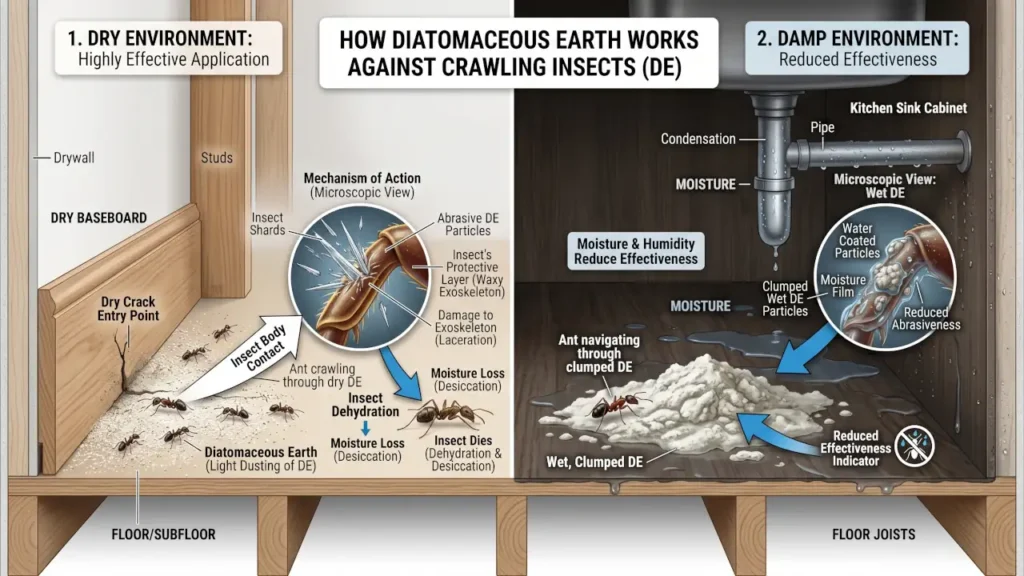
That simple detail is what makes it useful and what limits it at the same time. It needs to stay dry. If it gets wet or clumped up, it loses much of its effectiveness. That is why you do not just dump it anywhere and hope for miracles.
Diatomaceous earth works best in:
- dry cracks and voids
- hidden insect pathways
- low-moisture areas
- undisturbed treatment zones
Moisture control is critical. Once the dust gets damp, effectiveness drops quickly.
It is especially handy around cracks, voids, and dry hidden pathways for crawling pests.
This is also why people sometimes think it “did not work.” In real homes, I usually find the problem is moisture. People apply it in damp basements, under leaky sinks, or near condensation-heavy areas where the dust clumps up within days. Once that happens, performance drops fast.
In reality, they used it in the wrong spot, in the wrong amount, or in the wrong conditions. Diatomaceous earth is not a fogger. It is not a repellent. It is a targeted dry barrier tool. If you treat it like one, it can be very effective.
A good habit is to pair it with cleanup and exclusion. Dust alone will not save a messy kitchen or a damp basement. But once food is sealed, moisture is reduced, and entry points are blocked, diatomaceous earth can help finish the job quietly. That is how long-term low-toxicity pest control usually works in real homes. Long-term pest control usually comes from small, consistent actions done in the right places.
Remove Unhealthy Vegetation
If a yard keeps attracting pests, the plants themselves may be part of the problem. Dead limbs, diseased leaves, tangled groundcover, and overgrown shrubs all create shade, moisture, and shelter. That is exactly the kind of environment pests love. Good organic landscape care always comes back to sanitation, cleanup, and removing problem plant material before pests gain momentum.
This is one of the most underrated eco-friendly pest control steps because it does not feel like pest control. It feels more like organic garden maintenance than traditional pest control. But it works. When you prune back dead growth, clear out fallen debris, and remove unhealthy vegetation, you remove hiding places and breeding spots at the same time. Airflow improves. Sunlight reaches the soil. Moisture dries faster. That alone can make a yard far less welcoming to insects and some nuisance wildlife.
I see this mistake all the time in landscapes that seem “naturally protected.” People keep dense shrubs right against walls, let weeds grow around foundations, and leave old plant litter in place because they think it is harmless. It is not harmless. It is cover. And cover is valuable to pests.
The best part is that this change often gives fast results. You may not notice a dramatic pest drop overnight, but you will usually notice fewer damp spots, fewer hiding places, and a yard that is easier to inspect. That makes every other treatment work better too.
Don’t Forget Your Windows
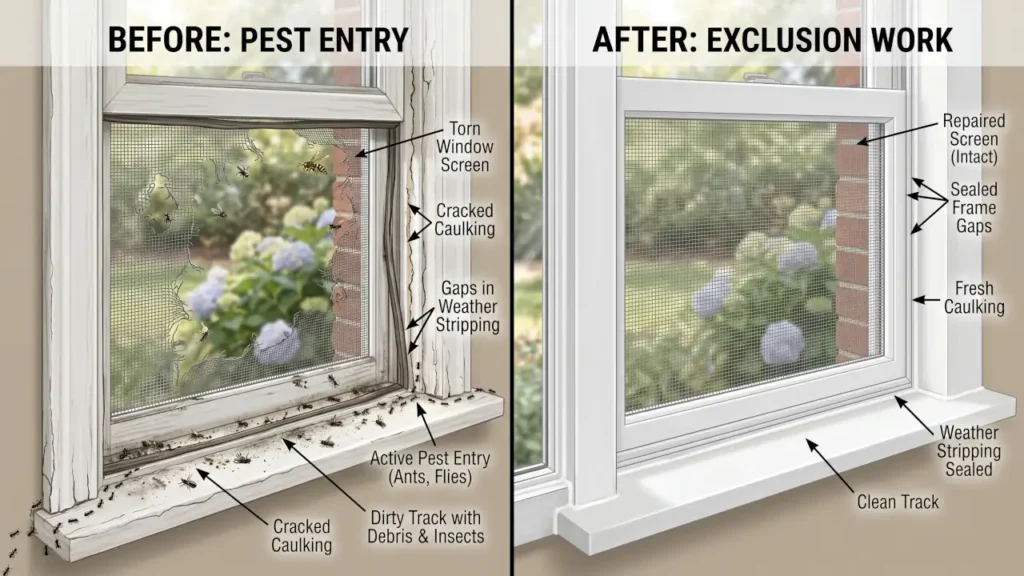
Windows are easy to overlook because they do not seem like a pest issue until a fly, spider, ant, or moth gets in through a tiny gap. But exclusion is one of the core ideas in IPM, and it is one of the cleanest eco-friendly pest control moves you can make. Prevention and exclusion are two of the cleanest eco-friendly pest control moves you can make, especially around common entry points like windows.
Screens should be checked first. Even a small tear can become a regular doorway for insects.
Check all common window entry points, including:
- damaged screens
- loose weather stripping
- cracked caulking
- warped frames
- dirty window tracks
A lot of people focus on the visible pests and ignore the access route they are using every day. That is backwards. I have seen homeowners spend hundreds on sprays while ignoring a torn screen or an unsealed frame gap that was letting insects enter every night.
This is especially important in kitchens, basements, laundry rooms, and rooms near outdoor lights. Light draws insects. Gaps let them enter. Windows become the bridge. Once you repair the screens and close the gaps, you are cutting off one of the easiest entry paths in the whole house.
I also tell homeowners to clean the window tracks. Dust, dead insects, and moisture around the frame can all attract more activity. So yes, windows are a barrier issue, but they are also a sanitation issue. That is why the small details matter so much in eco-friendly pest control.
Clean with Natural Products
Cleaning is not glamorous, but it is one of the strongest pest prevention tools you have. Simple household cleaners like vinegar can help reduce food residue, grease, and scent trails that attract pests in the first place.
Some homeowners also use diluted essential oils like peppermint or eucalyptus as part of natural cleaning routines, although they should still be used carefully around pets and sensitive surfaces.
Natural cleaning works because pests are looking for residue, grease, crumbs, fermentation, and moisture. If you remove those signals, you reduce the reasons they stay.
Focus cleaning efforts on areas pests care about most:
- kitchen counters
- greasy floor edges
- trash storage areas
- pet feeding stations
- damp utility spaces
A spotless home is not realistic. A less inviting home is. And that difference is enough to change the pressure.
I like natural cleaners for two reasons. First, they fit well into a routine you can keep up with. Second, they make it easier to clean often without worrying about heavy chemical buildup in living areas. That matters in homes with kids, pets, or people who are sensitive to strong fumes. Just remember that natural does not mean careless. You still need the right dilution, proper storage, and common sense around surfaces.
This section is also where people should stop thinking about cleaning as “after the problem.” Cleaning is part of the treatment. It tells pests there is less reward here. If they cannot find easy food or a greasy trail, many of them move on or at least slow down enough for other controls to work.
Keep Unwanted Animals Away
When the problem is rodents or larger nuisance wildlife, the strategy changes a little, but the eco-friendly mindset stays the same. You still want to remove food, water, and shelter before you jump to stronger measures. That approach prioritizes prevention and minimizes unnecessary risk before stronger treatments are considered.
Wildlife prevention usually starts with removing easy opportunities:
- secure garbage lids
- clean up fallen fruit
- store pet food properly
- seal crawlspace openings
- repair gaps around sheds and garages
If there is an easy meal near the house, animals will keep coming back. If there is a protected nesting area, they may stay longer than you want. Most “wildlife problems” are not random. In many cases, humane prevention methods work better long term than repeatedly trapping or removing animals after they settle in. They are opportunity problems.
You also want to think in terms of boundaries. A fence can help, but only if it is the right fence and the property is maintained around it. A food source can undo a fence. A hole under a deck can undo a clean yard. After enough infestations, the pattern becomes predictable. Remove the reward, remove the shelter, and the area becomes less attractive.
If you are dealing with animals that are protected or regulated in your area, do not improvise. Local wildlife laws and removal rules vary, and in some cases permits or local restrictions apply. That is another reason eco-friendly pest control is not just about “doing nothing.” It is about doing the right thing safely and legally.
Harness The Power of Mulch
Mulch is helpful, but it needs to be used the right way. In the garden, mulch helps with weed suppression, moisture retention, and soil stability. Mulch can support healthier plants and stabilize soil, but overdoing it or piling it too close to structures can also invite pest activity.
This is where a lot of homeowners accidentally create the very problem they are trying to avoid. They pile mulch against the foundation, mound it around trunks, or keep it too deep and too damp. That can create hiding places for insects and, in some settings, issues with rot or rodent activity. The solution is not to abandon mulch. The solution is to use it with discipline.
Good mulch management usually means:
- avoiding excessive mulch depth
- keeping mulch away from foundations
- leaving space around stems and trunks
- replacing old mulch only when necessary
It is one of those quiet upgrades that improves the landscape while also reducing pest pressure. Healthy beds, fewer weeds, less splash-back from soil, and better moisture control all make pests less comfortable.
I like mulch because it shows how eco-friendly pest control really works. You are not just killing bugs. You are shaping the space so bugs are less likely to thrive there in the first place. That is the real professional mindset.
Conclusion
Eco-friendly pest control works best when you stop looking for one miracle fix and start building a better system. Natural pest control works best when small prevention steps are combined with low-toxicity treatment methods that fit the problem. Friendly plants can help set the tone. Sanitation removes the reward. Exclusion closes the door. Oils, diatomaceous earth, and other targeted tools handle the pests that remain.
Unhealthy vegetation, messy windows, and poor mulch habits all create opportunities, so fixing those details matters just as much as any spray or dust. That is the deeper truth behind sustainable pest control. It is a mix of good habits, smart timing, and the least risky tool that still gets the job done.
The homeowners who get the best long-term results are usually the ones who focus on prevention first instead of reacting only after pests become visible.
The biggest secret is that eco-friendly pest control is not weak. It is disciplined. When you use the right methods in the right order, you can protect your home, your garden, and your family without overreacting. That is the kind of approach that lasts.