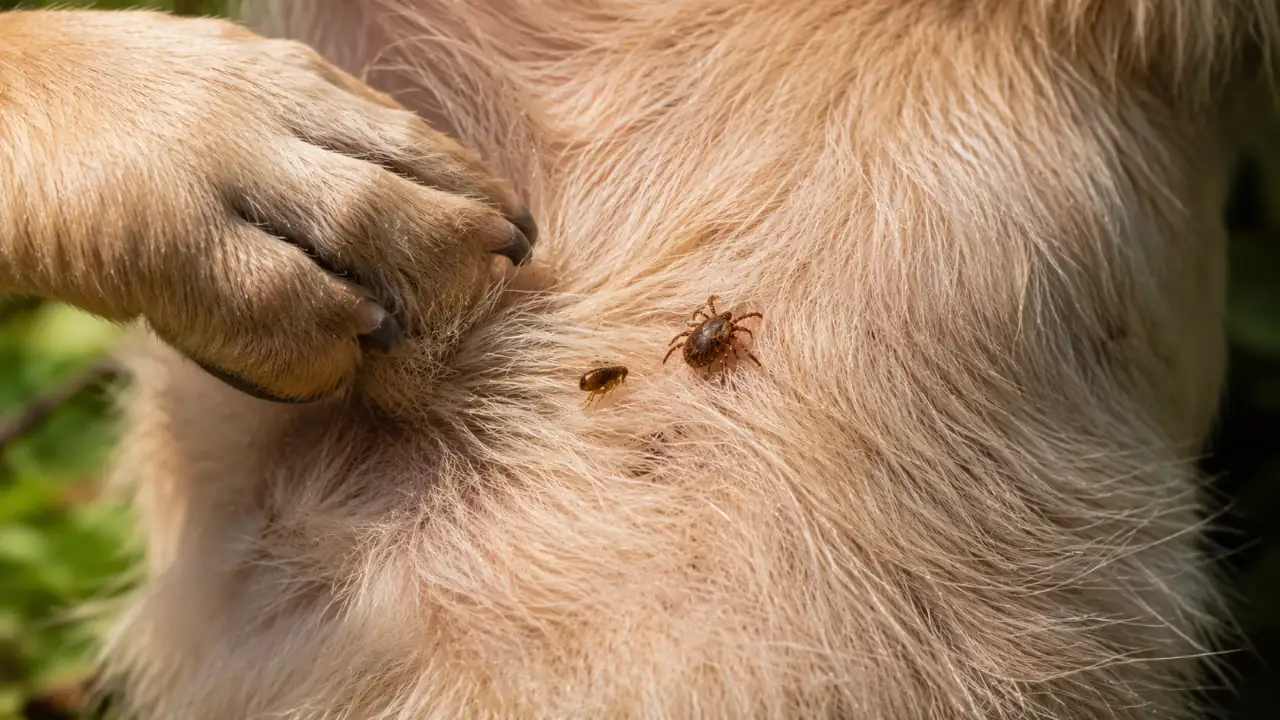
If you have tiny biting pests in your home or on your pets, it is easy to panic and mix them up. Fleas and ticks both feed on blood, both can show up around pets, and both can leave you dealing with itching, worry, and a mess you did not ask for. But they are not the same pest at all. Fleas are insects. Ticks are arachnids related to spiders. That one difference changes how they move, where they hide, how they feed, and how hard they are to get rid of.
The good news is that once you know what to look for, it becomes much easier to spot the difference fast. And that matters, because fleas usually mean an indoor infestation that keeps cycling through carpets, bedding, and pets, while ticks are more often tied to outdoor exposure and can pose a more serious disease risk. In plain English, fleas are usually the bigger nuisance. Ticks are usually the bigger health concern. If you’re wondering about the difference between fleas and ticks, understanding how they look, behave, and spread can help you identify the pest quickly and respond appropriately.
Also Read: Bed Bug Bites vs Flea Bites: Most People Misidentify Them, Do You?
Fleas vs Ticks: Quick Answer
The difference between fleas and ticks is that fleas are six-legged insects that jump and commonly create indoor infestations, while ticks are eight-legged arachnids that crawl, attach to a host, and are usually picked up outdoors. Fleas are generally the bigger household nuisance, while ticks pose the greater health risk because they can transmit serious diseases.
What Are Fleas?
Fleas are tiny wingless insects that survive by feeding on animal blood and sometimes human blood. They are small, fast, and built to move through fur and fabric. Fleas belong to the scientific order Siphonaptera, a group of specialized parasites adapted for feeding on warm-blooded hosts.
According to the Centers for Disease Control and Prevention (CDC), fleas can bite both people and pets and may occasionally spread diseases such as flea-borne typhus, plague, and cat scratch disease. Fortunately, these illnesses are uncommon compared to the everyday itching, irritation, and infestation problems most homeowners experience.
From a pest-control point of view, fleas are sneaky because they do not just live on the animal. A large part of the problem lives in the environment too, especially in carpets, rugs, pet bedding, cushions, and floor cracks. That is why a flea problem can keep coming back even after you think the pet is treated. The eggs, larvae, and pupae are still sitting in the house waiting to restart the cycle.
In homes I’ve inspected over the years, homeowners are often surprised to learn that the pet is only part of the problem. In many flea infestations, the majority of the population is actually developing in carpets, pet bedding, and cracks along baseboards. Treating the pet without addressing those areas usually leads to the same complaint a few weeks later: “I thought the fleas were gone, but they’re back.”
Fleas also have a very efficient life cycle. They go through egg, larva, pupa, and adult stages, and the adults are the blood-feeding stage. Under favorable conditions, the cycle can move fast enough that a small problem can become a full infestation before a homeowner realizes what is happening.
What Are Ticks?
Ticks are blood-feeding arachnids, not insects. That means they are in the same broad group as spiders and mites, not fleas. Adult and nymph ticks have eight legs, while larvae have six. Unlike fleas, ticks do not jump and they do not fly. They crawl and wait.
Ticks are best known for one thing: they attach and feed for a long time. Tickborne diseases can cause fever, aches, and rashes, and certain ticks are associated with illnesses such as Lyme disease, STARI, Rocky Mountain spotted fever, ehrlichiosis, tularemia, and others. Because ticks can stay attached long enough to transmit disease, quick removal matters a lot.
What makes ticks especially annoying is their patience. They wait in grass, brush, and leaf litter for a passing host. That means you do not usually “find a tick infestation” the way you find fleas inside a house. You usually pick ticks up from the outdoors, then bring them in on clothing, pets, or skin.
One pattern I see repeatedly is homeowners assuming ticks came from inside the house. In reality, the source is usually outdoor exposure. A dog walking through tall grass, a child playing near a wooded edge, or even a quick trip into overgrown vegetation can be enough to bring a tick indoors.
Physical Appearance Differences
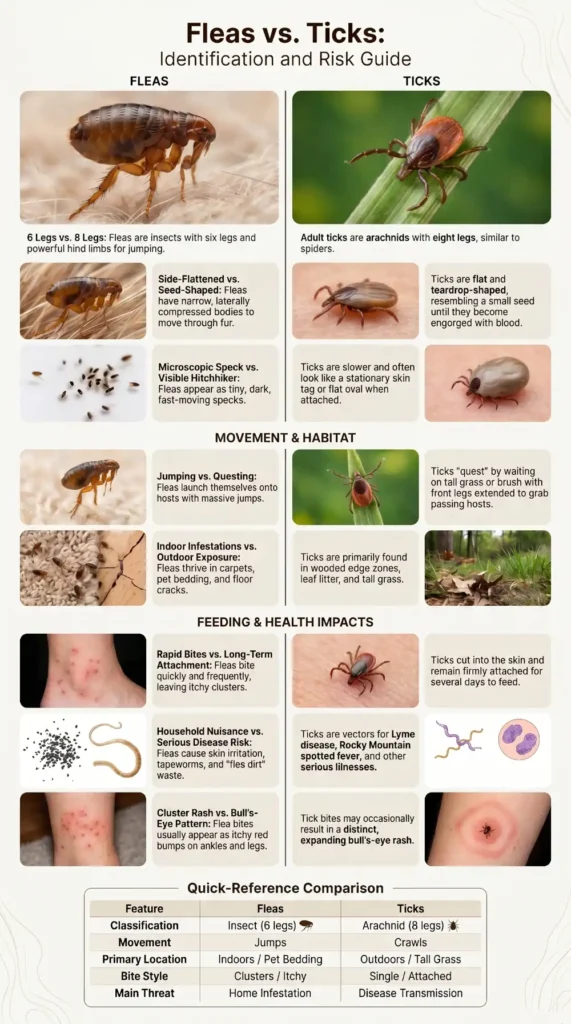
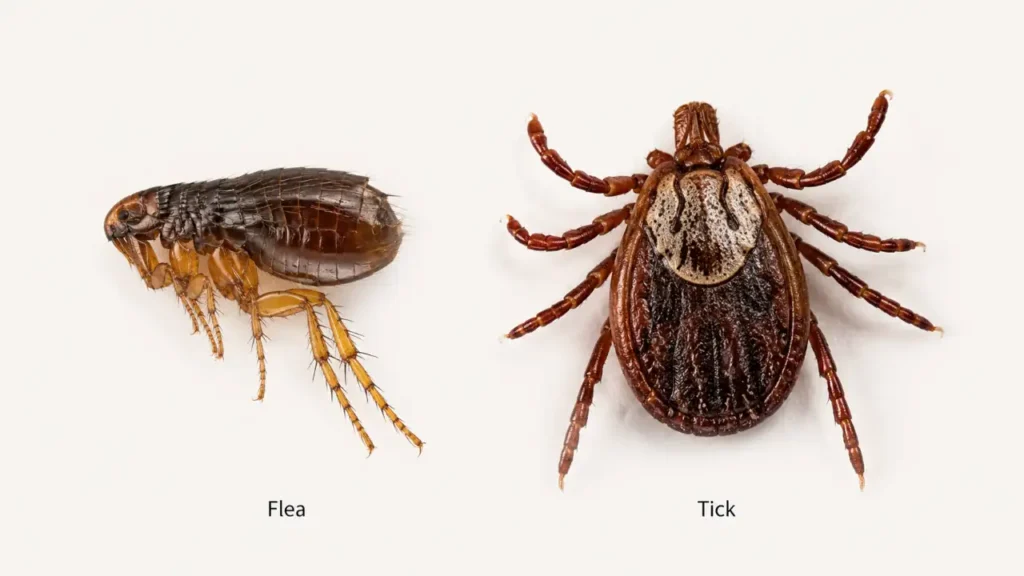
The fastest way to tell fleas and ticks apart is to look at body shape, leg count, and how they behave when disturbed. Fleas are tiny, dark, narrow, and built like little side-to-side jumpers. Ticks are flatter, rounder or teardrop-shaped, and built like slow-climbing seed-shaped hitchhikers.
Flea Appearance
Adult fleas are usually very small and dark reddish-brown to brownish-black. They are laterally compressed, which means their bodies are flattened from side to side. That shape helps them move through fur and hair without getting stuck. They have six legs, with powerful hind legs designed for jumping.
When people see a flea in real life, they often describe it as a tiny dark speck that vanishes the second they look at it. That is because fleas are fast and they do not sit still for long. Many homeowners notice flea dirt before they notice the insect itself. Flea dirt looks like tiny black pepper flakes, but it is really digested blood waste.
Tick Appearance
Ticks have a much broader, flatter body that often looks like a seed or small oval when unfed. Adult ticks have eight legs, while larvae have six. Their color can vary by species, often ranging from brown to reddish-brown or grayish tones. Some species have distinct markings that make them easier to recognize once you know what to look for.
Some tick species have distinctive markings that can help with identification. For example, female lone star ticks often have a noticeable white spot on their backs, while American dog ticks commonly have lighter markings along the shield area. While homeowners do not usually need to identify the exact species themselves, these markings can make ticks easier to recognize when comparing photos or inspecting a pet.
An unfed tick often looks like a tiny flat seed attached to skin, clothing, or fur. After feeding, it can swell and become much more obvious. An engorged tick may appear several times larger than it was before feeding. That engorged look is one reason people sometimes do not realize a tick is attached until much later than they should.
Quick Visual Comparison
Here is the simplest way I explain it to homeowners: if it looks like a tiny dark bug that keeps jumping away, think flea. If it looks like a small flat seed that stays attached, think tick. Fleas are built to move through fur and disappear fast. Ticks are built to attach and stay put.
Movement and Behavior Differences
This is where the two pests really separate. Fleas are active jumpers and crawlers. Ticks are slow crawlers and ambush feeders. This behavioral difference is often the fastest identification clue for homeowners. In the field, movement alone frequently allows you to identify the pest before you ever examine body shape or leg count. If you watch them long enough, the difference is obvious.
How Fleas Move
Fleas can jump impressive distances for their size. Fleas have a powerful jumping mechanism that helps them launch toward a host. That jump is exactly why fleas feel so hard to catch. They can be on the animal one moment and gone the next.
Once fleas reach a host, they crawl through fur, hide near warm protected areas, and feed quickly. They are not graceful little drifters. They are opportunists. They want easy access to blood, warmth, and a place where they can keep reproducing.
How Ticks Move
Ticks do not jump or fly. Instead, they “quest.” That means they climb onto grass, weeds, brush, or low vegetation, then extend their front legs and wait for something to brush past. This waiting strategy helps ticks latch onto a passing host.
Once a tick is on a host, it can crawl around for a while before biting. It often looks for warm, hidden spots with thinner skin. That slow, deliberate behavior is part of what makes ticks so tricky. They may go unnoticed until after they have already attached.
Where to Find Them
If you are trying to figure out whether you are dealing with fleas or ticks, location gives you a big clue. Fleas are often an indoor and pet-related problem. Ticks are more often tied to yards, woods, tall grass, and outdoor edge zones.
Flea Habitats
Fleas love places where pets sleep, rest, and move around. The same conditions that make these areas comfortable for pets are often what attract fleas in the first place. Carpets, rugs, furniture cushions, pet bedding, and floor cracks are all common hiding spots. They do not do well in dry, sunny places.
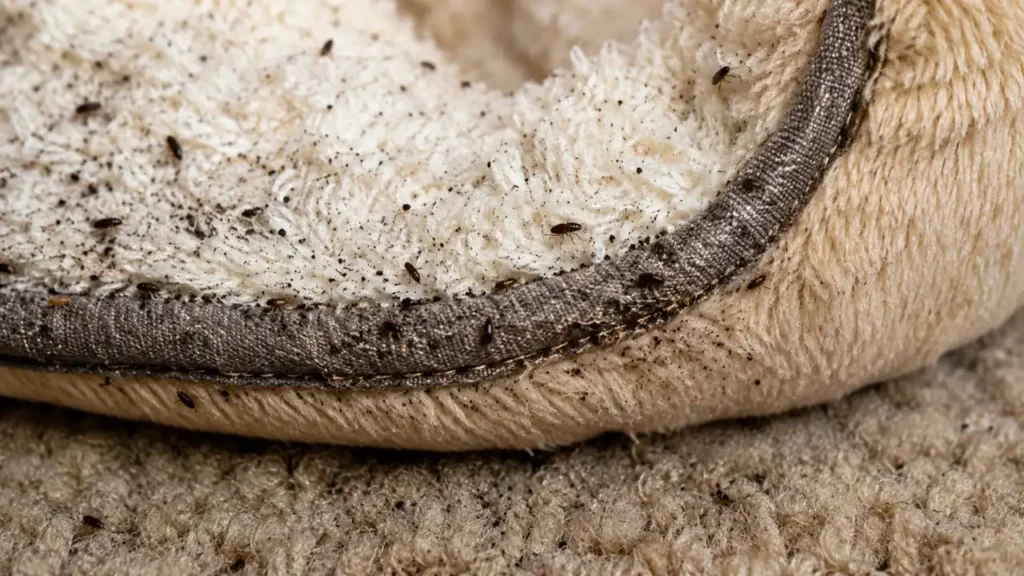
This is one of the biggest reasons fleas are so frustrating in homes. You can treat the pet and still miss the eggs and larvae in the environment. Environmental control, especially vacuuming and cleaning the areas where fleas develop, is one of the most effective ways to break the infestation cycle.
Tick Habitats
Ticks are mainly outdoor pests. They live in tall grass, brush, wooded areas, and leaf litter. Transition zones where lawns meet wild or brushy areas are prime places to pick up ticks because wildlife and people frequently cross paths there.
Most ticks are not household infestations in the way fleas are. They usually come indoors by accident on pets, clothing, or people. One exception is the brown dog tick, which can complete its life cycle indoors, but that is still a different situation from the classic flea problem most homeowners are dealing with.
How They Feed
The feeding difference is huge. Fleas feed fast and often. Ticks feed slowly and stay attached. That alone changes the risk profile quite a bit.
Flea Feeding
Fleas bite quickly with piercing mouthparts, take small blood meals, and may feed many times a day. Because they move on and off hosts, they can create repeated itching and irritation. Flea saliva often triggers an allergic skin response, which is why bites can be so annoying even when the bite itself is tiny.
Their feeding also leaves behind flea dirt, which is another clue for identification. If you find dark specks in pet bedding or fur, that is often one of the first signs fleas are active in the home. Many homeowners immediately reach for household insect sprays, but treating the pet alone or spraying visible fleas rarely solves the entire problem because immature stages are often hidden throughout the home.
Tick Feeding
Ticks behave very differently. Once they find a good spot, they cut into the skin, attach firmly, and feed for days. In many Lyme disease cases, transmission risk increases when infected ticks remain attached for extended periods, which is why fast removal is so important.
Ticks can also go unnoticed because their saliva includes compounds that reduce pain and help them stay attached. That is one reason people sometimes discover a tick only after it has fed for a while. The longer a tick stays attached, the more important the risk conversation becomes.
Life Cycle Differences
The life cycle is one of the biggest reasons fleas are such a headache indoors. The life cycle of fleas is designed around eggs falling off the host and developing in the environment. Tick life cycles are different. They are built around multiple feeding stages, often on different hosts.
Flea Life Cycle
Fleas go through four stages: egg, larva, pupa, and adult. The adult is the blood-feeding stage, while the earlier stages develop in carpets, bedding, and other protected places around the home. Under the right conditions, that cycle can move quickly.
That is why flea infestations can feel so stubborn. The visible fleas are only part of the story. The real problem is the hidden population in the environment, which keeps rebuilding the infestation if you only treat one part of the system.
Tick Life Cycle
Ticks also have four life stages: egg, larva, nymph, and adult. Many hard ticks feed at each active stage, and in many species the life cycle involves feeding on more than one host. Larvae have six legs, while nymphs and adults have eight.
Nymphs deserve special attention because they are extremely small and can be difficult to spot during routine tick checks, which increases the chance that they remain attached unnoticed.
Some tick species can take a year or more to complete their development, and others take longer. That is another reason ticks are not a quick, indoor rebound pest the way fleas often are. They are slower, but they can carry serious disease risk along the way.
Bite Marks and Symptoms
Bites are another place where homeowners get confused. Flea bites and tick bites do not always look the same, and not everyone reacts the same way. Still, there are a few common patterns that help.
Flea Bites
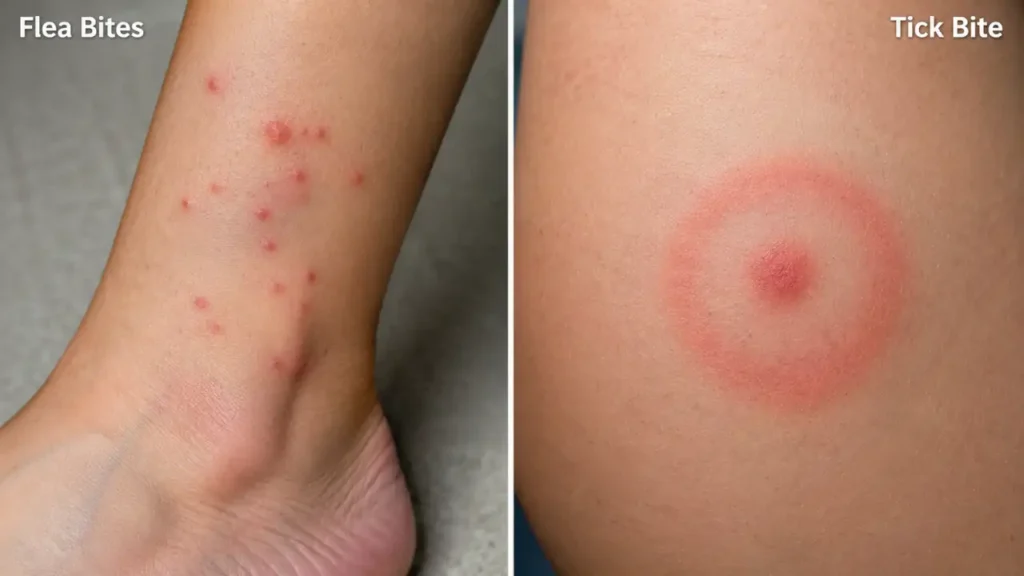
Flea bites are usually small, itchy bumps that may show up in clusters, especially on the ankles, legs, waistline, or other exposed areas. They can be irritating and sometimes inflamed, but the most obvious clue is often the itch.
If you notice several bites after time spent around pets, carpets, or upholstered furniture, fleas move to the top of the suspect list pretty quickly. The pattern matters just as much as the size. If you’re still unsure what’s causing the bites, comparing bed bug bites vs flea bites can help narrow down the source.
Tick Bites
Tick bites can be sneaky because they may not hurt much at first. A tick can stay attached without drawing attention, and symptoms may not appear until days or even weeks later. Watch for symptoms such as fever, chills, aches, fatigue, and rash after a tick bite.
Lyme disease symptoms may appear days or weeks after a bite and can include an expanding rash, fever, chills, headache, fatigue, and muscle or joint aches. In some cases, Lyme disease may produce a distinctive bull’s-eye rash around the bite area. That is why a tick bite should never be brushed off casually.
Health Risks and Diseases
This is the part people usually care about most, and for good reason. The real difference between fleas and ticks is not just how they look. It is what they can do to you, your family, and your pets.
Diseases from Fleas
Fleas can sometimes spread flea-borne typhus, plague, and cat scratch disease. Fleas can also spread tapeworms if an infected flea is swallowed accidentally. That is not everyday stuff, but it is real enough that fleas should never be treated like a harmless nuisance.
For most homeowners, though, the immediate flea problem is usually the repeated biting, skin irritation, and stress on pets. Some pets also develop flea allergy dermatitis, a condition in which even a small number of flea bites can trigger significant itching and skin irritation. A flea infestation can make animals miserable and can keep people on edge because the bites are so persistent. Cats are especially sensitive to flea activity, and recognizing the signs of flea bites on cats early can prevent a minor problem from becoming a larger infestation.
Diseases from Ticks
Ticks can spread a wider and often more serious list of diseases. Tickborne illnesses include Lyme disease, STARI, Rocky Mountain spotted fever, ehrlichiosis, tularemia, babesiosis, and others. The danger is not just the bite itself. It is the possibility of infection after attachment.
In North America, Lyme disease is most commonly associated with blacklegged ticks, often called deer ticks.
Prompt removal helps reduce the risk of Lyme disease transmission because infected ticks generally need time to transmit bacteria after attachment. That is why a quick check after time outdoors is one of the smartest habits you can build.
It’s important to remember that most flea bites and tick encounters do not result in serious illness. The goal is early identification and prompt action rather than panic.
A Real-World Example: When Fleas Were the Bigger Problem
A situation I’ve encountered more than once involves homeowners finding bites on their ankles and assuming ticks were somehow breeding indoors. After inspection, the culprit was almost always fleas. In one case, a family treated their dog repeatedly but never addressed the flea eggs and larvae developing in the carpet and pet bedding. The adult fleas temporarily disappeared, but the infestation kept returning every few weeks.
Situations like this are a reminder that successful flea control requires treating both the pet and the environment at the same time, which is why many homeowners struggle when trying to get rid of fleas completely.
By contrast, most tick complaints I see originate outdoors. Homeowners often discover ticks after yard work, hiking, or letting pets roam through tall grass near wooded areas. While ticks can present a greater disease concern, they rarely create the kind of widespread indoor infestation that fleas can.
The lesson is simple: if you’re finding multiple bites indoors and the problem seems to be getting worse over time, fleas are usually the more likely suspect. If you find a pest attached to skin after outdoor activity, think tick first.
How to Tell the Difference Between Fleas and Ticks
Fleas are six-legged insects that jump and commonly infest homes, carpets, and pets. Ticks are eight-legged arachnids that crawl, attach to a host, and are most often picked up outdoors. If the pest jumps away when disturbed, it is likely a flea. If it remains attached to skin or fur, it is more likely a tick.
If the pest jumps when you disturb it, think flea. If it stays attached and looks like a seed, think tick.
If the problem is happening mostly indoors, especially around pet bedding, carpets, and upholstery, fleas are more likely. If the problem started after yard work, hiking, walking through tall grass, or time near brush and woods, ticks are more likely.
If the bites are itchy and clustered around ankles or lower legs, fleas are a strong possibility. If you find a pest attached to the skin or later notice fever, rash, or body aches after outdoor exposure, ticks deserve immediate attention.
Fleas vs Ticks at a Glance
| Fleas | Ticks |
| Insects | Arachnids |
| 6 legs | 8 legs |
| Jump | Crawl |
| Indoor infestations common | Outdoor exposure common |
| Repeated bites | Long attachment |
| Household nuisance | Greater disease concern |
Which Is Worse?
This is the question everybody asks, and the honest answer is that it depends on what you mean by worse. If you are talking about household misery, fleas often win. They multiply fast, hide in the home, and keep biting until the life cycle is broken. If you are talking about health risk, ticks are usually worse because they can spread more serious diseases. That is a practical conclusion based on how each pest behaves and the health risks associated with each one.
From a pest-control perspective, I generally consider fleas the harder pest to eliminate once they become established indoors because you’re fighting multiple life stages hidden throughout the home. Ticks are typically easier to manage from a structural pest standpoint, but they deserve more immediate attention because of the diseases they may transmit.
So, fleas are usually worse for your couch, carpet, and pet comfort. Ticks are usually worse for your health. That is the simplest way to remember it.
Also Read: How to Get Rid of Fleas on Dogs: 10 Vet-Approved Steps
What Should You Do If You’re Not Sure Which Pest You Found?
If you’re unsure whether you’re dealing with a flea or a tick, start by looking at movement. Fleas jump. Ticks crawl. Next, consider where you found it. Pests discovered in carpets, pet bedding, or upholstery are more likely to be fleas. Pests found after yard work, hiking, or time spent in tall grass are more likely to be ticks. Taking a clear photo and comparing leg count can also help. Fleas have six legs, while ticks have eight.
The Bottom Line
Fleas and ticks both feed on blood, but they are built differently and behave differently. Fleas are insects that jump, hide in homes, and create fast-moving infestations through pets, bedding, and carpets. Ticks are arachnids that crawl, quest in outdoor vegetation, attach to hosts, and can spread serious disease if they stay attached long enough. Once you know those differences, identification gets a lot easier.
Correct identification is the most important first step. In my experience, many homeowners waste time and money treating the wrong pest because they assume every small biting pest is either a flea or a tick. Taking a few minutes to identify the pest correctly usually leads to faster and more effective control.
If you remember only one thing, remember this: fleas jump, ticks attach. That one line solves a lot of confusion.