
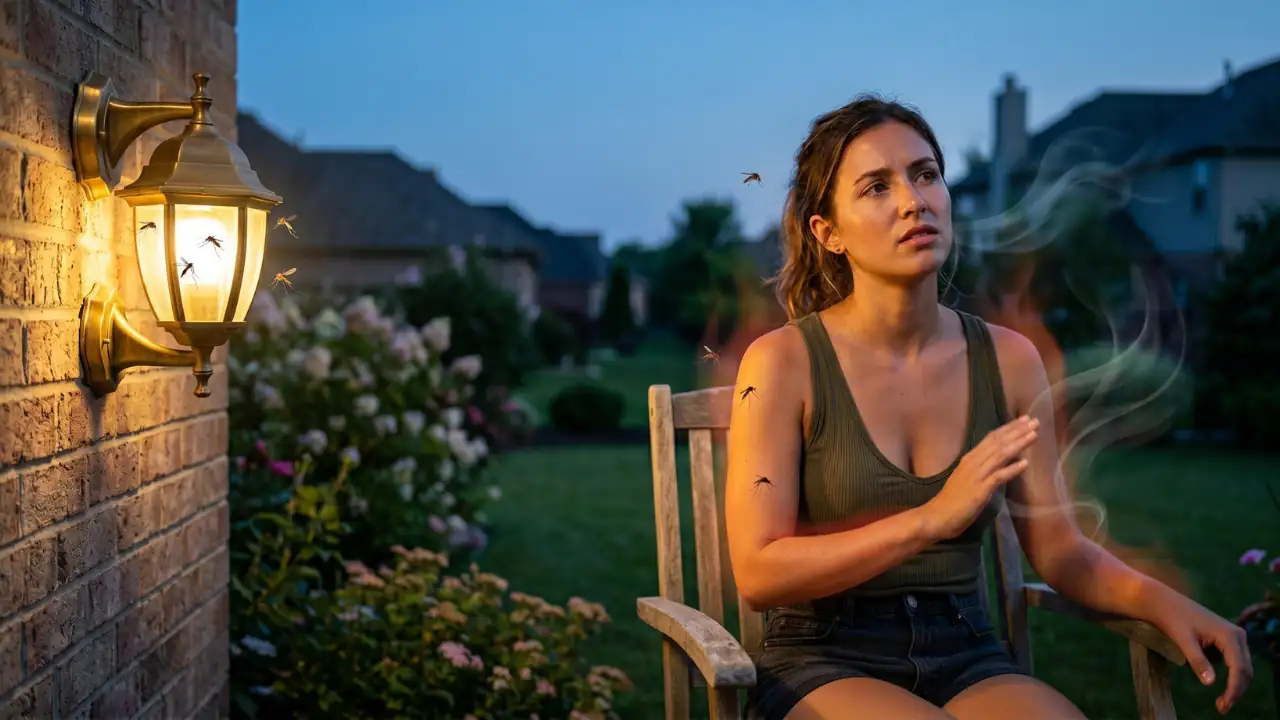
Mosquitoes can be maddening. One minute you are sitting outside enjoying the evening, and the next minute you are swatting at your ankles and wondering whether that bright porch light is basically a dinner bell. The reality is more complicated than most homeowners realize. Mosquitoes do react to light in certain ways, but they are not simple “light-chasing” insects like moths. What really pulls them in is a mix of carbon dioxide, body heat, and human scent. Light is more of a side story.
The good news is that once you understand what mosquitoes are actually responding to, it becomes much easier to protect your yard, patio, and home. That is what this article is about, in plain language, without the fluff.
Also Read: Spadepestcontrol blog
Quick Answer
Mosquitoes are not strongly attracted to light the way moths are. In most situations, mosquitoes are far more attracted to carbon dioxide, body heat, and human scent than any type of indoor or outdoor lighting. While some species respond to certain colors and wavelengths, mosquitoes primarily find people through carbon dioxide, body heat, and scent. Light can influence mosquito behavior, but it is usually a secondary factor rather than the main reason mosquitoes gather around humans.
Are Mosquitoes Attracted to Light?
Mosquito responses to light vary based on the species, the time of day, and the color of the light. Some day-biting mosquitoes were attracted to a wider range of light during the daytime, while night-biting mosquitoes tended to avoid short-wavelength light during the day. That means light can influence mosquito behavior, but it is not the main thing drawing them toward you.
Around homes, mosquitoes are usually reacting to the things your body gives off. Carbon dioxide is a huge one, and body heat and odor matter too. Researchers have long observed that mosquitoes rely heavily on carbon dioxide and other host cues when locating people and animals. That is why a person sitting on a patio can be more of a target than the lamp above the table.
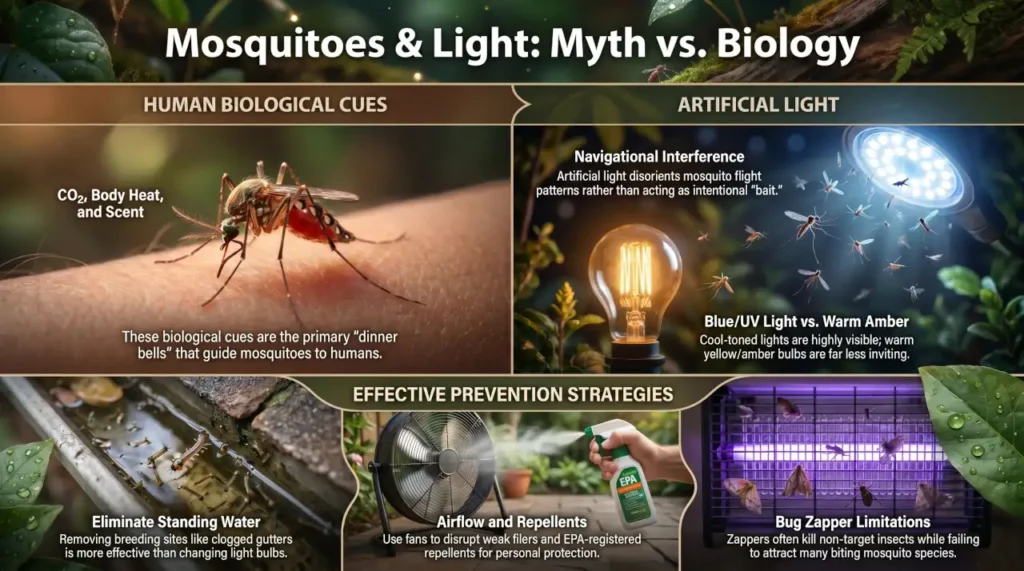
Quick tip: If mosquitoes seem to gather around your porch light, do not assume the light is the cause. Check for standing water, shaded resting spots, and weak screen protection first. Those are much bigger mosquito problems than most people realize. The CDC recommends eliminating standing water and using EPA-registered repellents as primary mosquito-prevention measures, which is why addressing breeding sites usually delivers better results than changing outdoor lighting alone.
Why Mosquitoes Seem to Gather Around Lights
In over 18 years working around residential mosquito complaints, I’ve lost count of how many homeowners were convinced a porch light was causing their mosquito problem. In most cases, the real issue was something else entirely—birdbaths, clogged gutters, decorative pots holding water, or dense landscaping that gave mosquitoes a cool place to rest during the day. Once those conditions were corrected, mosquito activity dropped noticeably even though the lighting never changed.
This is where things get confusing. People often see mosquitoes near lights and assume they are attracted to the bulb itself. Sometimes they are, but often the light is simply making them easier to notice. Bright outdoor lighting can also interfere with their normal navigation, which makes them drift or hover in odd spots.
Like many flying insects, mosquitoes use natural light sources such as the moon and horizon light patterns to help orient themselves during flight. Artificial lights can sometimes interfere with that process, causing mosquitoes to drift, circle, or appear unusually concentrated around illuminated areas even when the light itself is not attracting them. That does not mean the bulb is the “bait.” It may simply mean the insect is slightly disoriented.
Many mosquito species are most active around dawn and dusk, which is one reason homeowners often notice them around outdoor lighting in the evening. The timing can make it seem as though the light is attracting them when their natural activity period is actually the bigger factor.
There is also a species difference that matters a lot. Some mosquitoes are active at dusk and night, while others bite during the day. Day-biting and night-biting mosquitoes do not respond to light in the same way, which is why one homeowner can swear their patio light pulls mosquitoes in while another homeowner sees almost no pattern at all. Both people may be partly right.
The insect species in their area is not the same. For example, Aedes mosquitoes, which include several common daytime-biting species, can respond differently to light than many mosquitoes that are most active at night.
That is one reason bug zappers cause so much confusion. They light up, they make a popping sound, and they make people feel like the mosquito problem is being handled. One limitation of light traps is that they do not attract every mosquito species equally, and some traps collect insects that are not responsible for most nuisance biting around homes. In other words, a glowing trap can make a porch look successful while the real biting mosquitoes keep finding you anyway.
Common Light Myths About Mosquitoes
- Mosquitoes are not attracted to light the way moths are.
- Turning off a porch light will not eliminate a mosquito problem.
- Bug zappers do not target every mosquito species.
- Carbon dioxide and body heat are usually much stronger attractants than light.
Are Mosquitoes Attracted to UV Light?
This is one of the most common questions, and the answer needs a little nuance. UV light can attract certain insects, and some mosquito traps use light as part of their design. But that does not mean all mosquitoes are strongly attracted to UV light in a simple, universal way. Mosquitoes can respond differently to UV and other light colors depending on the species and time of day. Night-biting mosquitoes were especially sensitive to short-wavelength light during the day, but that is not the same thing as saying every mosquito is happily flying straight to your UV bulb.
Research on mosquito trapping helps explain why UV-style traps are not a cure-all. Light traps are used for mosquito collection, but CO2 is often added because light alone is not enough for reliable attraction across species. Not all mosquito species are attracted to light traps, and many trapping systems perform better when additional attractants are used.
So, are mosquitoes attracted to UV light? From a practical pest-control standpoint, homeowners often overestimate how much influence UV light has on mosquito populations. If I had to prioritize mosquito-control efforts, lighting would be near the bottom of the list compared to water management, habitat reduction, airflow, and personal protection measures.
Sometimes, under some conditions, for some species. But if you are asking whether UV light is the best or most dependable way to control mosquitoes around your home, the answer is no. The same principle applies to black lights. While some mosquitoes may respond to black light under certain conditions, black lights are not a reliable stand-alone mosquito-control solution. It is too inconsistent for that.
Quick tip: Do not buy a UV trap expecting it to solve a yard infestation by itself. Use it only as one small tool. The bigger win comes from removing breeding water, fixing screens, and using proven repellents when you go outside.
Are Mosquitoes Attracted to Blue Light?
Blue light gets a lot of blame, especially because many LEDs give off cooler-toned light and people notice more insects around modern fixtures. But the science is more complicated than “blue light equals mosquitoes.” Night-biting mosquitoes may avoid UV and blue light during the day, while day-biting species can respond differently depending on timing and conditions. So blue light can matter, but it is not a universal mosquito magnet.
In home terms, blue light is better thought of as a light color that may be more noticeable to some mosquitoes than warmer light, especially when conditions are right for their activity. That does not mean every mosquito will flock to it. It means blue light can be part of the picture, not the whole picture.
If your yard has a lot of bright cool-toned lighting and you are also dealing with standing water, dense shrubs, and little airflow, mosquitoes may seem worse near the lights. But again, the lighting is usually just one piece of a much bigger mosquito problem.
What Color Light Attracts Mosquitoes?
There is no single color that all mosquitoes prefer. Part of the reason is that North America has hundreds of mosquito species, and their behavior can vary considerably. Species that actively seek hosts during daylight hours often respond differently to visual cues than species that become active around dusk and overnight.
Different species respond differently, and time of day changes the result too. Some day-biting mosquitoes respond to a wider range of light spectra during the day, while many night-biting species react differently. So the better question is not “What color do mosquitoes love most?” The better question is “Which colors are least likely to help them find or orient themselves?”
For practical home use, warmer outdoor lighting is usually the better choice. Amber, warm yellow, or softer lights are a reasonable option because they are less likely to act like a strong visual cue for mosquitoes than cooler, short-wavelength lighting.
Homeowners often ask about red, yellow, green, and purple lights. In general, warmer colors such as amber and yellow are less useful to mosquitoes than shorter-wavelength colors. However, no light color reliably repels mosquitoes, and color alone will not solve a mosquito problem. That does not mean they repel mosquitoes in some magical way. It just means they are a smarter choice when you are trying to make your porch or patio less inviting.
If you want the simplest takeaway, think of it like this: mosquitoes are not shopping for a favorite light color the way humans shop for a lamp. They are using visual cues that help them orient themselves and move around, but the real hunt is still driven by the smell, warmth, and carbon dioxide coming from living things.
Can You Use Certain Light to Repel Them?
Not really, at least not in any reliable way. There is no lighting trick that will make mosquitoes disappear from your yard. Some lighting choices may be less helpful to them than others, but that is not the same as repelling them. In the real world, light is too weak a control method on its own.
In actual mosquito service calls, changing bulbs alone rarely produces a noticeable difference for homeowners. The biggest improvements almost always come from eliminating breeding sites and reducing the areas where adult mosquitoes can rest during the day.
The better strategy is to stop giving mosquitoes a reason to stay near your home. In many cases, simple eco-friendly pest control methods such as habitat modification and exclusion are far more effective than relying on lighting changes alone.
Proven EPA-registered repellents remain one of the most effective tools for reducing mosquito bites. Combined with standing-water reduction, proper screening, and habitat management, they provide far better results than changing outdoor lighting alone. That is the kind of prevention that actually moves the needle. Lighting is only the sidekick here.
If you still want the best lighting setup possible, choose warm-toned outdoor bulbs, avoid over-lighting your patio, and place lights away from seating areas when you can. That will not “repel” mosquitoes, but it can reduce how often they drift into the spaces where people are sitting and breathing.
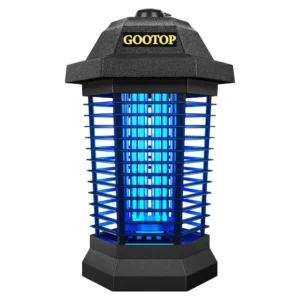
If you’re considering a bug zapper, think of it as a supplemental tool rather than a complete mosquito-control solution. You’ll usually see the best results when it’s combined with standing-water reduction, proper screening, and personal protection measures.
Quick tip: Pair softer outdoor lighting with a fan near your seating area. Mosquitoes are weak fliers, so moving air makes it harder for them to hover around you, especially while you are sitting still. Combine that with standing-water control and a good repellent, and you will usually see a much bigger difference than any bulb swap alone.
What Mosquitoes Actually Care About
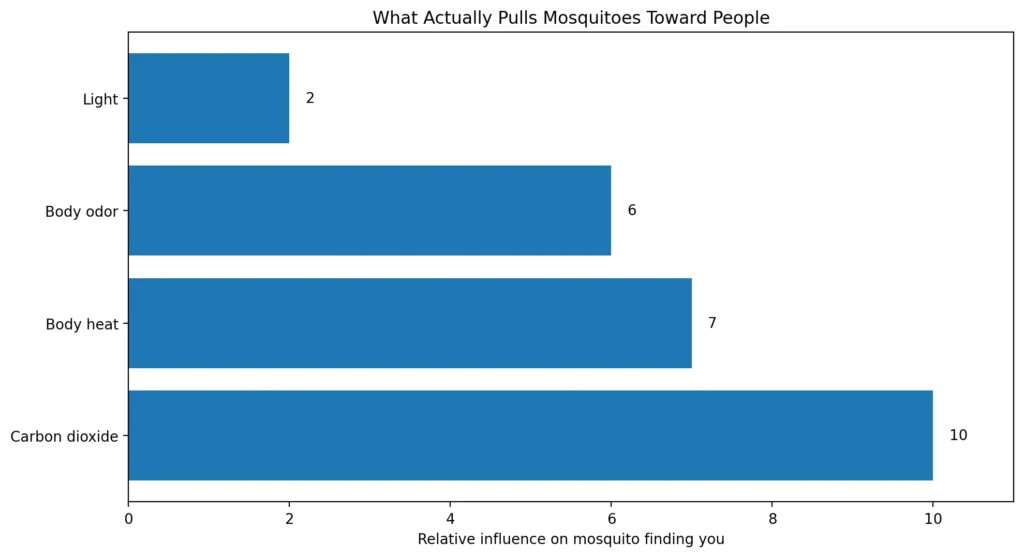
If mosquitoes prioritized their host-searching cues, light would not be at the top of the list. Carbon dioxide would rank near the top. If you compare light versus heat, heat is generally the stronger mosquito attractant. Mosquitoes use body heat as one of several cues to locate a host. In practical terms, carbon dioxide, body heat, skin odor, and human scent attract mosquitoes far more strongly than any outdoor light source. Those biological cues are what mosquitoes use to locate a host.
Female mosquitoes are responsible for biting because they need a blood meal to produce eggs, which is why host-detection cues such as carbon dioxide and body heat play such an important role in their behavior.
These host-detection cues work together, which is why mosquitoes can locate people surprisingly efficiently even in low-light conditions. Mosquito research consistently shows that traps perform best when they mimic the cues produced by a living host, especially CO2 and other chemical cues.
That is the real reason mosquitoes find people, pets, and outdoor gathering spots so easily. Many of the same environmental factors that attract mosquitoes can also contribute to problems like flea bites on cats around the home.
A common example is the backyard barbecue where everyone gathers under a covered patio. Homeowners often blame the overhead light when mosquitoes appear, but what the insects are actually detecting is a concentrated source of carbon dioxide, body heat, and human scent from multiple people sitting in one area. The light may help you notice the mosquitoes, but the guests are usually the stronger attraction.
Also Read: Bed Bug Bite vs Mosquito Bite: How to Tell the Difference Fast
That also explains why two neighbors can sit outside under similar lighting and have very different mosquito problems. One yard may have clogged gutters, potted plants full of standing water, heavy shade, and little breeze. The other may be dry, open, screened, and better ventilated. The lights may look the same, but the mosquito pressure is not the same at all.
So when someone asks, “Are mosquitoes attracted to light?” the best answer is this: light can affect mosquito behavior, but it is not what truly drives them to you. Mosquitoes are following the living signals of a host, not just the glow of a bulb. Similar to understanding what attracts fleas, identifying the cues that draw mosquitoes to a property can make prevention much more effective.
Final Thoughts
Mosquitoes respond to light, but the evidence shows that light is usually a secondary factor compared to the biological signals they use to locate hosts. Some mosquitoes respond to certain wavelengths, some avoid them, and some seem to care more about the time of day than the color itself. That is why there is no one perfect bulb that solves everything.
If you are trying to make your home less attractive to mosquitoes, do not start with the lights. Start with standing water, screens, airflow, and repellent. Then, if you want to fine-tune your outdoor setup, switch to warmer lighting and avoid turning your patio into a bright beacon. That approach is far more realistic, and it fits how mosquitoes actually behave.