

If you’ve noticed little dusty-looking flies hanging around your bathroom sink or shower drain, you’re probably dealing with drain flies, and you’re probably wondering why they won’t just go away no matter how many times you wipe down the counter. If you’re trying to figure out how to get rid of drain flies, you’re not alone. I get it. I’ve been called out to more homes than I can count where the owner had already scrubbed the sink three times and sprayed everything in the cabinet, and the flies just kept coming back.
Here’s the thing: the sink itself usually isn’t the problem. The real issue is the organic film coating the inside of the drain or another damp area nearby. That’s where drain flies can lay eggs and where their larvae develop. Once you find and remove that breeding material, the adults you see around the bathroom usually stop being a recurring problem. Let’s look at how to find that source and get rid of it.
Also Read: Spadepestcontrol blog
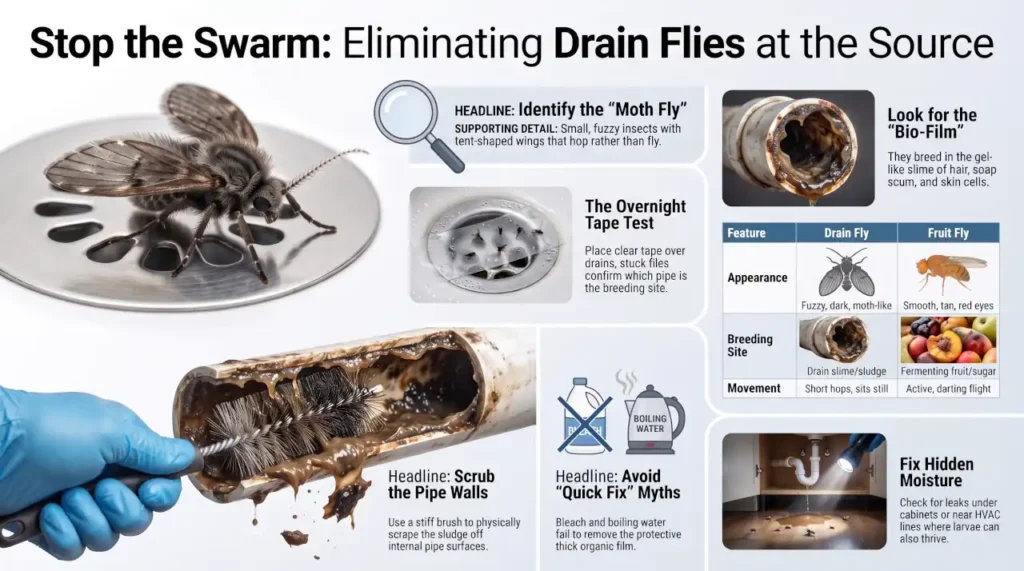
Quick Answer: How to Get Rid of Drain Flies
The most effective way to get rid of drain flies is to find and remove the wet organic buildup where they’re breeding. Scrub the affected drain and accessible plumbing, check nearby drains and hidden moisture sources, and monitor activity afterward. Sprays and traps can reduce adult flies, but they won’t solve the problem if the breeding site remains.
What I’d Check First
If I walked into a bathroom with drain flies, I wouldn’t start by spraying the walls. I’d start by figuring out where the adults are coming from.
I’d check the drain where they’re clustering, then look at nearby sinks, tubs, showers, and floor drains. I’d also check underneath the sink cabinet for leaks or damp organic material. Once the likely source is identified, I’d inspect the drain cover, stopper, and accessible pipe for sludge and hair before deciding what treatment is actually necessary.
That’s an important distinction with drain flies: don’t escalate the treatment before you’ve improved the diagnosis. If you treat the wrong drain, stronger products won’t fix the problem.
What Are Drain Flies?
Drain flies are small, fuzzy-looking insects that breed inside the slimy buildup that forms on the walls of your drain pipes. You might also hear them called moth flies, sewer flies, filter flies, or sink flies. “Drain fly” is the common name used for several closely related species in the family Psychodidae, so those names don’t necessarily mean one exact species. They belong to a family of insects called Psychodidae, and their whole life revolves around damp, organic gunk, the kind that quietly builds up inside a pipe over weeks or months without you ever seeing it.
Here’s what throws people off. A drain fly infestation has almost nothing to do with how clean your bathroom looks on the surface. You can have a spotless countertop, a freshly mopped floor, and a sink that gleams, and still have an established breeding population of drain flies living inside the drain, trap, or other damp plumbing area where organic material has accumulated.
That’s because the mess they need isn’t visible dirt. It’s the thin, gel-like film of soap scum, hair, skin cells, and grease that clings to the inside of the pipe. Female drain flies lay their eggs directly into that film, and the larvae live right there, feeding on it until they’re ready to become adults.
So when someone tells me they’ve cleaned the bathroom top to bottom and still have flies, I already know where to look. The fix isn’t on the counter. It’s inside the pipe.
Do Drain Flies Bite?
No, drain flies don’t bite, and they can’t sting either. If you’re getting itchy bumps and blaming the little flies hovering by your sink, it’s worth looking at something else, because drain flies simply aren’t built for that. They don’t have the mouthparts for it.
That doesn’t mean they’re pleasant to live with, though. A heavy infestation means dozens or even hundreds of these things resting on your bathroom walls and tile, and that gets old fast. Some people also notice a musty or sewer-like smell around the drain. When that’s present, the odor may be coming from the organic buildup, stagnant water, or another plumbing issue associated with the area rather than from the flies themselves. So while you don’t need to worry about bites, you do need to take them seriously, because a small problem this week can turn into a much bigger one within a month if the breeding site is left alone.
How Do Drain Flies Look Like?
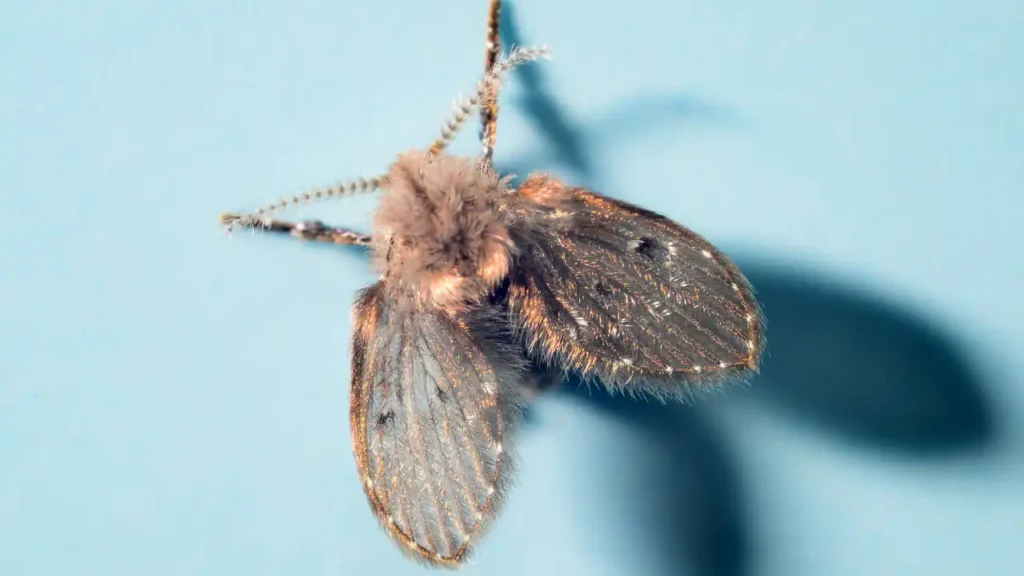
Once you know what to look for, drain flies are pretty easy to identify. They’re very small, usually only a few millimeters long. Their bodies and wings are covered in short, fine hairs, which gives them a soft, dusty, almost fuzzy appearance. A lot of people describe them as looking like miniature moths, and that’s a fair comparison.
One of the easiest ways to recognize a drain fly is to look at how it rests. When a drain fly lands, it folds its wings up over its body in a tent-like or roof-like shape, sitting almost perfectly still on the wall or tile for long stretches. They’re also weak fliers. Instead of zipping around the room the way a housefly does, drain flies tend to hop or flutter short distances before landing again, usually staying close to whatever drain they came from. If you see a cluster of small, fuzzy, moth-like insects sitting quietly near a sink or shower and barely moving, that’s about as textbook a drain fly sighting as it gets.
Signs Of Drain Flies Infestation
The first sign most people notice is exactly what I just described: small, fuzzy flies resting on the wall near a sink, tub, or shower, often in the same general spot day after day. Unlike gnats or fruit flies, drain flies aren’t constantly buzzing around your head. They tend to sit still for long periods, which is actually a useful clue, because it means you can usually track them back to a specific drain just by paying attention to where they cluster.
Another sign worth checking for is activity that keeps showing up around one particular drain rather than spread evenly through the house. If you’re seeing flies by the bathroom sink but nowhere else, that sink is very likely the breeding site.
You can check it with a simple trick plumbers and pest techs use all the time: tape a strip of clear packing tape sticky-side down over part of the drain opening before bed, and check it in the morning. If flies are stuck to the tape, you’ve found a drain associated with the activity, which makes it a strong candidate for further inspection.
A third sign is persistence. If the flies keep showing up several days in a row rather than just once or twice, that points more toward an established breeding source than a stray fly that wandered in from outside. And here’s the part that trips people up: if you clean one drain thoroughly and still see flies a day or two later, don’t assume the treatment failed. It may simply mean that adults are still emerging, or that you’ve cleaned the wrong breeding site. That’s when it’s worth checking nearby drains and other damp areas instead of immediately reaching for a stronger treatment.
Drain Flies vs Fruit Flies
These two get confused all the time, and it’s an easy mix-up to make, since both are small and both tend to show up in kitchens and bathrooms. The problem is that treating one like the other almost never works, because they breed in completely different places and need completely different fixes.
Drain flies, as we’ve covered, are dark and fuzzy with that moth-like, hairy body, and they hold their wings roof-style when resting. They breed in the organic slime inside drains, and they’re weak, short-hop fliers that don’t move around much.
Fruit flies look nothing like that once you know what to check. They have small, tan or light brown bodies, noticeably red eyes, and smooth wings without the fuzzy coating. Rather than drains, fruit flies breed in overripe fruit, sugary spills, empty soda cans, or anything fermenting on the counter, and they’re much more active fliers, darting around a kitchen instead of sitting still.
If you’re standing there squinting at a tiny fly trying to decide which one it is, start with the overall appearance. A fuzzy, moth-like insect that sits quietly near a drain points toward a drain fly. A smoother, more active little fly around fruit, sugary spills, or fermenting material points more toward a fruit fly.
Once you’ve identified the pest, the next step is to look for the right breeding source. For fruit flies, that means food and fermentation sources; for drain flies, it means damp organic material in or around plumbing. Clean out the fruit bowl and wipe up spills for fruit flies, or go after the drain itself for drain flies. Mixing up the two just means wasting time on a fix that was never going to work.
If you still can’t tell what you’re looking at, don’t start treating the drain based on appearance alone. Where the insects are consistently found and what they’re breeding around can be just as useful for identification as their size and color.
First, Find the Breeding Site
Before treating anything, make sure you’ve found where the flies are actually coming from. Don’t automatically assume the drain closest to the flies is the source.
Check bathroom sinks, showers, tubs, floor drains, laundry drains, utility sinks, and other rarely used drains nearby. If you’re not sure which one is responsible, cover individual drains overnight with clear tape or another temporary cover that allows you to monitor activity without permanently sealing the plumbing.
You can also inspect for the conditions drain flies need: standing moisture, sludge, hair, soap residue, or other organic material inside or around the drain. A drain that looks clean from above can still have buildup farther down.
This matters because you can scrub the wrong drain perfectly and still have flies appearing the next morning. Find the source first, then treat it.
10 Best Ways to Get Rid of Drain Flies
Every method below is built around one idea: the breeding site is inside the pipe or another damp area, not simply on the surface, so that’s where the real work needs to happen. Some steps remove the breeding material, some help monitor activity, and others provide temporary control of adult flies or address moisture problems. Start with source removal and use the other steps when they actually fit the situation.
1. Scrub the Organic Film Out of the Drain
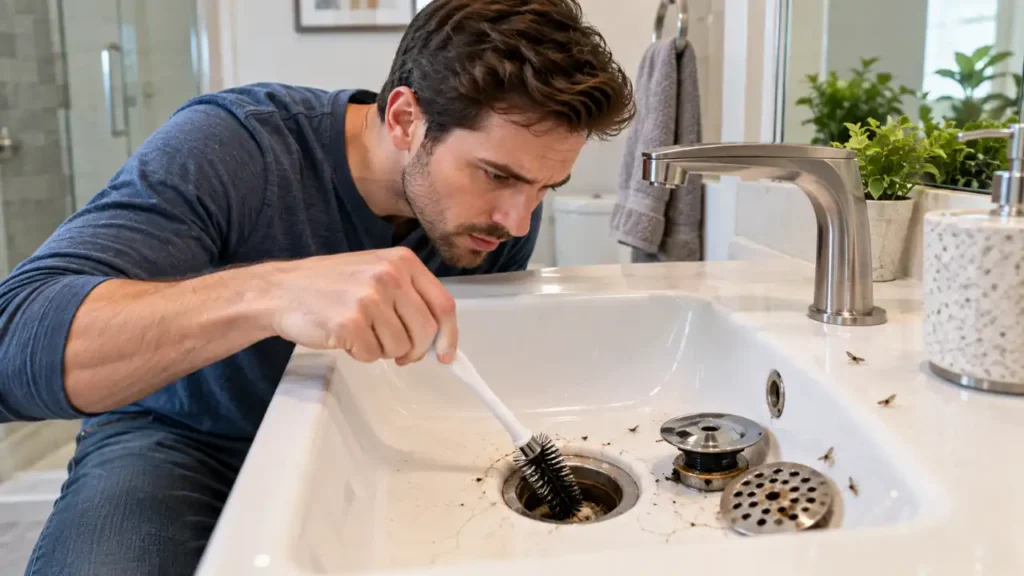
This is where you start, and honestly, it’s the step people skip most often because it takes a little elbow grease. Pouring a cleaner down the drain without physically breaking up the buildup first usually doesn’t do much, because drain fly larvae and pupae are living right inside that thick, gelatinous film clinging to the pipe walls.
Grab a stiff drain brush, the kind sold for exactly this purpose, or even a bent wire hanger in a pinch, and work it into the drain opening, going down as far as it will reach. You want to physically scrape the sides of the pipe, not just run water through it. While you’re at it, take a few extra minutes to scrub around the drain cover itself, since grime and hair tend to collect in those little crevices and screws too. This single step does more to solve a drain fly problem than almost anything else on this list, because it removes the actual nursery the flies depend on.
2. Use Baking Soda and Vinegar Only as a Minor Follow-Up
Baking soda and vinegar are popular DIY drain treatments, but I wouldn’t make them a central part of a drain fly treatment plan. The fizzing reaction can loosen or move some surface debris, but it doesn’t reliably remove the established organic film where drain fly larvae develop.
If you’ve already scrubbed the drain and want to flush away loosened residue, you can use them as a follow-up. But don’t confuse the bubbling reaction with deep cleaning. The physical removal of the buildup is the important part.
Also, never combine vinegar or other household cleaners with bleach or products containing bleach. Mixing cleaning chemicals can create dangerous fumes.
3. Apply an Enzyme or Biological Drain Cleaner
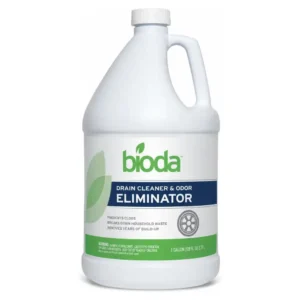
After scrubbing and rinsing, an enzyme-based drain treatment is worth adding into the rotation, especially if the buildup has been sitting for a long time. These products use enzymes, microorganisms, or a combination of biological ingredients to help break down organic residue in drains. That’s useful because reducing the buildup removes some of the material drain-fly larvae depend on.
Use the product according to its label directions, often allowing it to remain in the drain for an extended contact period. The goal is continued breakdown of organic residue rather than a one-time blast of chemicals.
These treatments can be useful after physical cleaning and as part of ongoing drain maintenance, but they shouldn’t be presented as a substitute for removing heavy buildup that you can physically reach. If the drain is heavily fouled, mechanical cleaning is still the first job.
Harsh chemical drain cleaners aren’t a reliable substitute for physically removing the organic film, either. They may affect some material or organisms they contact, but they don’t guarantee that the buildup lining the pipe has been removed.
4. Remove Hair, Sludge, and Organic Debris Around the Drain
Don’t overlook the material sitting immediately around the drain opening. Hair, soap residue, sludge, and other organic debris can provide additional food and moisture for developing drain flies.
Remove the drain cover if it can be safely removed, clean the cover and accessible surfaces, and scrub away anything coating the inside of the opening. If you have a removable stopper, clean that as well. This is particularly important in bathroom sinks and tubs, where hair and soap residue can build up out of sight.
The goal isn’t to make the drain smell cleaner. The goal is to physically remove the material the larvae can use.
5. Clean the Drain Trap and Accessible Plumbing
If the drain opening looks clean but flies continue to appear, don’t stop at the surface. The trap and other accessible sections of the plumbing can collect organic material where drain-fly larvae develop.
If you’re comfortable removing and cleaning an accessible trap, inspect it for sludge, hair, and other organic residue. Put a bucket underneath before disconnecting any plumbing and reassemble everything carefully afterward. If you’re not comfortable taking plumbing apart, leave that portion to a plumber.
The important point is that cleaning the visible drain opening doesn’t always mean you’ve cleaned the entire accessible breeding area.
6. Clean Every Nearby Drain
Here’s a mistake I see constantly: someone treats the one drain where they spotted flies, feels good about it, and then gets blindsided a week later when the flies are back, except now the source is a different drain elsewhere in the bathroom, laundry area, or nearby plumbing. Drain flies don’t stick to a single pipe once the conditions are right, so if one drain in your bathroom has buildup, there’s a decent chance others do too.
Go through every drain in the affected room and nearby rooms, including ones you don’t use often, like a guest bathroom or a laundry room floor drain. Rarely used drains deserve special attention because organic residue can sit undisturbed for long periods.
If a drain has gone unused for a while, the water in its trap can evaporate and break the normal water seal between the home’s interior and the drainage system. Restore the water in the trap and inspect the drain for buildup or other problems. Scrub each one the same way you did the first, and get in the habit of avoiding food scraps, grease, and hair going down any drain in the house going forward.
7. Use Sticky Traps to Monitor Adult Drain Flies
Yellow sticky traps won’t end an infestation on their own, but they’re genuinely useful for something else: telling you whether your treatment is actually working. Place one close to the drain you’ve been treating, since drain flies are weak fliers and rarely travel far from where they emerged.
For the best comparison, put traps in consistent locations and check them at roughly the same intervals rather than judging the infestation from one night’s catch.
Check it every couple of days. If the number of flies caught keeps dropping, that’s a good sign the breeding source is shrinking the way it should. If the count stays flat or climbs, that usually means there’s still buildup left in the pipe, or there’s a second drain you haven’t gotten to yet. Think of the sticky trap less as a weapon and more as a progress report, letting you know whether to keep going or start looking elsewhere.

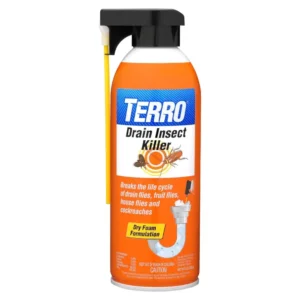
8. Use an Indoor Flying-Insect Spray Only for Adult Knockdown
If adult flies are becoming a nuisance, an indoor flying-insect product labeled for the specific use can provide temporary knockdown. It should be considered a convenience measure rather than the treatment that eliminates the infestation.
Follow the product label exactly, including where the product may be applied and any requirements involving ventilation, food, children, pets, or re-entry. Never spray a product into a drain unless the label specifically permits that use.
Just keep your expectations realistic here. A spray aimed at the adult flies you can see won’t eliminate an inaccessible breeding site inside the drain. Even if it knocks down the adults, new flies can continue emerging while eggs and immature stages remain in the breeding material. Use it as a short-term nuisance-control measure, not your main strategy.
9. Don’t Rely on an IGR Instead of Source Removal
Insect growth regulators can be useful in some pest-control situations, but they’re not the step I’d put ahead of finding and removing the drain fly breeding material. If the larvae have a steady supply of organic film and moisture, interrupting development doesn’t solve the underlying plumbing, moisture, or buildup problem.
If a persistent infestation requires an insecticide or IGR, use only a product whose label specifically allows the application and location you’re considering. For a stubborn infestation, identifying the breeding site is more important than simply adding another pesticide.
10. Fix Leaks and Persistent Moisture
Drain flies don’t always stay confined to the drain itself, and this is a step people forget about way too often. Any spot in your home that stays consistently damp and has some organic material sitting around can turn into a second breeding site, even if you’ve already cleaned every drain in the house. That includes the area under a sink cabinet, around a leaking supply line, behind a washing machine, or in a basement corner that never quite dries out.
Depending on the home, also check around HVAC condensate lines, drain pans, and other systems that regularly produce moisture. A blocked or leaking condensate line can create a damp area that deserves investigation if drain flies keep appearing away from the obvious plumbing fixtures.
A slow, barely-noticeable leak is easy to miss, but it doesn’t take much moisture to keep the breeding population going once it’s established. If you’ve done everything else on this list and flies are still showing up, walk through the house and check under every sink, behind appliances that use water, and anywhere you’ve had past water damage. Fix the leak, dry the area out completely, and keep an eye on it for a few days to make sure it’s staying dry. Skipping this step is one of the most common reasons a drain fly problem seems to “come back” a few weeks after everything looked fixed.
If the flies are concentrated around a wall, floor, or cabinet rather than a particular drain, don’t assume the plumbing fixture is responsible. A hidden plumbing leak, damaged drain line, sewage backup, or chronically wet organic material can create the same kind of breeding conditions. In that situation, finding the moisture source comes before applying more insecticide.
What If Drain Flies Are Still There After Cleaning?
If you’ve thoroughly cleaned the obvious drain and the flies aren’t declining, don’t keep repeating the same treatment on the same drain. Start looking for a second source.
Check nearby sinks, tubs, showers, floor drains, laundry areas, condensate lines, plumbing leaks, and damp organic material under cabinets or around appliances. A persistent infestation can also point to a breeding site that’s inaccessible from the drain opening.
This is where monitoring becomes useful. If flies continue appearing despite proper cleaning, the problem may not be that your treatment is too weak. You may simply be treating the wrong place.
How Long Does It Take to Get Rid of Drain Flies?
Once the breeding material is removed, adult drain-fly activity should begin trending downward, but the exact timeline varies. You may continue seeing adults for days or even a couple of weeks because individuals that were already developing can still emerge.
The important point is that cleaning the drain doesn’t instantly remove every stage that was already present. Eggs, larvae, and pupae that developed before treatment can still progress through the life cycle. That’s why a declining number of adults is more meaningful than expecting every visible fly to disappear the same day you clean the drain.
If the number of flies is steadily falling, that’s encouraging. If activity stays the same or increases after thorough source removal, assume you haven’t found every breeding site or that moisture and plumbing conditions are still supporting the infestation.
As long as you keep cleaning the drain every few days and the numbers are trending down rather than staying flat, the treatment is doing its job. Don’t use a fixed two- or three-week deadline as proof that treatment has or hasn’t worked. The more useful measure is the trend: activity should decline after the breeding source has been properly removed.

Are Drain Flies a Health Hazard?
For most homeowners, drain flies are primarily a nuisance rather than a biting or stinging pest. They don’t bite people, and they aren’t considered an important disease-transmitting pest in the home.
The University of Florida’s Institute of Food and Agricultural Sciences notes that drain flies are non-biting and that they are not known to transmit pathogens to people. The same source also points out that heavy infestations can become a nuisance because scales and other material from the insects’ bodies can become airborne.
That doesn’t mean you should ignore a large infestation. Drain flies develop in wet areas containing organic material, so a recurring population is a useful clue that there’s a moisture, drainage, or buildup problem somewhere that needs attention.
If flies are appearing around food-preparation areas, clean and sanitize affected surfaces as you normally would. And if anyone in the household has unusual respiratory symptoms or irritation that they believe is associated with a heavy infestation, address the infestation and discuss persistent symptoms with a healthcare professional rather than assuming the flies are the cause.
Also Read:
When to Call a Pest Control Professional
The point where I’d stop treating this as a simple “dirty drain” problem is when you’ve removed the accessible buildup but the fly activity doesn’t decline. That’s when the source may be outside the obvious fixture.
If you’ve scrubbed the drains, checked nearby drains and damp areas, used an appropriate drain treatment where needed, and checked for hidden leaks, but the flies are still hanging around after several weeks, it’s probably time to bring in a professional. At that point, the breeding site is likely somewhere you simply can’t reach with a brush and a bottle of cleaner, whether that’s deep inside a pipe run, under a concrete slab, or in a section of plumbing that would need to be taken apart to access.
A qualified pest professional can help trace persistent activity and determine whether you’re dealing with a hidden breeding site rather than simply another dirty drain. Depending on what they find, the solution may involve pest treatment, plumbing repair, moisture correction, or some combination of the three.
This is especially worth doing if the infestation has spread across multiple rooms, like your kitchen, bathroom, and basement all at once, or if it keeps returning no matter how consistent you’ve been with DIY treatment. There’s no shame in calling in backup on this one. Some drain fly sources genuinely are hidden well enough that even a determined homeowner can’t get to them alone.
Conclusion
Getting rid of drain flies comes down to finding and eliminating the place where they’re developing. Killing the adults you see on the wall may make the bathroom look better for a day, but it won’t solve the problem if larvae are still developing in organic buildup somewhere nearby.
Start by identifying the source. Scrub the accessible drain and remove hair, sludge, and other organic material. Check nearby and rarely used drains, look for persistent moisture or leaks, and use sticky traps to see whether adult activity is actually declining.
If you’ve thoroughly cleaned the obvious sources and the flies keep returning, stop adding more treatments and start looking for a hidden source. A persistent drain-fly infestation can be a sign of a plumbing or moisture problem that isn’t visible from the surface.