Squirrel poop vs rat poop is one of those questions that sounds simple until you’re standing in the attic with a flashlight and a handful of dark pellets. I’ve spent 18 years crouching in crawl spaces and attics looking at exactly this, and the honest answer is that size alone rarely settles it. Shape, location, distribution, and the other signs around the droppings are much more useful when you put them together. Here’s how I sort those clues out in the field.
Also Read: Do Coffee Grounds Keep Squirrels Away? What You Need to Know Before Trying It
Quick Answer
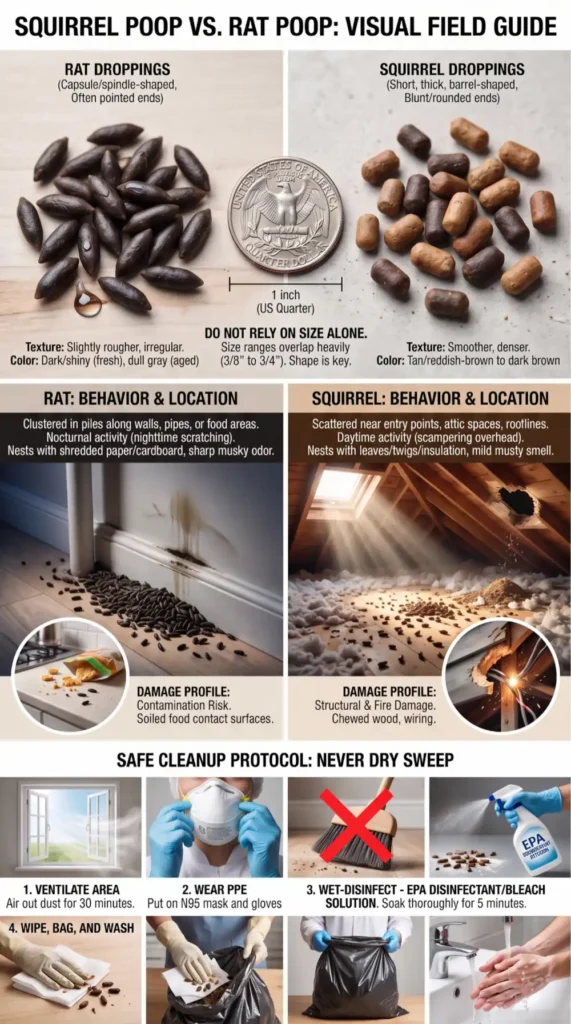
Rat droppings are typically elongated or capsule-shaped and are often concentrated along travel routes, near food, or around nesting areas. Squirrel droppings tend to be shorter, thicker, and more rounded, and may be scattered around an attic, roofline, tree, or feeding area. You can often narrow it down in a few seconds, but some droppings are too similar to identify confidently without looking at the surrounding evidence.
Squirrel Poop vs Rat Poop: Quick Comparison
| Feature | Rat | Squirrel |
| Size | Roughly 1/2 to 3/4 inch | Roughly 3/8 to 3/4 inch (overlaps with rats) |
| Shape | Capsule or spindle, often pointed ends | Rounder, blunter ends |
| Texture | Slightly rougher or less uniform | Usually smoother and denser |
| Fresh appearance | Dark, often slightly shiny | Dark brown to reddish-brown; may be softer when fresh |
| Activity pattern | Often follows repeatable routes | More often scattered between feeding/nesting areas |
| Color | Dark brown to black | Tan to dark brown, lighter when fresh |
| Pattern | Clusters, along walls and near food | Scattered, near entry points or nesting spots |
| Location | Kitchens, basements, walls | Attics, eaves, near trees |
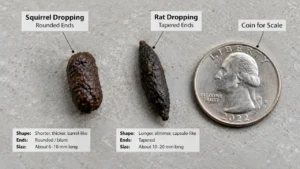
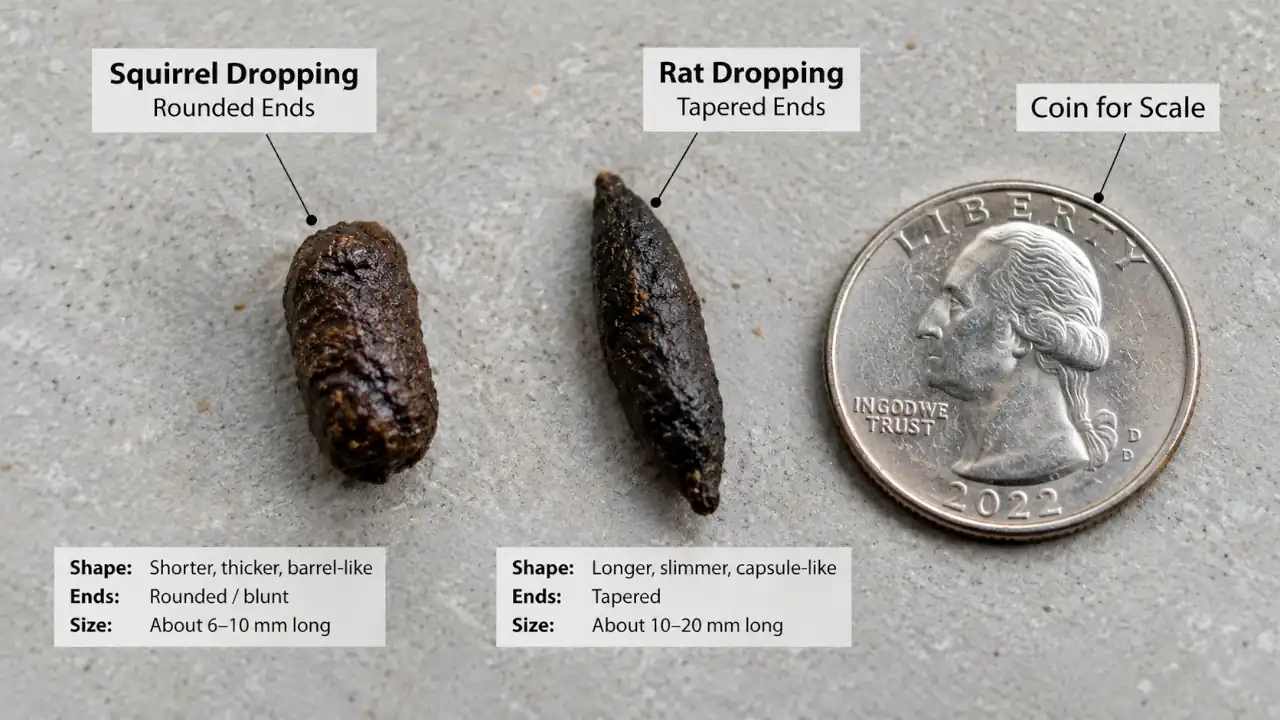
Size overlaps, so don’t judge by size alone. Shape, pattern, and location are the real tells. A big squirrel and a small roof rat can leave droppings that look almost the same in a photo.
Which One Is Actually Dangerous?
Both, but for different reasons.
Bottom line: rats generally raise more concern for household contamination, while squirrels are especially well known for attic and exterior damage. But either animal can create both health and property problems.
Rats generally deserve extra attention when droppings or urine are found around kitchens, pantries, food storage, or other living areas because rodents can contaminate surfaces and food. The CDC explains that disturbing dried rodent urine, droppings, and nesting material can put contaminated particles into the air, which is why how you clean up matters as much as what you found. I’m not going to name a list of specific diseases here, because the risk depends on your region and your situation. The CDC’s guide to cleaning up after rodents is the source I’d trust for that, and it’s worth a read.
Squirrels can be especially damaging to the house. They chew through wiring, insulation, and wood, and chewed wiring in an attic is a real fire risk. I’ve seen repair bills that dwarfed the cost of removing the animal. Squirrel droppings shouldn’t be treated as harmless. The exact health risk depends on the type and amount of contamination and how the material is disturbed. For cleanup purposes, avoid creating dust from either animal’s dried droppings and use appropriate protective measures.
Safe cleanup box
What Does Squirrel Poop Look Like?
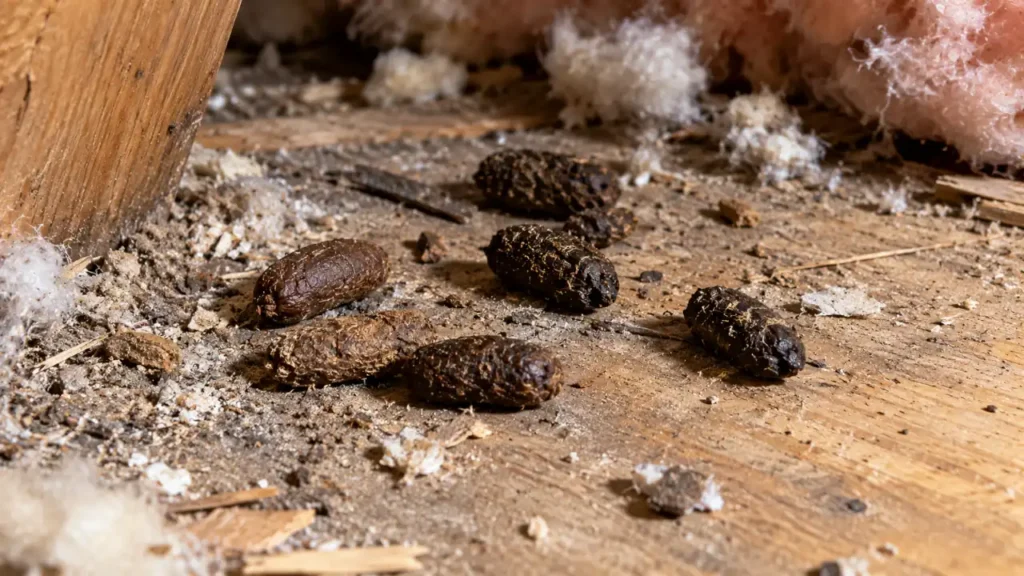
Squirrel poop is usually short, thick, and barrel-shaped, with rounded or blunt ends. It can range from tan or reddish brown to dark brown when fresh and generally becomes lighter and drier with age. The shape and location are more useful for identification than color alone.
Squirrel droppings look like tiny barrels. They’re rounder and stubbier than rat droppings, and both ends tend to be blunt rather than pointed. Most I see are somewhere around 3/8 to 1/2 inch long, though a big fox squirrel can push toward the upper end of that range. They’re thick for their length, which is why they look chunky.
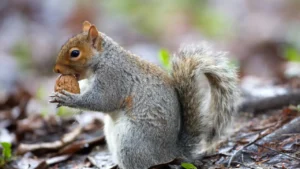
Color is where people get tripped up. Squirrels eat a mix of nuts, seeds, bark, fruit, and sometimes bird feed, and that diet changes the color. Fresh droppings can be tan, reddish brown, or dark brown. They lighten and dry out as they age. Because the color moves around so much, I never use it as the deciding factor.
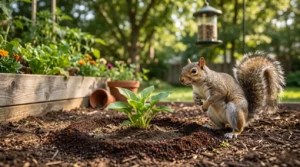
What really helps with squirrels is where and how the droppings show up. They may be spread around an attic, near an entry point, or outdoors beneath trees, along fence tops, on deck rails, and around bird feeders. Outdoors, you may also find squirrel droppings beneath nut-producing trees, around bird feeders, on deck rails, or along other places where squirrels regularly feed and travel. Squirrels don’t usually concentrate their droppings into the same kind of obvious latrine pattern you may see with some rodent activity, but distribution alone isn’t enough to identify the animal.
If the droppings are in your attic but sit close to a hole in the soffit, fascia, or roof vent, and you hear daytime scampering overhead, a squirrel is the likely guest.
What Does Rat Poop Look Like?
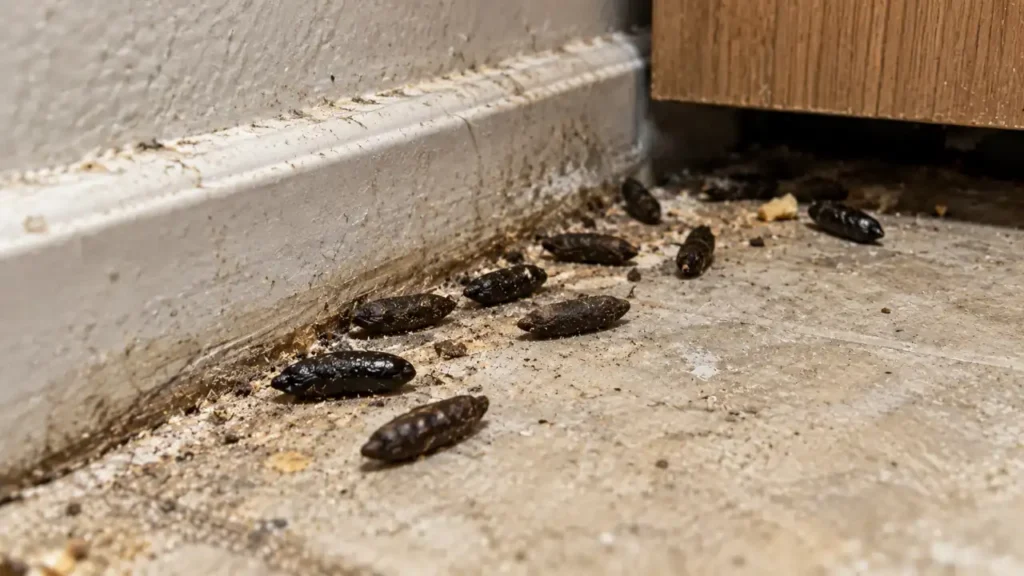
Rat poop is usually longer and slimmer than squirrel poop, with a capsule or spindle-like shape. Roof rat droppings are often smaller and more tapered, while Norway rat droppings tend to be larger and blunter. Fresh pellets are usually dark and may look slightly shiny.
Rat droppings take a little more care because two species show up in most American homes, and their droppings differ.
Norway rats are the stocky ones that live low, in basements, crawl spaces, and burrows. Their droppings run about 3/4 inch long and look like fat capsules, usually with blunter ends. Roof rats are slimmer and love high places like attics and rafters. Their droppings are closer to 1/2 inch and shaped like a spindle, with ends that taper to a point.
Also Read: How To Get Rid of Rats in the Attic (What Really Works)
So “pointed ends” isn’t a hard rule. It’s more common with roof rats, and a Norway rat’s can look quite blunt. What stays consistent is that rat droppings look sleeker and more uniform than squirrel droppings, like dark grains of rice or small olive pits that have been stretched out.
Fresh rat droppings are dark brown to black, often a bit shiny and soft. As they age, they generally dry out, become duller, and may eventually turn gray and crumbly. That can help you estimate whether you’re looking at older or more recent contamination, but it cannot prove that an infestation is inactive. To determine whether the animal is still present, look for new droppings appearing over time, fresh gnawing, tracks, nesting activity, sounds, or other current signs.
One caution: the appearance of droppings can suggest age, but it cannot prove that an infestation is inactive. Old droppings may remain after an animal has moved on, while fresh droppings tell you that there has been relatively recent activity. To determine whether the animal is still present, look for new droppings appearing over time, fresh gnawing, tracks, nesting activity, sounds, or other current signs.
Rats are creatures of habit. They run the same routes along walls, pipes, and joists, and they leave droppings along those routes, plus heavier piles near food and nesting spots. A line of droppings against a wall, or a cluster behind the fridge, is classic rat behavior.
Key Similarities Between Squirrel Poop and Rat Poop
Let’s be honest about why this is hard. The two overlap more than most guides admit.
Both are small, dark, and oval or capsule-like. Fresh droppings from both can look dark brown to nearly black. A large squirrel and a small rat can produce pellets within a few millimeters of each other. Both animals can end up in attics, garages, and sheds, especially when the weather turns cold and they look for shelter.
Both also share the same risks when it comes to cleanup. Dry droppings crumble into dust, and dust is what you don’t want to breathe. And both leave droppings that tell a story only when you read them together with everything else around them.
7 Reliable Ways to Tell Them Apart in Real Life
No single clue is foolproof, especially when squirrel and rat droppings overlap in size and appearance. The best identification comes from putting several clues together and seeing whether they tell the same story. Here’s how I work through them.
1. Size Comparison with Reference Objects
Start with a photo rather than handling the droppings. Put a coin or other familiar object beside them for scale, then use the image to compare their proportions. A quarter is about an inch across, which makes it handy. If the pellets are about half the width of the coin or a bit more, you’re in the range for either animal. If they’re clearly much smaller, you may be looking at mice, which leave droppings about the size of a grain of rice.
It’s not exact, but it helps you notice proportions. Rat droppings look longer compared to their width. Squirrel droppings look blockier.
I always tell people not to trust size alone. The ranges overlap, and published figures vary slightly by species. Use size to narrow things down, then move on to the next clue.
2. Shape and End Texture
Look at the ends. If most of the pellets come to a point at one or both ends, lean toward rat, especially roof rat. If both ends look rounded and blunt, lean toward squirrel.
Don’t pick them up to check. A flashlight and a phone camera zoomed in do the job. Take a photo, enlarge it, and look at the outline. Rat droppings tend to have a slightly rougher, more irregular surface, while squirrel droppings look smoother and denser. You’ll see the difference more easily in a photo than with the naked eye.
3. Location and Trail Patterns
Rats commonly use repeatable routes along walls, pipes, joists, and other protected edges. Squirrels often move between an exterior entry point and an attic or nesting area, so their signs may be concentrated around rooflines, soffits, vents, or the path into the nesting space. Neither animal follows a single pattern every time, which is why the surrounding evidence matters.
Droppings in a kitchen cabinet, behind an appliance, or along a basement wall point to rats. Droppings on a roof, near an eave, or scattered across an attic floor near a gap in the exterior point to squirrels. Outdoors, droppings under a tree or near a bird feeder are far more likely to be squirrel.
4. Amount and Clustering
Think about how each animal lives. A rat stays near a nest and a food source, so droppings pile up in a few spots. A squirrel spends part of its day outside, so droppings are thinner and spread out.
A tight pile in one corner suggests rats. A loose sprinkle across a wide area suggests squirrels. If you find dozens of fresh droppings in one small area, don’t dismiss them as a one-time visit. A concentration of fresh droppings suggests repeated activity in that location, especially if you keep finding new ones after cleaning. At that point, look for the entry point, food source, nesting area, and other signs rather than assuming the animal is simply passing through.
5. Presence of Other Evidence
Droppings are only one clue, and the rest of the scene often decides the case.
Start with sound. Squirrels are generally active during daylight, so daytime running, chewing, and thumping in an attic can fit squirrel activity. Rats are primarily nocturnal, making nighttime scratching and scurrying more consistent with rats. But sound can travel through walls and ceilings, and other animals can make surprisingly similar noises. Flying squirrels are another exception because they are nocturnal. Treat the timing of the noise as one clue, not a diagnosis.
Next, look at gnaw marks. Squirrels can leave substantial chew damage around exterior wood, fascia, soffits, vents, and other entry points. Rats commonly gnaw on food packaging, softer building materials, wiring, and other accessible objects. The size and location of the damage can help, but gnaw marks alone aren’t a reliable species test because tooth marks can vary with the material being chewed.
Then look for the entry point. In an attic, check soffit returns, roof vents, fascia gaps, chimney flashing, and other openings along the roofline if you’re trying to confirm squirrel activity. For rats, check foundation gaps, utility openings, crawl-space vents, garage edges, and other low or sheltered access points. The entry point isn’t proof by itself, but when it matches the droppings, damage, and activity pattern, it can make the identification much more convincing.
Then check for nests and rub marks. Squirrels build nests from leaves, twigs, and torn insulation. Rats prefer shredded paper, fabric, and cardboard. Rats can also leave greasy dark smudges along the walls they travel, because their fur picks up oil and dirt.
Finally, look for food stashes and damage. Squirrels hide nuts and seeds. Rats chew into packaged food and leave gnawed corners behind.
6. Smell Test
Smell the room, not the droppings. Please don’t put your nose over a pile. That’s exactly how you breathe in dust you shouldn’t.
Walk into the space and notice what hits you. Rat problems often bring a sharp, musky, urine smell that gets stronger the longer the rats have been there. Squirrel problems tend to smell milder, more earthy or musty. A strong odor in a closed space usually means a bigger, older infestation.
Use smell to decide whether something deserves a closer inspection, not to identify the animal by itself. A strong odor can tell you that contamination or nesting activity may be significant, but it can’t reliably distinguish rat from squirrel without the other evidence.
7. Seasonal Patterns
Timing can hint at who’s moving in. Rats are active all year, and they push indoors as temperatures drop in fall because your home is warm and has food. Squirrels are also busy in fall as they prepare for winter. Many squirrels breed in late winter and again in summer, so you may see attic nesting activity in those windows.
If you find spring or early-summer attic activity along with repeated daytime sounds and nesting material, squirrels become one possibility worth investigating. If activity increases around food sources and continues at night, rats may be more likely. Season can help establish a pattern, but it shouldn’t override the physical evidence. Season won’t give you a verdict by itself, but it helps you test your guess.
Health Risks and What to Do If You Find Droppings
Treat any unknown droppings as something to clean up carefully, whether they turn out to be squirrel or rat. One important concern with dried rodent urine, droppings, nesting material, and contaminated dust is that disturbing them can put contaminated particles into the air. That’s why the biggest mistake I see is a homeowner grabbing a broom or shop vac and attacking a dry pile. Don’t do either one. Wet-cleaning the material helps reduce the chance of stirring contaminated dust into the air.
Here’s the approach I’d use for a small amount of accessible contamination. First, open doors and windows and let the space air out for about half an hour while you stay out of it. Put on rubber or plastic gloves, and wear an N95 mask as an extra layer. Spray the droppings until they’re soaked with either an EPA-registered disinfectant or a bleach solution made fresh, using 1 part household bleach to 9 parts water.
Let it sit for five minutes, or follow the label. Then wipe everything up with paper towels, drop them in a covered trash can, and disinfect the area around it. Wash your gloved hands, take the gloves off, and wash again with soap and warm water.
Also Read:
If droppings or urine have contaminated loose-fill or other porous insulation, wiping the surface isn’t always enough. Contaminated insulation may need to be removed and replaced rather than simply sprayed and left in place. This is one situation where the size of the contaminated area and how accessible it is should determine whether the cleanup is a DIY job or better handled professionally.
One extra note: if you spot fleas or dead rodents, wear gloves and take appropriate precautions, since rodents can carry fleas and other pests.
If you start feeling sick after exposure, talk to a healthcare provider and tell them about the rodent contact.
When to Call a Professional
A few droppings in an accessible garage corner don’t automatically mean you need professional help. Clean them up safely, then check for signs of an active animal or an entry point.
Call a pro if the droppings are in your attic, crawl space, or wall voids. Call if you find a large amount of droppings or keep finding new droppings after cleanup, especially if you can’t locate the entry point. Call if you hear activity at night or day and can’t find the entry point. Call if you see chewed wiring, torn insulation, or nesting material. Heavy infestations require more precautions than a small, accessible amount of droppings, particularly when contaminated insulation or enclosed spaces are involved.
Cleaning is only half the job. If the animals can still get in, you’ll eventually see new signs again. A proper inspection should identify the entry points, determine which animal is responsible, check for nesting or food sources, and address any damage or contaminated material.
If you’re tempted to use poison because you think you’re dealing with a rat, don’t assume it’s appropriate when squirrels are also a possibility. Rat poison and squirrels can create additional risks for wildlife and pets, so identification should come before choosing a control method.
For homeowners who aren’t comfortable entering an attic or crawl space, who find extensive contamination, or who can’t determine where the animal is getting in, professional help is a reasonable next step. The goal isn’t simply to remove the droppings. It’s to identify the animal, correct the access point, and make sure the problem is actually resolved.
Final Thoughts
So, how do you tell squirrel poop vs rat poop in 10 seconds? Look at the shape, the pattern, and the location. Rounder, thicker pellets found around an attic entry point, roofline, tree, or feeding area can point toward squirrel. Darker, elongated pellets concentrated along walls, travel routes, food areas, or nesting sites can point toward rat.
The strongest identification comes when the droppings match the location, activity pattern, entry point, gnaw marks, and other evidence. Size can help, but because the ranges overlap, treat it as the weakest clue, not the strongest.
Remember the distinction too. Rats generally raise more concern for household contamination, while squirrels are especially well known for attic and exterior damage. But either animal can create both health and property problems, so neither one is something to ignore. Clean up carefully with a wet method, wear protection, and never sweep dry droppings.
Then look for the cause, because droppings are the symptom and the entry point is the problem. If the mess is in your attic or there’s a lot of it, get a professional to take a look. It’s cheaper than finding out the hard way.