If you found this page because you walked into your backyard and froze at the sight of a coiled, copper-colored snake, welcome — I get it. Copperheads are the kind of wildlife sighting that makes a normally calm person tense up, and for good reason: they’re venomous, well-camouflaged, and often show up in places where people don’t expect them. That said, copperheads are also part of the local ecosystem and removing them humanely is almost always the best long-term plan.
I’ve dealt with copperhead situations in suburban yards, rural properties, and wooded neighborhoods for years. They’re venomous, extremely well camouflaged, and often show up where rodents and shelter are easy to find. The good news? In most cases, you can solve the problem without killing the snake — and without turning your yard into a chemical war zone.
This guide explains how to get rid of copperhead snakes humanely, what actually works in real yards, what doesn’t, and when you should bring in a licensed professional.
Also Read: Spadepestcontrol blog
How To Get Rid of Copperhead Snakes
The most effective way to get rid of copperhead snakes is to remove yard clutter, eliminate rodent activity, seal gaps under structures, and reduce moisture and hiding areas. Repellents alone rarely work. If a snake is inside or repeatedly seen, contact a licensed wildlife professional for humane removal.
What Are Copperhead Snakes?
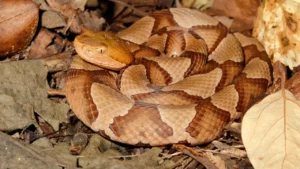
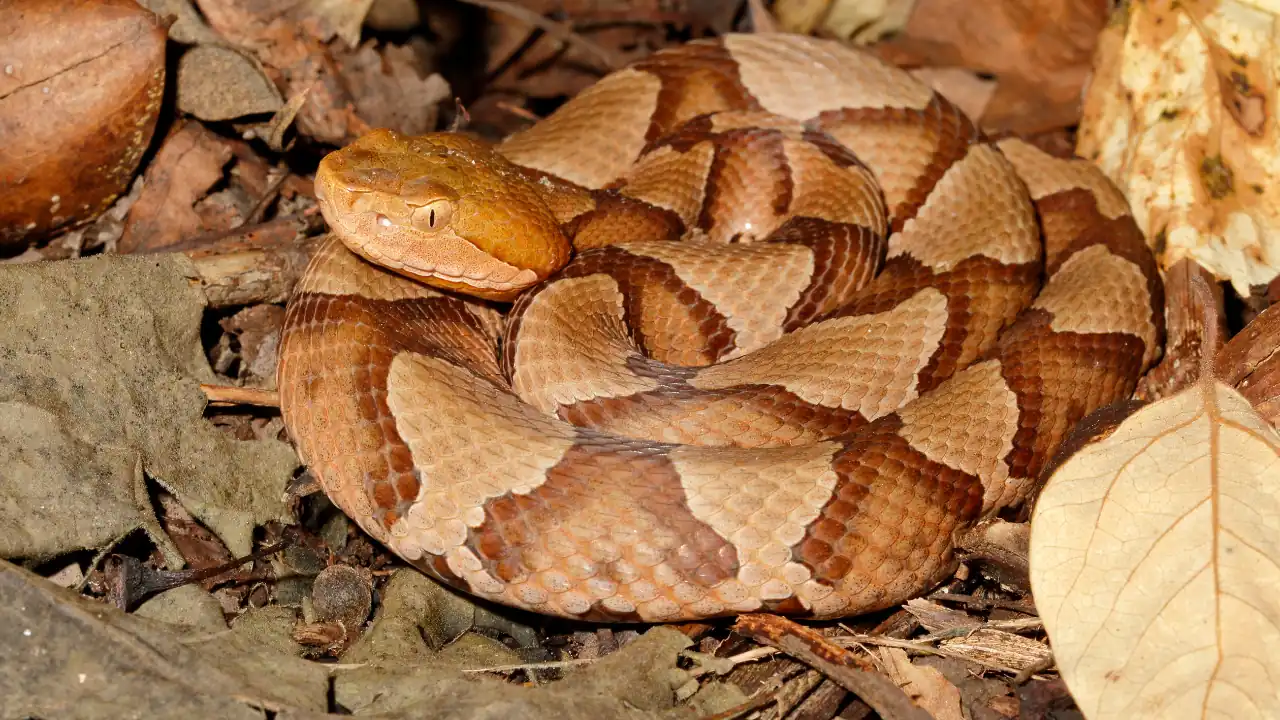
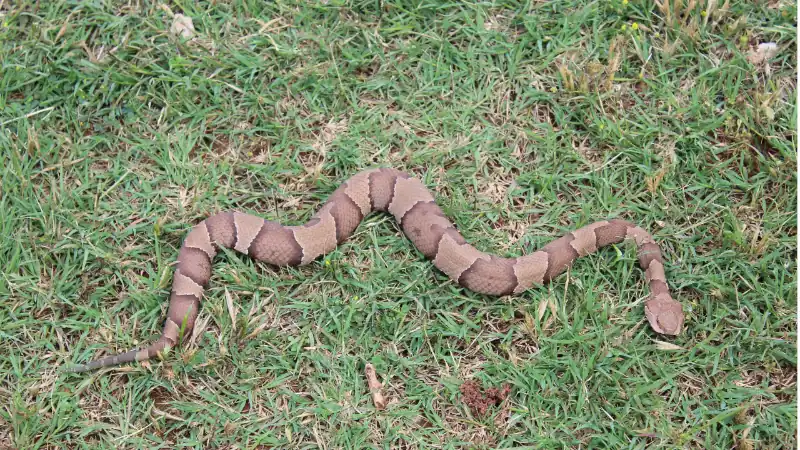
Copperheads (scientific name Agkistrodon contortrix) are venomous pit vipers found across much of the eastern and central United States. They have a stout body, a triangular head, and a distinctive pattern of darker hourglass-shaped bands across a lighter background that blends perfectly into leaf litter and brush.
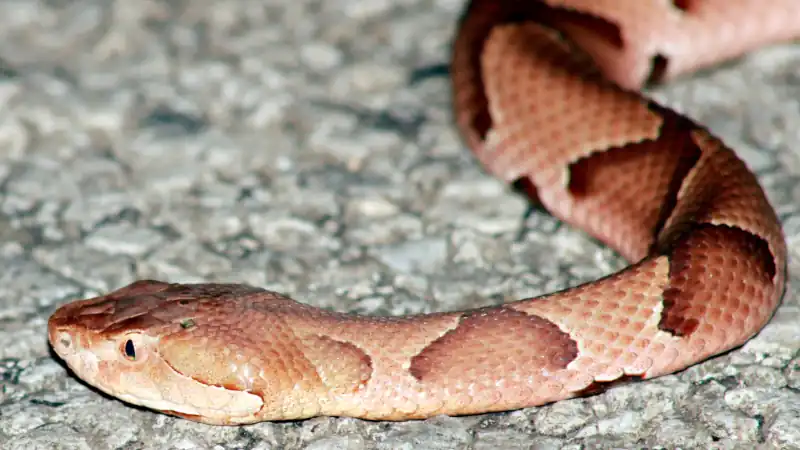
Young copperheads often have a bright yellow or greenish tail tip that they wiggle to lure small prey. They belong to the pit viper family, which means they have heat-sensing pits between the eyes and nostrils to detect warm-blooded prey.
Quick Tip: If you’re not sure whether a snake is a copperhead, keep your distance and take a clear photo from where you are. That keeps you safe and makes identification accurate.
Are They Dangerous?
Yes, copperheads are venomous and should always be treated with caution. That said, their venom is generally less potent than that of some other pit vipers, and bites are rarely fatal to healthy adults if medical care is sought promptly. Most copperheads prefer to avoid people and will only bite when accidentally stepped on or deliberately provoked. They also sometimes deliver “dry bites” that inject little or no venom. Still, any bite from a venomous snake is a medical emergency.
Quick Tip: If a bite happens, call emergency services right away. Do not try folk “treatments” like cutting, sucking, or applying ice. Keep the person calm, immobilize the bitten limb, and get professional care.
Where To Find Them in Your Yard
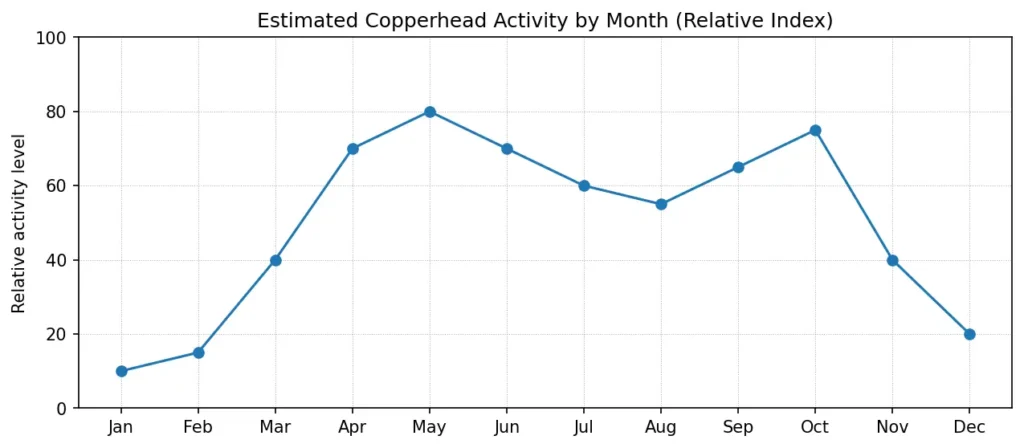
Knowing when copperheads are most active helps homeowners stay alert and focus prevention efforts during peak months.
Copperheads are ambush hunters and excellent at blending into natural debris. In a typical suburban yard, you’ll most often find them in shaded, humid, or cluttered spots: leaf piles, rock and wood stacks, compost heaps, the edges of stone walls, under decks and sheds, tall uncut grass, near water features, and in brushy borders where rodents and frogs live.
They also like warm, sheltered hiding places in spring and cool, damp spots in summer. If you have a pond, poorly kept woodpile, or thick ground-cover near the house, those are the first places to check — carefully. State extension publications and wildlife agencies document these typical microhabitats and note how copperheads exploit human-made features of yards.
Real-World Example: Backyard Deck in North Georgia
A homeowner in north Georgia called after seeing a copperhead under their elevated deck three evenings in a row. The yard backed up to woods, and they had a decorative pond, a loosely stacked firewood pile, and thick ivy groundcover along the fence line.
During inspection, we found heavy rodent activity in the woodpile and frogs around the pond edge. The copperhead wasn’t “living in the yard” — it was following food.
We removed and restacked the woodpile on a raised rack, trimmed back the ivy, cleared leaf litter under the deck, and sealed the deck skirting gaps. Rodent control was implemented in the shed.
Within two weeks, sightings stopped.
In my experience, about 80% of residential copperhead encounters trace back to food and shelter — not random aggression.
Lesson: Habitat modification works. Killing one snake would not have solved that yard’s problem.
How To Get Rid of Copperhead Snakes
Below I’ll walk through the practical steps that reduce the chances copperheads will take up residence on your property. Think of this section as a plan you can implement across a weekend and then maintain seasonally.
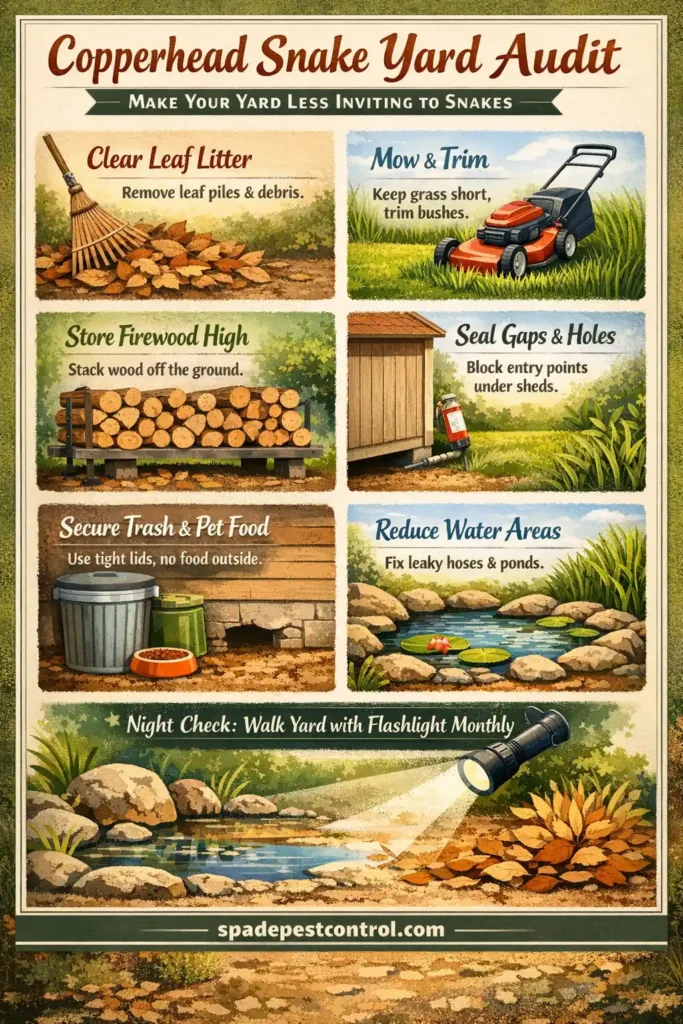
Most copperhead problems start with simple yard conditions like leaf piles, tall grass, or accessible food sources. Fixing these issues removes the reason snakes stick around in the first place.
Take Care of Your Yard
Start with the basics: a tidy yard is a less attractive yard for copperheads. Rake and remove leaf litter, especially in shady gardens. Trim groundcover and keep grass short; tall grass gives snakes cover and a runway for rodents.
Move firewood off the ground and stack it in a neat pile away from your house — elevated stacks are far less attractive to snakes. Repair gaps under porches and sheds where snakes can slip in. Store garden materials and children’s toys in bins with tight lids so mice don’t nest inside them.
Quick Tip: Walk your property with a flashlight in the evening once or twice a month — that’s when copperheads are active in many seasons. Spotting and removing small brush piles or clutter gives immediate results.
Why this works: Copperheads are ambush predators. Remove their cover and the places they like to hide, and they’ll move on. This is the single most effective and human-first strategy.
Get Rid of Their Food Sources
Copperheads follow prey. If your yard has lots of small mammals, frogs, or large insects, you are essentially running a snake buffet. Seal easy rodent entry points into garages and sheds, pick up pet food at night, secure compost bins (or keep them farther from living areas), and make your yard less hospitable to frogs by limiting standing water and dense groundcover.
Quick Tip: Install metal or concrete edging around ponds and keep pond edges clear of heavy vegetation. That reduces frog habitat and, in turn, copperhead interest.
Why this works: Removing food reduces the ecological reason for copperheads to stick around. Over time, fewer prey animals equals fewer snakes.
Put Down Snake Repellent (and what to expect)
You’ll see products advertised under names like “Snake-Away” or “Shake-Away.” The idea is attractive — sprinkle something and snakes go elsewhere — but the scientific record and expert analyses are mixed at best.
Controlled studies and snake specialists often find repellents give inconsistent results, may harm non-target wildlife, and can deteriorate quickly with rain. Some products work in very specific, limited circumstances; many do not repel reliably in a real yard. If you try a repellent, use it as one small part of a multi-step approach (yard cleanup, removing food and cover), not the whole plan.
In nearly two decades of field work, I have never seen a repellent solve a copperhead problem on its own. At best, it may create short-term avoidance. At worst, it gives homeowners a false sense of security while the real attractants remain.
Quick Tip: If you try a repellent, apply it to foundation gaps or the edge of a defined barrier and reapply after heavy rain — and keep expectations low.
If you want the short truth: Repellents are not a reliable replacement for habitat modification. They sometimes make homeowners feel better, but they don’t replace removing brush, sealing gaps, and reducing rodents.
Consider Using a Snake Trap
Live trapping is an option if you want to remove a specific snake humanely. There are commercially available live traps sized for snakes and methods that experienced handlers use: funnel traps placed along walls or drift fences, or simple box traps baited with live prey (in many places using live animals as bait is illegal or regulated — check your local rules). If you use a trap, check it at least daily. Never use glue traps or inhumane methods.
Quick Tip: If you’re not trained, hire a pro. Live-trapping venomous snakes is risky and requires the right equipment and insurance.
Important: Move trapped snakes only as allowed by local laws and wildlife regulations — many states prohibit transporting or releasing wildlife without authorization. Relocating a snake too far from its home range can also doom it. Always check local wildlife agency guidance first.
Should You Kill Them?
Short answer: don’t. Killing snakes creates ecological imbalance and often makes the problem worse. Remove a predator like a copperhead, and prey populations such as mice and rats can surge, attracting more snakes. From a practical standpoint, killing a snake can be dangerous, may be illegal in many states, and is unnecessary in the vast majority of cases. Many wildlife and extension agencies explicitly advise against killing snakes unless a person’s life is in immediate danger.
In real-world situations, attempting to kill a venomous snake is when most bites occur. I’ve responded to more than one call where the injury happened during a homeowner’s attempt to “handle it themselves.”
Quick Tip: If a copperhead is on your porch or inside, the safest immediate action is to keep everyone away, close doors if possible, and call a licensed wildlife removal expert.
Keeping Copperhead Snakes Away in the Future
Once you complete the initial cleanup and rodent-proofing, keep a simple maintenance schedule: mow weekly in the growing season, clear leaf litter in fall, stack and rotate firewood periodically, and inspect foundation vents and shed gaps each spring.
Consider a gravel or mulch perimeter (3–6 feet) around foundations — copperheads and rodents dislike loose, hot gravel right along walls. If your yard is high-risk because it borders woods or wetlands, a professionally installed snake-proof fence angled outward can be an effective long-term barrier. Remember, a long-term success in how to get rid of copperhead snakes comes down to consistent maintenance.
Quick Tip: Set a recurring calendar reminder for a seasonal “snake audit” — 20–30 minutes is enough to keep your yard unattractive to snakes.
Does Snake Away Work on Copperheads?
Products sold as “Snake Away” or similarly named repellents have been tested by different parties with mixed outcomes. The consistent expert takeaway is this: repellents are not a guaranteed solution.
They may work in limited, controlled situations but won’t fix the underlying attractions that bring copperheads in the first place, like abundant rodents and leaf litter. Relying solely on a repellent is a common homeowner mistake. Use repellents, if at all, as a short-term supplement to solid habitat fixes and professional guidance.
Humane Capture & Relocation — Realities & Ethics
If you plan to capture and relocate a copperhead, know two important things. First, legality varies widely. Some states allow relocation with a permit; others restrict removal or prohibit transporting wildlife.
Second, relocated snakes often suffer if moved far from their home range — they can become disoriented, struggle to find food, or become more vulnerable. For these reasons, humane wildlife professionals usually follow strict protocols: they check state laws, capture with proper tools, and relocate within a sensible distance to suitable habitat when permitted. If you’re not experienced, your best choice is to call someone who is.
Why professionals? Trapping, handling, and transporting venomous snakes requires training, protective gear, liability insurance, and knowledge of both the animal’s needs and local regulations. Expect experienced pros to charge for safety and compliance — it’s money well-spent when venomous wildlife is involved.
When To Call a Professional
Call a licensed wildlife removal company when the snake is inside a structure, when there are repeated sightings, when you don’t feel safe handling traps, or when there’s a young child, pet, or an elderly person in the household. A trained pro can assess whether the snake is likely to be resident or just passing through, set up humane traps if appropriate, and advise on permanent yard changes.
If your state has a wildlife agency that will remove venomous snakes, that’s often the best free resource. Otherwise, look for local wildlife control professionals who are insured, fully licensed, and who use humane, documented methods.
Most copperheads found in yards are passing through. But if you see the same snake multiple times in the same location, that’s when a professional inspection makes sense. For more information contact spadepestcontrol.com.
What To Expect During Professional Removal
A credible service will first ask questions: where the snake was seen, when, and if there have been multiple sightings. They’ll conduct a property inspection, find and remove attractants, and then either capture the snake live or deter it from the immediate area. If the snake is captured, the pro will tell you whether they will relocate it and where, or whether they must hand it to the wildlife agency. Expect a written summary and recommendations for preventing future encounters.
Aftercare: What to Do If You Keep Seeing Copperheads
If sightings persist after you’ve cleaned the yard and removed food sources, there may be a deeper reason: a nearby storm drain, neighbor’s woodpile, or a nearby wetland that keeps drawing prey. Do another sweep with a focus on the edges of your property where yard meets wild habitat. At that point it’s time for either more intensive exclusion work (foundation sealing, fencing) or a professional wildlife ecologist’s inspection.
Myths and Mistakes — What Not to Do
Don’t try to handle copperheads without experience and the right tools. Don’t assume that all patterned, brown snakes are copperheads — many harmless species mimic that look. Don’t pour gasoline or chemicals into burrows. Don’t rely on snake repellent as your only fix. Don’t release a trapped snake across town without checking local laws and ecological consequences. These are the shortcuts that lead to tragedy for people or animals.
Why Leaving Some Snakes Alone Helps You
Copperheads eat rodents and keep populations of mice and rats in check. Removing every predator makes pest control harder in the long run. Humane removal and habitat modification are about balancing human safety with preserving the ecosystem services snakes provide. When you reduce what attracts them, you protect your family and keep the balance of your yard’s ecosystem intact.
Daily & Seasonal Checklist
Do a 10–20-minute yard sweep at least monthly: look for leaf piles, tidy the woodpile, pick up fallen fruit or pet food, check under decks, and inspect pond edges. In spring and fall, clear heavy debris and trim borders. After storms, inspect for new brush piles or soggy areas that could attract prey.
Frequently Asked Questions About How to Get Rid of Copperhead Snakes
Conclusion
Copperheads are a real concern in many backyards, but learning how to get rid of copperhead snakes the right way means focusing on habitat and safety — not fear. The best approach is humane and practical: reduce cover and food, rodent-proof your property, employ live trapping only when appropriate and legal, and call a trained professional when you need help. Repellents like Snake-Away rarely solve the core problem on their own — think of them as a possible short-term supplement, not a fix. In the long run, a tidy, dry yard with fewer places for rodents to hide is the most reliable way to keep copperheads away without causing harm.
View Sources
- University of Georgia — CAES: Natural History Series: Copperhead. Good for species behavior and habitat.
- Live Science — Copperhead snakes: Facts, bites & babies. Overview of venom, bites, and safety.
- Animal Diversity Web — Agkistrodon contortrix. Species account; identification and natural history.
- CDC Snakebite — Venomous Snakes at Work.