
When people say they found “bed bug nests,” they are usually talking about the places bed bugs hide, breed, and leave behind a mess of clues. That matters, because bed bugs do not act like ants or bees. They do not build a single neat nest with one obvious center. Instead, they gather in tight hiding spots close to where people sleep, then spread into nearby cracks, seams, furniture, and clutter. That is why an infestation can feel confusing at first. You may see a bite, a stain, or one live bug, but not the full picture.
The good news is that once you know what to look for, bed bug harborages are easier to spot than most homeowners expect. You are looking for a mix of live bugs, eggs, shed skins, dark fecal spots, and sometimes rusty blood stains or a faint musty odor. These signs usually cluster around beds first, but they can also show up in couches, wall cracks, outlets, books, furniture, and other tight hiding places. In other words, the clue is not just the bug. It is the pattern around it.
Also Read: How Long Can Bed Bugs Live Without Food from a Host?
Quick Answer: Bed Bug Nests
Bed bugs do not build true nests. What people call “bed bug nests” are usually harborages—tight hiding spots where bed bugs gather, lay eggs, shed skins, and leave fecal spots. These are most often found in mattress seams, box springs, bed frames, nearby furniture, wall cracks, and clutter close to where people sleep.
Do Bed Bugs Have Nests?
Not in the way most people think. Bed bugs do not build a classic nest like ants, termites, bees, or birds. What they do have is a harborage, which is a protected hiding place where they rest, digest, molt, mate, and lay eggs. In a light infestation, that harborage may be tiny and easy to miss. In a heavy infestation, there may be several of them spread around the home, which is why it can feel like the bugs are coming from everywhere at once.
Quick Tip: When you are trying to locate bed bugs, stop thinking in terms of one nest and start thinking in terms of hiding zones. Bed bugs usually stay close to where people sleep, so the first place to inspect is the bed itself, then the area around it, then the clutter just beyond it. That simple shift saves a lot of time.
Bed bugs are also expert hitchhikers. They can move in luggage, clothing, furniture, and other belongings, and they squeeze into very small spaces because their bodies are flat and narrow. That is why bed bugs are not just a bedroom problem. They can show up in apartments, houses, hotels, dorms, and any place where people sleep or rest.

MGK Crossfire® Bed Bug Concentrate
If you are checking belongings near the bed, it helps to think beyond the obvious. Books sitting beside a bed can hold bed bugs in tight seams and along hard edges, especially when clutter is present. Electronics can also become hiding spots because bed bugs fit into tiny gaps and have been found in appliances and receptacles. Wood furniture is another common place because cracks, joints, screw holes, and unfinished edges give them the cover they want.
What Does a Bed Bug Nest Look Like?
What most people call a bed bug nest usually looks more like a dirty, tight cluster than a real nest. You may see tiny white eggs, pale shell casings, live bugs at different stages, black or reddish-brown spotting, and sometimes a few dead bugs mixed in. The area often looks stained, slightly gritty, or just “off” compared with the rest of the furniture or fabric. On fabric and seams, the dark spots may look like ink dots or tiny smears. On wood or hard surfaces, they can look like pepper-sized specks or dried residue.
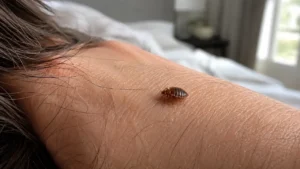
A bed bug cluster can be easy to miss because the insects themselves are small, flat, and built to disappear into seams and cracks most homeowners would never think to inspect on a first pass. Adult bed bugs are about apple-seed sized, while nymphs are much smaller and lighter in color. Eggs are tiny and sticky, which helps them cling to surfaces. That is why you should not rely on a quick glance. You need light, patience, and a close look at seams, edges, joints, and hidden corners.
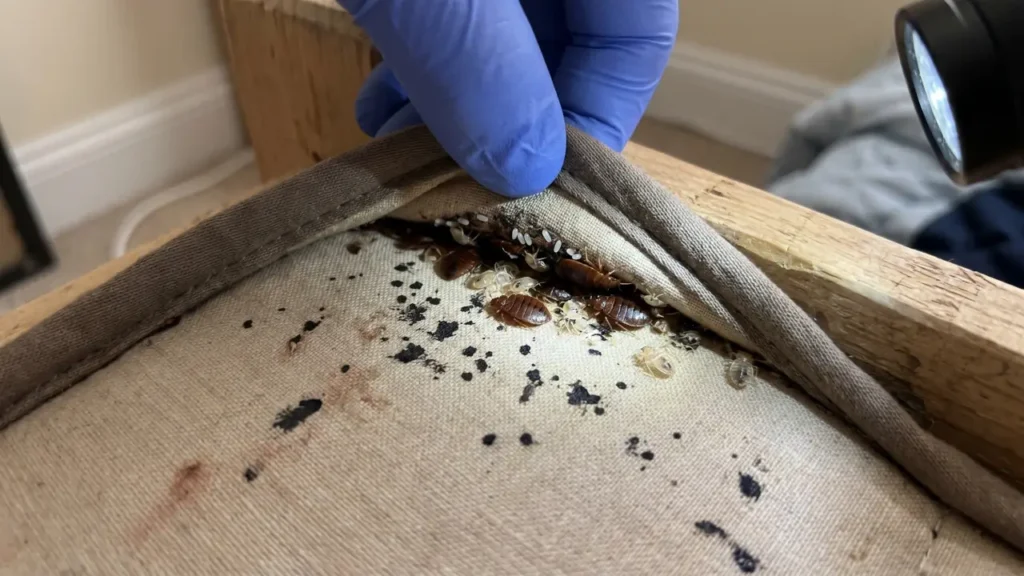
If you are trying to identify baby bed bugs, look closely for tiny, straw-colored or pale nymphs that resemble miniature adults. In a real harborage, you will usually find different life stages together, because bed bugs do not all develop at the same pace. That mix of eggs, nymphs, adults, and cast skins is one of the clearest signs that you have found the source rather than a random stray bug.
A true bed bug harborage often has a faint odor too, especially when the population is larger. People describe it as musty or sweet, but smell alone is not reliable. It is better used as a clue that pushes you to inspect more carefully, not as proof by itself. The solid proof comes from finding the bugs or their signs.
Bed Bug Nest Pictures: What Homeowners Usually Notice First
These examples show what homeowners commonly call a bed bug nest, although pest professionals refer to these hiding places as bed bug harborages.
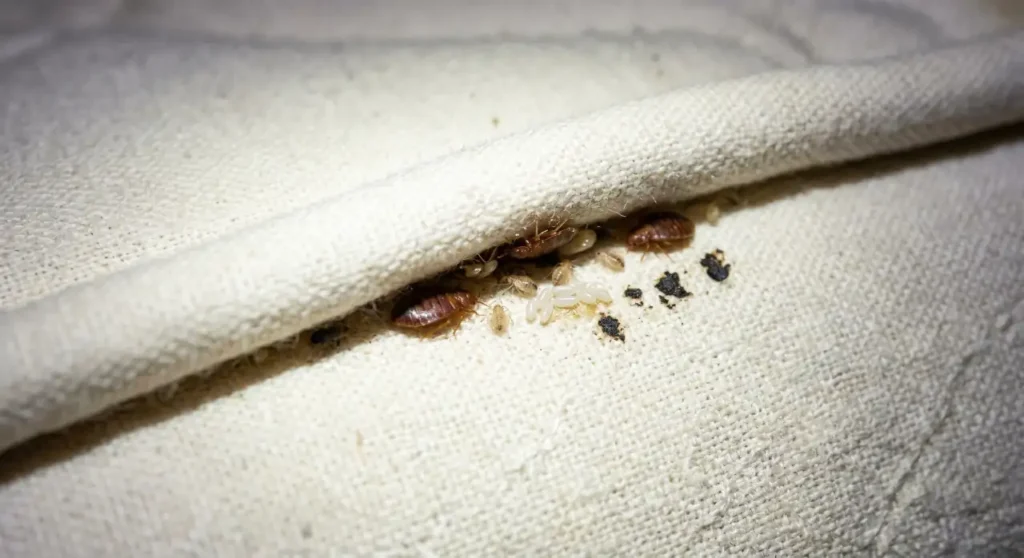
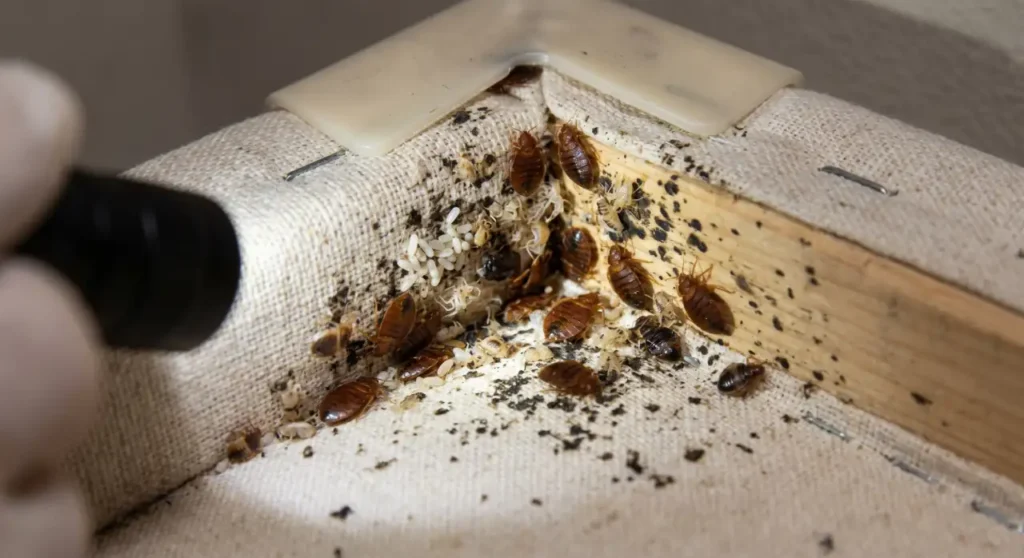
One thing that surprises people is how rarely they discover a bed bug harborage by spotting a large group of bugs.
In most homes, the first clue is usually something small. It might be a few dark spots along a mattress seam, a pale shed skin stuck in a corner of the box spring, or a single bug hiding near a bed frame joint. The actual harborage often stays hidden until someone starts pulling furniture apart or checking places they normally ignore.
In heavier infestations, the signs become harder to miss. You may find clusters of eggs, multiple shed skins, dark staining, and bed bugs packed tightly into cracks where they have been gathering for weeks or months.
A common mistake is expecting a bed bug nest to look obvious. Most do not. The hiding place often looks more like a dirty crack or stained seam than something homeowners would immediately recognize as an infestation.
Signs You Found the Main Bed Bug Nest
Finding one bed bug does not necessarily mean you have found where the infestation is centered.
A stray bug can wander away from the main harborage, especially after feeding or when the hiding place has been disturbed. What you are really looking for is a concentration of evidence. When you start finding eggs, shed skins, dark fecal spotting, and multiple life stages in the same location, you are usually getting close to the source.
In many homes, the main harborage is not on the sleeping surface itself. It is often tucked into a protected area nearby, such as a box spring corner, a headboard attachment point, or a crack in the bed frame where the bugs can stay hidden during the day.
How To Find Bed Bug Nests
Start where people sleep, because that is where bed bugs usually group first. Inspect the mattress seams, tags, piping, pillows, blankets, comforters, box spring, bed frame, and headboard. Then move outward to nearby furniture, wall hangings, window frames, curtains, and electrical areas. The EPA’s bed bug guidance consistently points homeowners toward cracks, crevices, mattress seams, and nearby furniture because bed bugs flatten their bodies and hide in spaces most people overlook during a quick inspection.
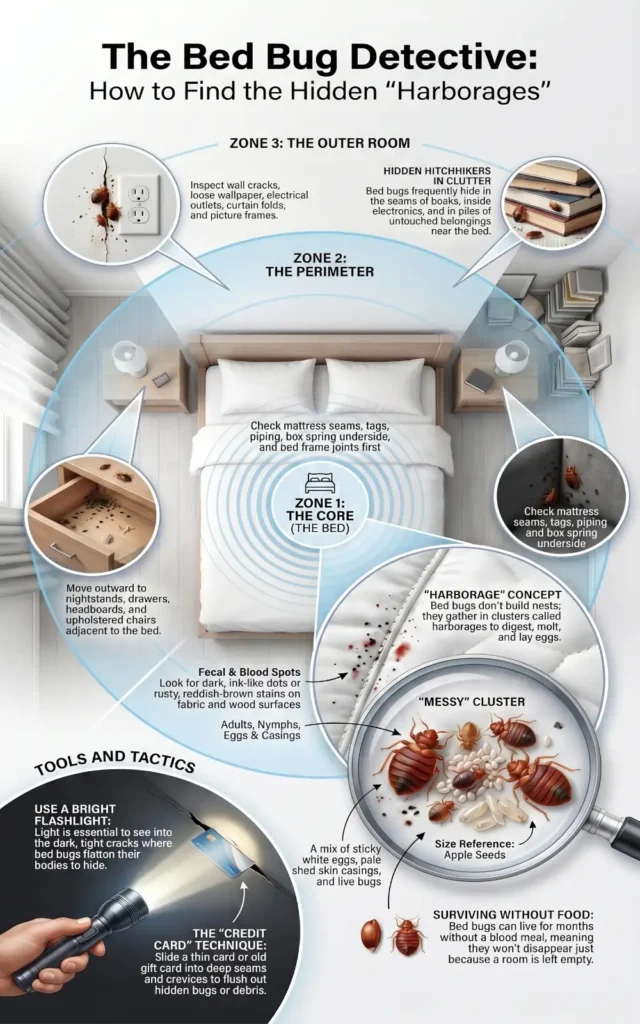
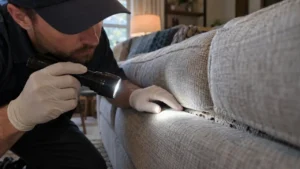
A flashlight helps, and so does patience. Pull bedding back slowly. Turn the mattress edge up. Check the underside of the box spring. Look along the bed frame joints, screw holes, and corners. If you find one bug or one stain, keep going in that same area, because bed bugs rarely travel alone in a neat line. They cluster where they feel protected.
A bright flashlight is usually enough, but a thin card, old gift card, or similar flat edge can also help you check tight seams and cracks without damaging the material. If the infestation seems light, a simple magnifying glass can make eggs and young nymphs easier to spot.
Common mistake: Many homeowners stop after checking the mattress surface, but the real harborage is often in the box spring, bed frame joints, or the furniture right beside the bed.
Quick Tip: Search in a circle, not in a straight line. Begin at the bed, then inspect the nightstand, nearby chair, baseboards, wall cracks, and nearby clutter. That pattern mirrors how bed bugs spread from their main hiding spot into the room around them. It is much easier than bouncing randomly from one object to another.
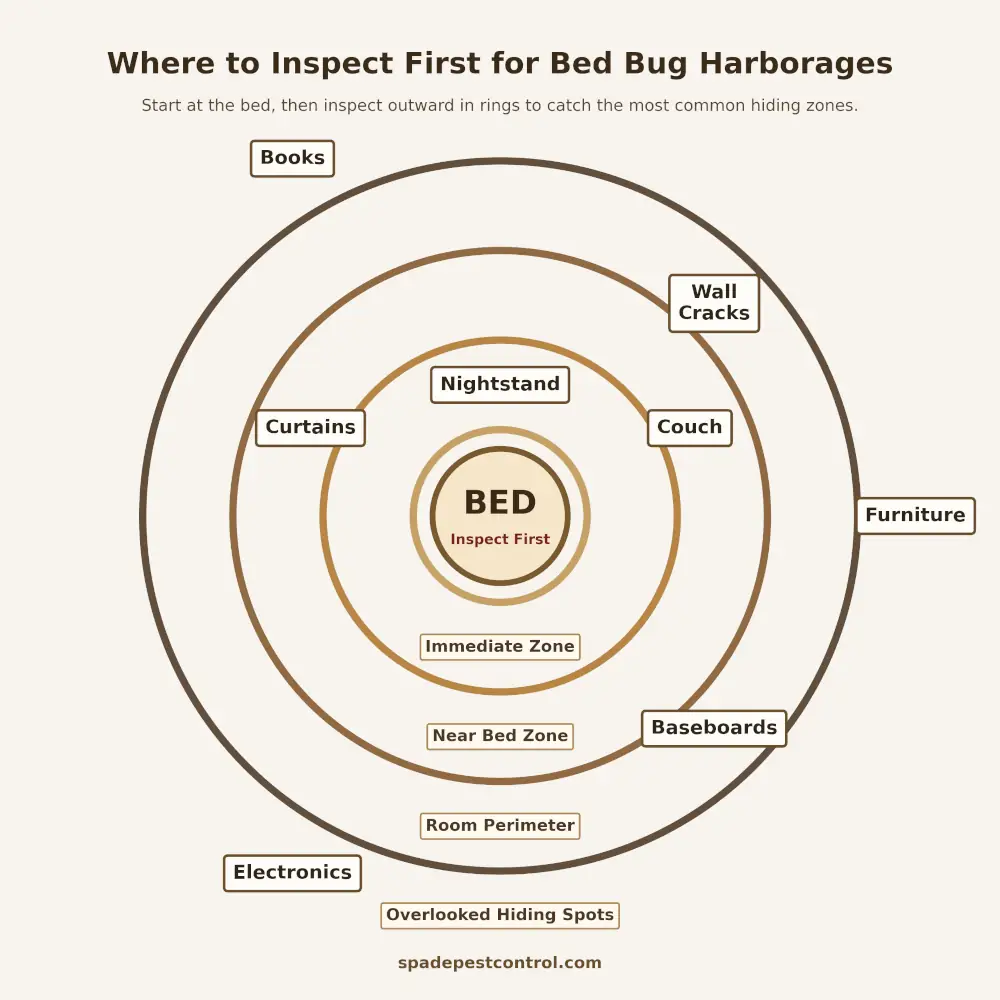
Do not skip items people tend to overlook. Bed bugs can hide in furniture seams, drawer joints, behind wallpaper, in wall voids, and in electrical receptacles or appliances. They have also been found in clutter and belongings such as books, paper items, and electronics, especially when those items sit close to sleeping areas or remain untouched for a long time.
In heavier infestations, it is also worth checking framed wall art, curtain folds, loose baseboards, and nearby rugs or upholstered chairs, especially if they sit close to the bed or sofa.
In stubborn or widespread infestations, it can also be worth checking door hinges and even nearby smoke detectors if they are close to a regular sleeping or resting area.
When you are checking wood furniture, pay extra attention to screw holes, joints, underside seams, and any unfinished crack in the wood. Bed bugs love the shelter that wood furniture gives them because it has all the tiny protected spaces they need. Furniture with lots of joints or decorative trim can hide more than a plain metal frame.
And when you are checking electronics, be careful and methodical. The goal is inspection, not damage. Do not open powered devices or remove outlet covers unless you know how to do it safely. Bed bugs do not eat electronics, but the small gaps, vents, and protected edges around them can make them a resting spot. The same logic applies to cluttered shelves, power strips, and devices stored near the bed.
If you are looking through clutter, remember that the more items you have piled around the sleep area, the harder inspection becomes. That is one reason bed bug problems last longer in crowded rooms. The bugs are not only hiding in the obvious places. They are hiding in the stuff around the obvious places.
They are usually far less likely to start in bathrooms, kitchens, garages, or unfinished basements unless people regularly sleep or rest there, so focus your time first on the places where someone sits or sleeps for long periods.
When Do Bed Bugs Usually Leave Their Nests?
Bed bugs usually leave their hiding places when they need a blood meal, when they are disturbed, or when a location becomes too crowded. They do not wander around all the time for no reason. Most of the day, they stay tucked away in harborages near the host. They are most active when they sense a sleeping person nearby, but hungry bugs can also feed in daylight if the opportunity is there.
They also leave when conditions force the issue. If a harborage is disturbed by cleaning, vacuuming, heat, treatment, or movement, bed bugs may scatter into nearby cracks or adjacent rooms. Females may also spread to new hiding spots as they look for places to lay eggs. This is one reason a partial cleanup can sometimes make the problem look worse before it gets better.
Another thing people get wrong is the idea that bed bugs must feed every night. They do not. They can go a long time without food, which is one reason infestations hang around so stubbornly. In real homes, adults and older nymphs can survive for months without feeding, and in cooler conditions even longer. That is why bed bugs do not simply disappear if a room is empty for a little while.
If you are trying to understand why an infestation seems to “come back,” it helps to know that they can live for a while without food. Bed bugs are built to wait. They do not need a meal every day, and that makes them a much tougher target than many homeowners expect.
Why Is Finding Bed Bug Nests So Important?
Because if you miss the hiding place, you miss the infestation. A few bugs in one mattress seam can become bugs in the bed frame, then the nightstand, then the sofa, then the luggage, and eventually other rooms. Bed bugs are efficient hitchhikers, and the CDC notes that they spread by moving in belongings like luggage, bedding, furniture, and other items where they can hide. Early detection makes control much easier.
The reason this matters so much is simple. Bed bugs reproduce inside those harborages. Females lay multiple eggs over time, nymphs go through several molts before adulthood, and all of those stages can exist together in one hiding spot. If you only treat the bugs you see and ignore the source, the population will keep rebuilding.
Also Read: What Eats Bed Bugs at Night? Hidden Predators Revealed
That is why it is worth understanding how fast bed bugs spread. Once the infestation is established, it is not just a “few bites” issue anymore. It becomes a room-by-room inspection problem, and in some cases a whole-home problem. The sooner you locate the harborages, the more likely you are to stop the spread before it gets out of control.
There is another reason this search is so important. Bed bug bites are not a reliable confirmation by themselves. Some people do not react at all, others react late, and bite marks can look like mosquito bites, rashes, or other skin issues. So if you rely only on bites, you may keep guessing while the bugs keep multiplying. Finding the signs in the room is much more dependable.
What We Commonly Find During Bed Bug Inspections
In real inspections, the mattress is often not the main harborage. More often, we find larger concentrations inside box springs, behind headboards, inside bed frame joints, and around furniture close to the bed.
One apartment inspection looked completely clean on the surface. The homeowner had already checked the mattress several times. The actual harborage was hidden inside a hollow metal bed frame near the headboard, where dozens of bed bugs, eggs, and shed skins were packed into a narrow gap.
This is why experienced inspectors spend more time checking hidden structural areas than visible fabric surfaces.
Final Thoughts
If you remember only one thing, make it this. Bed bug nests are not true nests. They are harborages—hidden clusters near sleeping areas where bed bugs rest, reproduce, and leave behind visible signs. The signs are usually small, but they are not invisible. Look for eggs, shell casings, fecal spots, blood stains, live bugs, and tight hiding places in beds, furniture, wall gaps, and clutter.
The smartest approach is slow, careful, and methodical. Start at the bed, inspect outward, and do not stop at the first bug you see. In real homes, the people who find bed bugs fastest usually stop chasing bites and start looking for clusters of evidence in the room itself. Bed bugs spread through the places people sleep and the items they carry, which means thorough inspection matters as much as treatment. If you are finding signs in multiple rooms, if bugs keep showing up after cleaning, or if you live in an apartment or shared-wall home, a professional inspection is often the fastest way to find every harborage before the infestation spreads further.