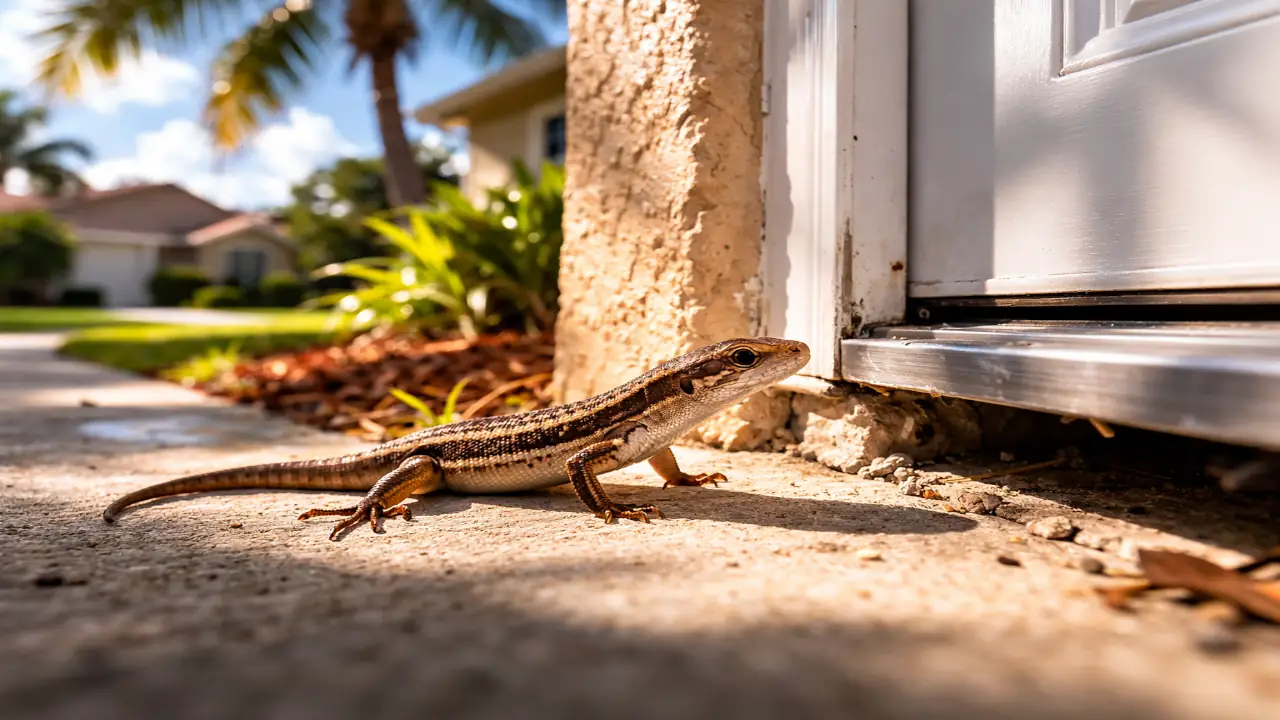
If you’ve started noticing small, fast lizards darting across your patio or slipping into your garage, you’re not alone. I’ve had homeowners call me in a panic thinking they had baby snakes in the house — only to discover it was a growing skink population nesting under mulch near the foundation.
Skinks aren’t aggressive, and in small numbers they’re harmless. But when conditions are right — moisture, insects, clutter — they multiply quickly. I’ve seen properties go from “just one or two” to dozens under a single compost pile within one season.
The good news? If you approach this correctly, learning how to get rid of skinks is usually straightforward. You don’t need poisons or extreme measures. You need to remove what’s attracting them and close off the areas they depend on.
I’ve spent nearly two decades in the field dealing with reptiles and household pests, and the best approach is simple: remove what they want (food, water, shelter), make your home uninviting, and use targeted, humane tactics that work quickly.
Skinks aren’t big, noisy invaders, but they reproduce fast and hide in cluttered, damp places. Left alone, a small skink problem can become a yard full of them before you notice.
In this article I’ll walk you through everything step by step: what skinks are, whether they’re dangerous, where they hide in the house, and practical, proven methods to get rid of them fast. I’ll also show how to prevent them from returning and which common mistakes slow down results.
Also Read: How To Get Rid of Clover Mites: Step-by-Step Home Guide
Quick Answer: How To Get Rid of Skinks Fast
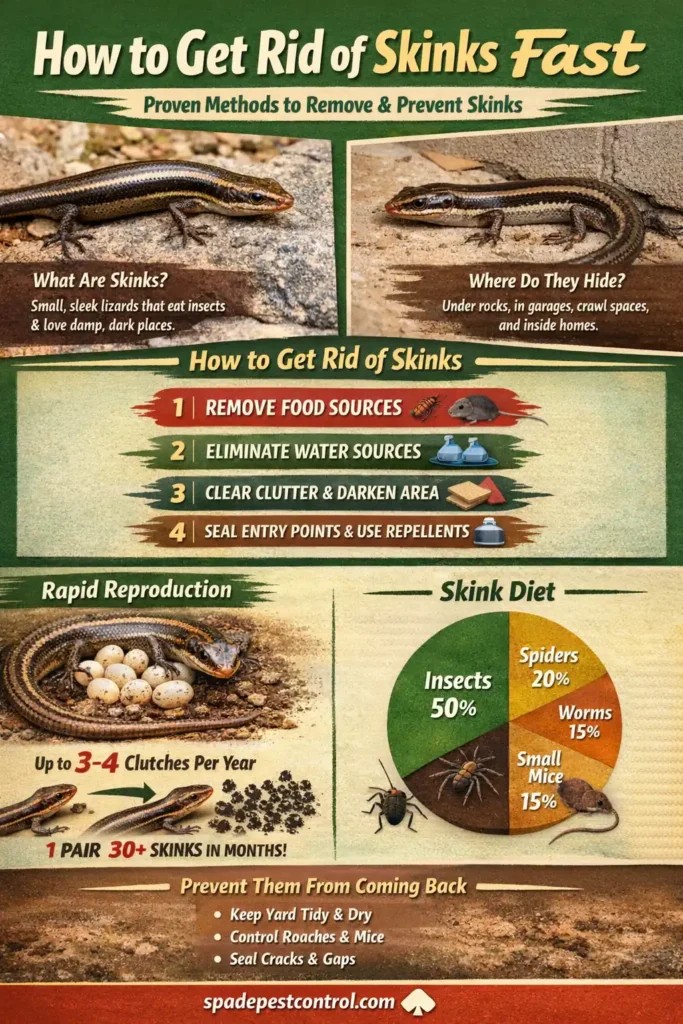
To get rid of skinks fast, remove their food sources (insects and small rodents), eliminate moisture, clear clutter near foundations, seal entry points larger than 1/4 inch, reduce outdoor lighting that attracts insects, and use targeted trapping or repellents as a temporary support method. Long-term control depends on habitat removal, not killing individual skinks.
Here’s a quick visual overview of the exact steps we’ll walk through below:
What Are Skinks?
Skinks are a type of lizard with smooth, shiny scales, a streamlined body, and relatively short legs. There are hundreds of skink species worldwide, and according to the University of Florida IFAS Extension, many North American species thrive in residential landscapes because they hunt insects and shelter in mulch beds and groundcover.
They’re cold-blooded, which means they favor warm, sunny spots for basking and cool, damp spots for hiding. Many skinks eat insects, spiders, and other small invertebrates — which is why they’re often seen in gardens and around foundations where insects live.
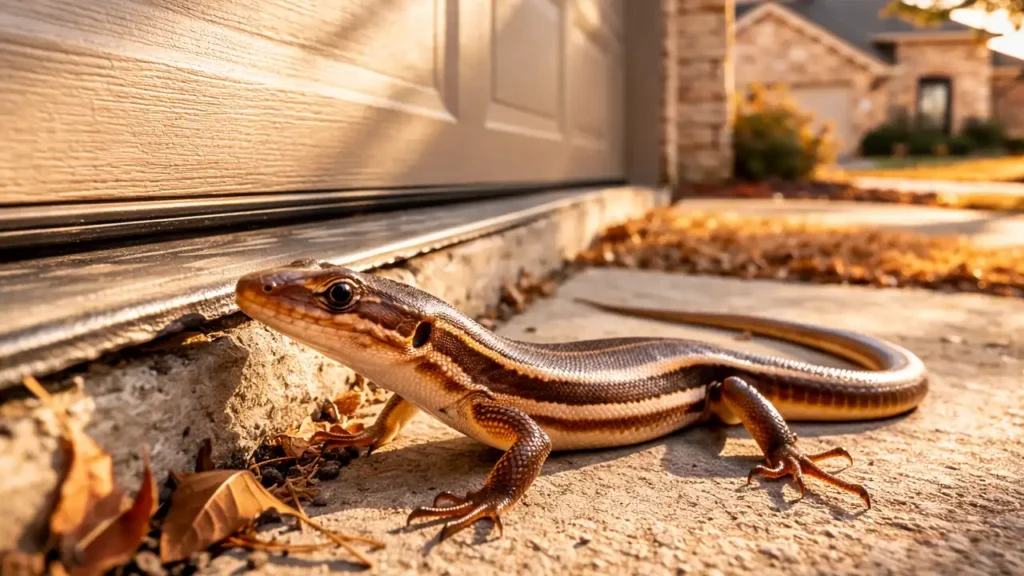
In the southern United States — especially Florida, Texas, and the Gulf states — skinks are extremely common around homes due to warm temperatures and high insect activity. In cooler northern states, they’re more seasonal and typically less active during colder months.
Quick Answer: If you see a fast, smooth-bodied lizard darting under a pile of leaves or into a gap near your foundation, it’s probably a skink. Snap a quick photo with your phone; ID helps choose the fastest removal method.
Are They Dangerous?
Short answer: no, most skinks are not dangerous to people. They are not venomous, and their mouths are tiny; a bite is rare and usually causes nothing worse than a minor scratch. Skinks avoid people and will flee if cornered. That said, like any wild animal, they can carry bacteria like Salmonella on their skin, so you should avoid handling them with bare hands and clean up any droppings promptly.
The Centers for Disease Control and Prevention (CDC) notes that reptiles, including lizards, can carry Salmonella bacteria on their skin even when they appear healthy, which is why handwashing after contact is important.
Some skink species are described as poisonous if eaten, meaning their bodies may contain toxins that can upset a predator’s stomach. This is different from venomous animals, which inject venom through a bite. Most common North American skinks are neither dangerous nor toxic to humans, but pets that eat them may experience digestive upset.
Quick Answer: If you must remove one by hand, wear gloves, gently guide it into a container with a piece of cardboard over the opening, and release it back to natural habitat away from your house. Don’t try to kill them: that’s ineffective for long-term control and often illegal in some places.
Where Will You Find Them?
Skinks are shy and secretive, so you often don’t see them directly. Instead look for signs and places they like. You’ll spot skinks in the cool shade beneath compost piles, under stacked firewood, behind garden pots, under old roofing tiles, in crawl spaces, and in cluttered garages.
Signs They’re In Your House
Indoors — if they make it inside — they hide along baseboards, in crawlspaces, behind boxes, and under sinks where it’s warm and moist. You might also find shed skin, small droppings that look like tiny dark pellets, or movement at night near exterior lights (because lights attract insects, which attract skinks).
Skinks can also drop their tails when threatened. If you find a small detached tail near baseboards, garage corners, or door gaps, that’s a strong sign of skink activity. The tail may continue moving briefly after detaching, which often startles homeowners.
Another common sign: frequent sightings where the lawn meets foundations or near hedges and rock borders.
Skink droppings typically look like a small dark pellet with a white chalky tip attached. The white portion is uric acid — similar to what you see in bird droppings. You may also find dropped tails near entry points. Skinks can detach their tails when threatened, and it continues moving briefly, which can alarm homeowners.
Quick Answer: Walk your property at dusk with a flashlight. Skinks are most active in low light, so you’ll spot the movement and the exact hiding spots to target.
How To Get Rid of Skinks
Getting rid of skinks fast is less about one dramatic trick and more about stacking the right small actions in the right order. That means: remove their food, remove shelter and water, make the place dark and uncomfortable, and then use repellents or traps where necessary. Below I’ll expand each step and explain why it works.
Remove Their Food Sources
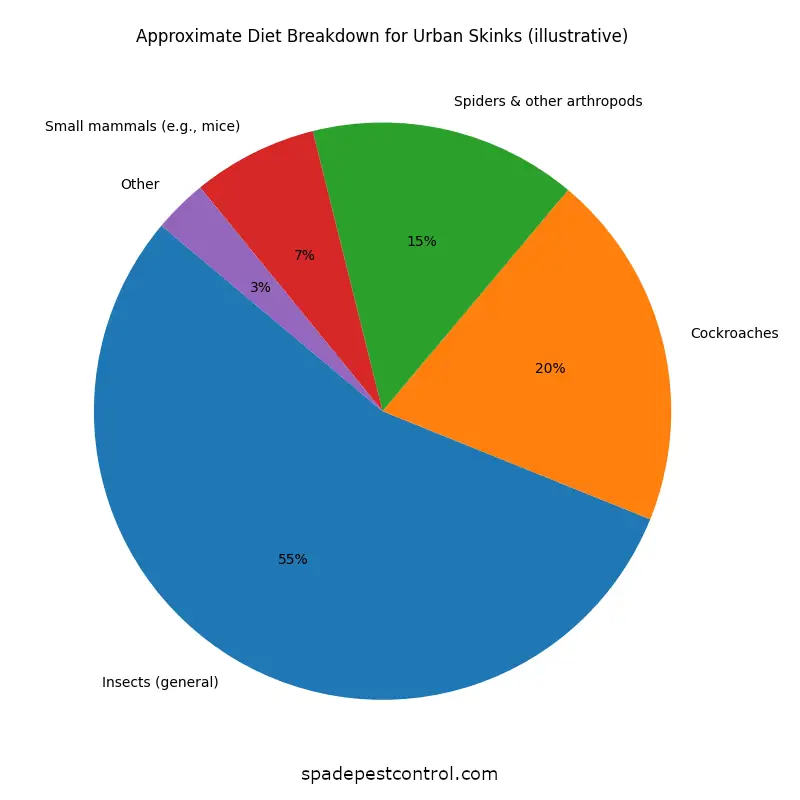
Skinks are hunters. They follow what they eat — bugs, worms, spiders, and even baby rodents on occasion. If you make your property and home less attractive to these food items, skinks will leave in days or weeks rather than months. That means reducing insects around foundations, under eaves, and near entry points. Keep lights off at night or use yellow “bug” bulbs on porches, clean up leaf litter and compost, and keep mulch away from the foundation so you’re not creating an insect-rich buffer zone against your walls.
When I find a skink heavy property, there’s usually another pest population feeding them. Look for cockroaches or mice — both are high-value food items that keep skinks around. If you have cockroaches or mice, control those problems first or alongside skink measures. For your convenience, here are direct resources you can link to for targeted control on these pests: cockroaches and mice.
Here’s a quick visual showing why fast action matters:
Quick Answer: Turn off or shield outdoor lights at night. Simple light control reduces insect counts dramatically, and the skinks will follow the food elsewhere.
Eliminate Sources of Water
Skinks browse where there’s moisture. Dripping pipes, leaky hoses, condensation around air conditioners, and standing water in saucers or planters give skinks a reliable water source and attract insects. Fix leaks, empty saucers, tilt planters to improve drainage, and make sure gutters and downspouts move water away from your foundation. Inside, check under sinks and water heaters for slow leaks and condensation.
Quick Answer: After a rain, walk the perimeter and fill in low spots that pool water. Those shallow puddles are insect magnets and skink magnets too.
Tidy Up
Clutter is skink candy. Piles of wood, bricks, leaf litter, overgrown shrubs, and stacks of cardboard provide cool, protected microhabitats perfect for hiding. Cleaning up is the most underrated and fastest-acting control measure. Move firewood at least 3–4 feet from the house and elevate it on a rack. Trim dense groundcover along foundations so soil and air get more sun and airflow. Inside, clear boxes away from walls and seal gaps behind stored items.
Quick Answer: Make a 2-3 foot “no habitat” zone along the foundation — bare soil or gravel with minimal mulch. Skinks won’t like the exposed area and will move outward.
Keep It Dark
Skinks hunt in low light and near insect-rich light sources. If they’re using your porch lights or garage lighting to hunt at night, reduce those attractants. Use motion-sensor lights only when necessary, and swap bright white bulbs for warm or yellow bulbs designed to attract fewer insects.
Use A Repellent
There are a few repellents and deterrents that can be effective if used correctly. Home remedies like garlic, pepper sprays, or strong-smelling plant oils are often suggested. Real-world experience and field testing show mixed results: many homemade sprays must be reapplied frequently and fail after rain or watering. Commercial reptile repellents can help as a short-term tactic around entry points, but they’re not a stand-alone solution.
If you choose repellents, apply them carefully to likely entry points and under eaves — places skinks use as travel routes. A safer, effective option is a barrier approach — combine a repellent with exclusion work like sealing gaps and removing habitat.
Quick Answer: Don’t rely on a repellent alone. Use it as a temporary barrier while you seal access points and remove food and water.
Why Sprays Alone Rarely Solve Skink Problems
One of the biggest misconceptions I see is homeowners relying entirely on a repellent spray. While sprays can temporarily push skinks away from treated areas, they do nothing to eliminate insects, moisture, or nesting sites. If those conditions remain, new skinks move in.
Lasting control comes from environmental correction first — chemicals second.
Physical Exclusion — Seal Entry Points
This is one of the fastest, most permanent steps you can take. Skinks can squeeze through surprisingly small gaps underneath doors, around plumbing penetrations, and through poorly fitted vents. Inspect the foundation and exterior walls, and seal holes larger than about 1/4 inch with caulk, hardware cloth, or foam backer rod. Use door sweeps on exterior doors and screen or seal vents. For crawlspaces, ensure the skirting and vents are intact and that there are no gaps under skids.
Quick Answer: Do a quick test walk on a rainy day — skinks move to sheltered gaps to escape water. Where you see them moving is where you need to seal.
Traps and Live Capture
Traps can work fast when you target the right places. Small glue boards or sticky traps placed in corners and behind appliances will catch small skinks, but be careful: glue traps are inhumane to many people and can catch non-target animals.
Live-capture traps — a small plastic container propped on one side with bait like insects or a damp sponge inside — are kinder and effective: skinks slip in and can’t easily climb back out. Check traps daily and release captured skinks away from your home.
If you use glue boards, place them inside protective trap stations to prevent pets or wildlife from contacting them. Always check local wildlife regulations before using lethal trapping methods.
Quick Answer: If you use live traps, release skinks at least several hundred feet away in suitable habitat so they don’t return.
Professional Removal — When to Call in Help
If your property has many skinks (you’re seeing them daily, inside rooms, or in communal egg nests), call a professional pest control service. Professionals will combine exclusion work, habitat modification, targeted trapping, and pest control for prey species. A trained tech will also ensure that methods used are permitted in your area and are safe for children and pets.
Quick Answer: Ask the pro you call for a written action plan: what they’ll do now, and how they’ll prevent return visits. A one-off spray without follow-up rarely solves the problem.
Preventing Them from Coming Back
Long-term prevention is where a lot of homeowners fail. Once you’ve removed current skinks, keep them from returning by sustaining the habitat changes.
Keep landscaping neat and well-drained. Replace dense mulch at the foundation with gravel or bare soil strips. Maintain good exterior lighting practices. Keep garbage sealed and avoid leaving pet food outdoors. Continue insect control measures if you had a prior cockroach or mice problem — those prey populations will bring skinks back fast if they rebound.
If you suspect skinks are nesting nearby, look for communal nests under deep mulch or compost where dozens of soft, small eggs may be incubating. If you find a nest, don’t disturb it in a way that scatters eggs into areas kids or pets access — instead, consult a professional. In many places, moving wildlife eggs can be illegal.
Wildlife education programs such as Backyard Buddies also document communal nesting behavior in some skink species, where multiple females lay eggs in the same protected site.
Quick tip: Schedule a short property audit twice a year — spring and fall — to check for new entry points, damp areas, and clutter that could invite skinks back.
Why Our Method Works Fast
The reason this method is fast is simple: skinks stay where their basic needs are met. Remove those needs quickly and you remove the skinks quickly.
That’s why the order of operations is important: deal with food sources (especially cockroaches and mice), fix water and drainage, remove hiding spots, darken the area and then use repellent or trapping as a finishing measure. Doing sealing and habitat cleanup right away creates immediate discomfort for skinks, so they migrate away rather than staying put and reproducing.
In my experience, homeowners who skip habitat removal and go straight to sprays almost always call back within weeks. Skinks are survivors — if the insects and shelter remain, new ones move in quickly. Structural correction is always more permanent than chemical shortcuts.
Quick note on reproduction: Many small skink species lay multiple clutches per year. Research on ground skinks (Scincella lateralis) published by Animal Diversity Web shows females may lay multiple clutches per season, typically 2–4 egg batches during warm months under ideal conditions.
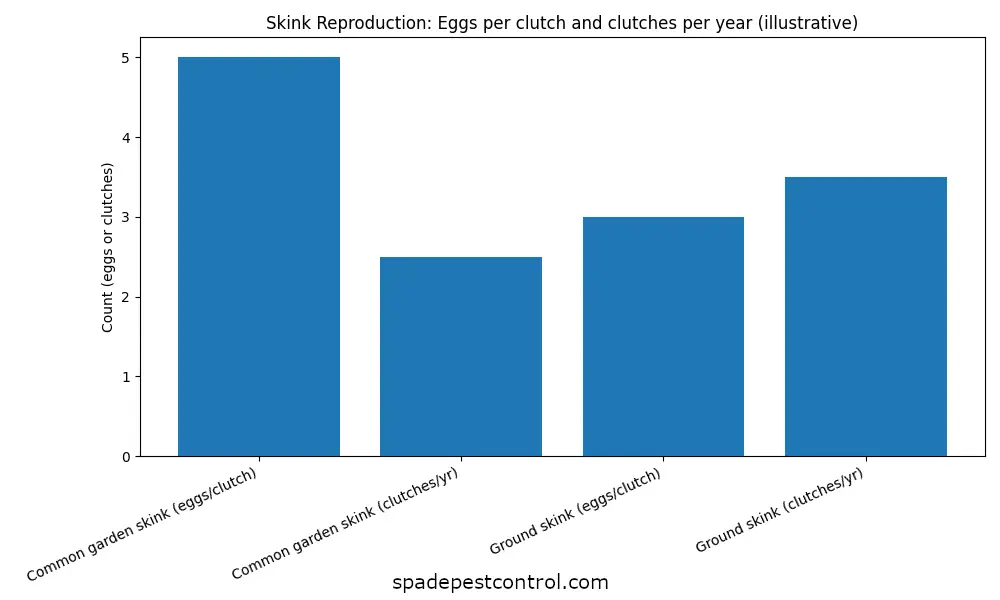
Quick Answer: If you’re seeing juveniles (tiny, bright-tailed skinks), act fast — those tell you reproduction is happening right on your property.
Real-World Case Example
A homeowner I worked with in late summer had skinks appearing daily inside their garage. They had already tried spray repellents for weeks with no success. When I inspected the property, the issue wasn’t the garage at all — it was a thick mulch bed and stacked pavers directly against the foundation. Beneath that mulch were insects and moist soil, plus three small nesting pockets.
We removed the pavers, thinned the mulch to less than one inch, sealed a 3/8-inch foundation gap near a conduit line, and switched their bright porch lights to yellow bulbs. Within ten days, sightings dropped to zero — without using any poison.
The lesson: eliminate habitat first. Repellents alone rarely solve the root problem.
Common Mistakes That Slow Results
People often spray repellent and call it done. Or they focus only on trapping a few visible animals while leaving the conditions that attracted them untouched. Another common mistake is ignoring prey control: if cockroaches or mice are still present, skinks have every reason to stay. Finally, many people apply repellents haphazardly — under a deck where it rains or around plants that get watered — and the repellent washes away.
Practical Day-By-Day Action Plan
- Day 1: Walk the perimeter and take photos where skinks are most visible. Secure pet food, turn off porch lights, and remove obvious clutter.
- Day 2, fix any leaks and eliminate standing water.
- Day 3: Do a focused cleanup: move firewood, trim vegetation from foundations, and thin mulch.
- Day 4: inspect for entry holes and seal obvious gaps — door sweeps, caulk, and mesh vents.
- Days 5–7: set up live traps in corners where you’ve seen skinks and monitor daily. If cockroaches or mice are active, address those infestations immediately using a structured control plan — eliminating prey is one of the fastest ways to reduce skink pressure.
Legal and Humane Considerations
Local rules vary. Some jurisdictions protect certain native reptiles, and in any case humane methods are both more effective and less likely to get you in legal trouble. Avoid poisons intended for mammals (which won’t reliably control skinks and can harm pets) and use traps and exclusion where possible. If in doubt, a local wildlife or pest control authority can advise on legal restrictions and humane options.
Also Read: How To Get Rid Of Spider Crickets Fast