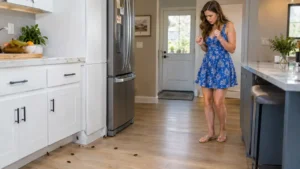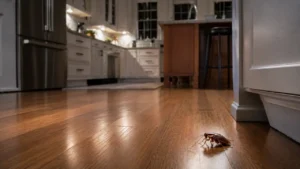
If you have ever switched on the kitchen light at night and spotted a roach darting under the fridge, you probably wondered a few things at once. Where did it come from, how many more are hiding, and why do these things move so fast? One small detail people often miss is the legs.
Cockroaches look like they have a whole mess of moving parts, but the answer is actually simple. They are built for speed, balance, and survival, and their legs are a big reason they are so hard to deal with in a home. Once you understand how their legs work, you will understand a lot more about why they show up, how they escape, and why one sighting should never be ignored.
Also Read: German Cockroaches vs. American Roaches: Which One Is Hiding in Your Kitchen?
Quick Answer: How Many Legs Do Cockroaches Have?
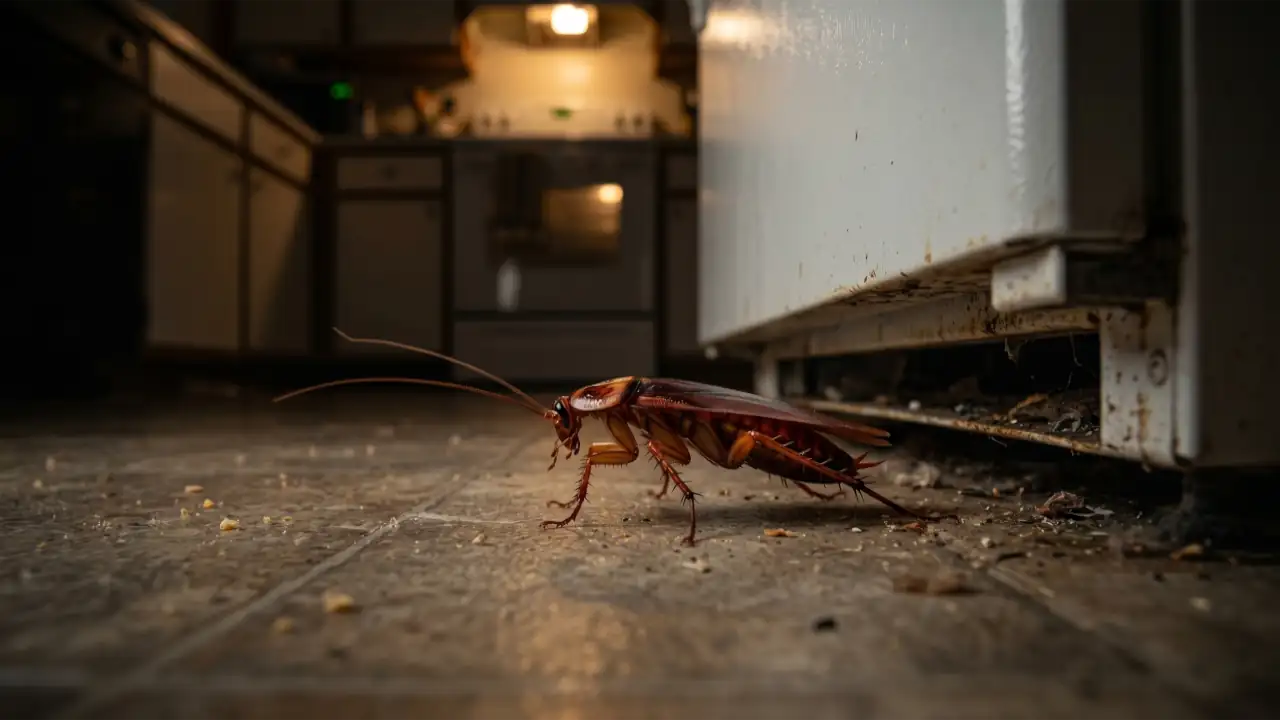
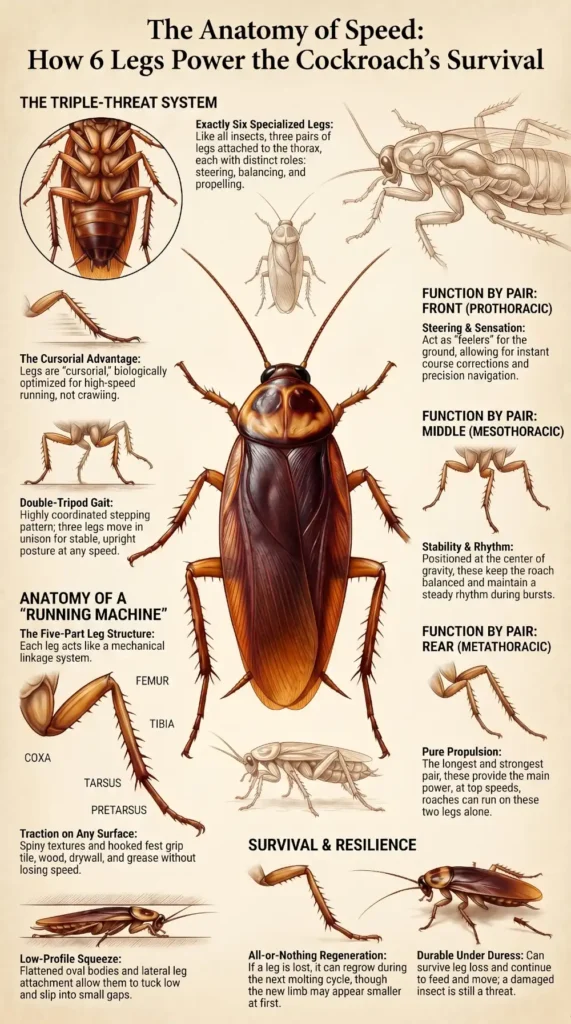
Cockroaches have six legs, just like all insects. Their legs are attached in three pairs along the thorax: front legs for steering, middle legs for balance, and rear legs for speed and propulsion. Those specialized legs are one reason cockroaches move quickly and survive so well inside homes.
An Easy Way to Check
An easy way to check is to look at the body, not just the feet. If you are seeing one cockroach, chances are it is moving fast, tucked low to the ground, and trying to get back into a crack or dark hiding spot.
Cockroaches also have long antennae that constantly move while they explore their surroundings, which is another clue that helps separate them from spiders or beetle-like insects people sometimes confuse them with. Cockroaches are mostly active at night, so seeing one in the open during the evening usually means more are hiding nearby.

So if you catch one in the open, it is worth paying attention. A quick flashlight check around sinks, baseboards, appliance gaps, and cabinet edges usually tells you more than staring at one blurry insect for ten seconds. In real infestations, homeowners often notice roaches near dishwashers, under sinks, or around refrigerator compressor areas long before they ever get a perfect close-up look at one.
Cockroach Leg Anatomy
A cockroach leg is not just one simple stick. Each leg has several parts, and those parts work together like a little machine. The University of Minnesota’s insect morphology guide explains that insect legs contain several specialized sections including the coxa, femur, tibia, tarsus, and pretarsus. In practical terms, that structure gives cockroaches the flexibility and traction they need to move efficiently through homes.
Their low, flattened body shape works together with those legs to help them squeeze into narrow gaps behind appliances, cabinets, and wall voids.
In a home infestation, you do not need to memorize every Latin term, but it helps to know that the long back leg is not random. It is built to push, grip, and keep the insect stable while it runs over rough or smooth surfaces.
In real homes, this matters because those hooked feet and flexible joints help roaches move across tile, wood, drywall, cardboard, and even textured cabinet interiors surprisingly well. Homeowners often underestimate how easily cockroaches can travel through kitchens and utility spaces until they actually see one climb or squeeze behind an appliance.
Quick tip: if a roach is dead or upside down, it is much easier to count the legs by looking at where they attach to the thorax, not by trying to follow every foot as it jerks around.
The Purpose of Each Pair of Legs
1. Prothoracic Legs
The prothoracic legs are the front pair. They attach to the prothorax, the segment closest to the head. In simple terms, these legs help the roach feel the ground in front of it and make quick course corrections. They are part of the insect’s running system, but they are also the pair most likely to help the roach control where it is going when it suddenly changes direction. Cockroaches use a highly coordinated stepping pattern, not six independent legs doing their own thing.
2. Mesothoracic Legs
The mesothoracic legs are the middle pair. These are the stabilizers. They sit at the center of the body and help the cockroach keep rhythm while moving quickly. In a cockroach, balance matters just as much as speed. The front, middle, and rear legs work together in a double-tripod gait, which helps the insect stay upright and move smoothly across surfaces. If the body shifts, the middle legs help correct that shift fast.
3. Metathoracic Legs
The metathoracic legs are the back pair, and they are usually the longest and strongest. These are the main power legs. Entomologists sometimes describe cockroach legs as “cursorial,” which simply means they are specialized for fast running.
The leg pairs increase in size from front to back. The hind legs act as the main source of propulsion. At higher speeds, cockroaches can even shift into quadrupedal or bipedal running, which tells you how heavily the back end contributes when the insect needs a burst of speed. Relative to their body size, cockroaches are extremely fast runners and can cover distance surprisingly quickly before disappearing into cover. If a roach suddenly rockets across your floor, those back legs are doing most of the work.
What I Usually See During Real Cockroach Inspections
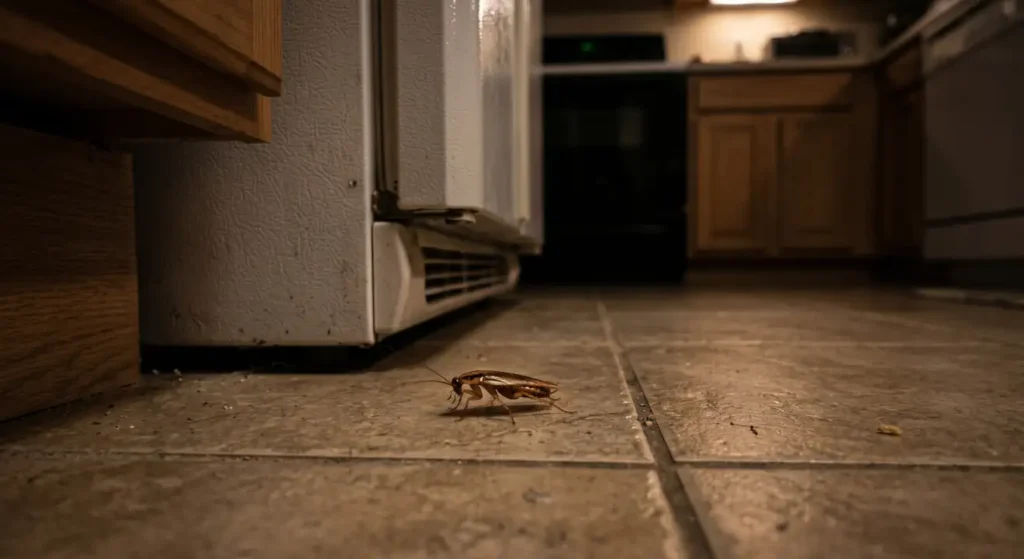
In real cockroach inspections, homeowners almost never notice the legs first. What they usually notice is speed. German cockroaches especially can disappear into gaps around dishwashers, refrigerators, and cabinet hinges in seconds. Smaller indoor species like German roaches are usually far harder to eliminate than larger outdoor roaches because they reproduce quickly and stay hidden deep inside kitchens and wall voids.
In heavier infestations, I’ve seen roaches move across uneven surfaces, grease-covered compressor areas, and cluttered storage rooms without slowing down much at all.
Their leg structure is a huge part of that survival ability. Those long rear legs help them burst forward quickly, while the lower body stays close to the surface so they can slip into cracks that look too small to use. That combination of speed and body control is one reason cockroach infestations spread quietly before homeowners realize how established they are.
Why It’s Sometimes Hard to See All of Their Legs
It is harder than people expect to count all six legs because a cockroach is built to stay low, move fast, and disappear into cover. The body is flattened and oval, which keeps the legs tucked close to the floor.
According to the University of Kentucky Entomology Department, cockroaches prefer dark protected spaces and are primarily active at night, which is one reason infestations often grow unnoticed in kitchens, basements, and wall voids.
That means when you spot one in a kitchen or bathroom, you are often seeing it in motion, not sitting still for a neat close-up. By the time your eyes lock onto the insect, one or more legs may already be hidden by its body angle, the floor edge, or the blur of movement. That is why people often think they saw fewer than six. They did not. They just did not get a clean look.
Can They Survive When Missing Legs?
Yes, often they can. Cockroaches are surprisingly tough, and they can survive leg loss and keep eating. Missing legs can also change the way cockroaches grow and move, but leg loss does not automatically kill them. That is one reason roaches are such a problem in homes. They can take damage, escape, recover, and keep going. Even a severe injury, or contact with a predator, does not always stop them right away if the insect is not fatally harmed. In a real infestation, that toughness is exactly what makes them frustrating.
Can They Regrow Their Legs?
Yes, cockroaches can regrow legs, but not instantly. Regeneration happens across the molting cycle. Cockroach leg regeneration works as an all-or-none process within a single instar, meaning the animal either starts a regeneration response in that cycle or it does not. Regenerated legs can sometimes appear smaller or slightly less developed than the original.
Scientists are still studying the genetic mechanisms behind cockroach leg regeneration, which shows that this is not just a folklore fact. It is a real survival mechanism that helps explain why cockroaches remain one of the hardest household pests to fully eliminate. The important thing for homeowners is simple: a missing leg does not mean the roach is out of the fight, and it definitely does not mean the infestation is small.
What This Means in a Real Home
If you are seeing cockroaches, the leg count is not just a trivia question. It tells you something about how the pest survives. Six legs give roaches speed, grip, and balance. That is why they can vanish behind appliances, slip through tiny gaps, and keep moving even after injury.
One thing experienced pest professionals learn quickly is that cockroaches hide well, move mostly at night, and are often undercounted when they first show up. So when you see one, do not treat it like a random one-off. A lot of homeowners immediately reach for strong-smelling DIY repellents, but some common roach remedies create more problems than they solve. Treat it like a clue. Look for water, crumbs, grease, pet food, cardboard clutter, and gaps around pipes or cabinets. That is where the real problem usually starts.
In many kitchens, the first activity starts behind refrigerators or under sinks where moisture and food debris collect quietly for weeks before homeowners notice anything unusual.
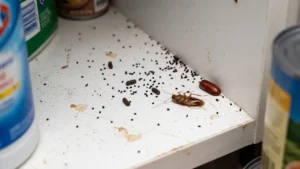
Cockroaches are not just unpleasant to look at. In larger infestations, they can contaminate surfaces with droppings, shed skins, and bacteria picked up from drains, trash areas, and damp voids. That is one reason early identification matters.
Also Read: What Do Cockroach Droppings Look Like? Identification Guide + Real Photos
Conclusion
So, how many legs do cockroaches have? Six. Not five, not eight, and not “too many to count.” They have three pairs of legs, each pair attached to a different thoracic segment, and each pair plays a different role in helping the roach run, balance, and survive. The front legs help guide the body, the middle legs stabilize it, and the back legs provide much of the power. That combination of speed, balance, and grip is one reason cockroaches survive so well inside homes. If you are seeing one cockroach, the safest assumption is that more may be nearby.
In my experience, homeowners who spot a cockroach early and immediately start checking moisture sources, food debris, and hidden gaps usually have a much easier time controlling the problem. Waiting until sightings become frequent almost always means the infestation has had time to spread deeper into walls, appliances, or adjoining rooms.
The longer cockroaches stay hidden inside a home, the harder they usually become to eliminate, which is why even a single sighting deserves attention early.