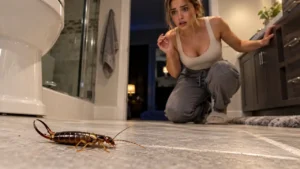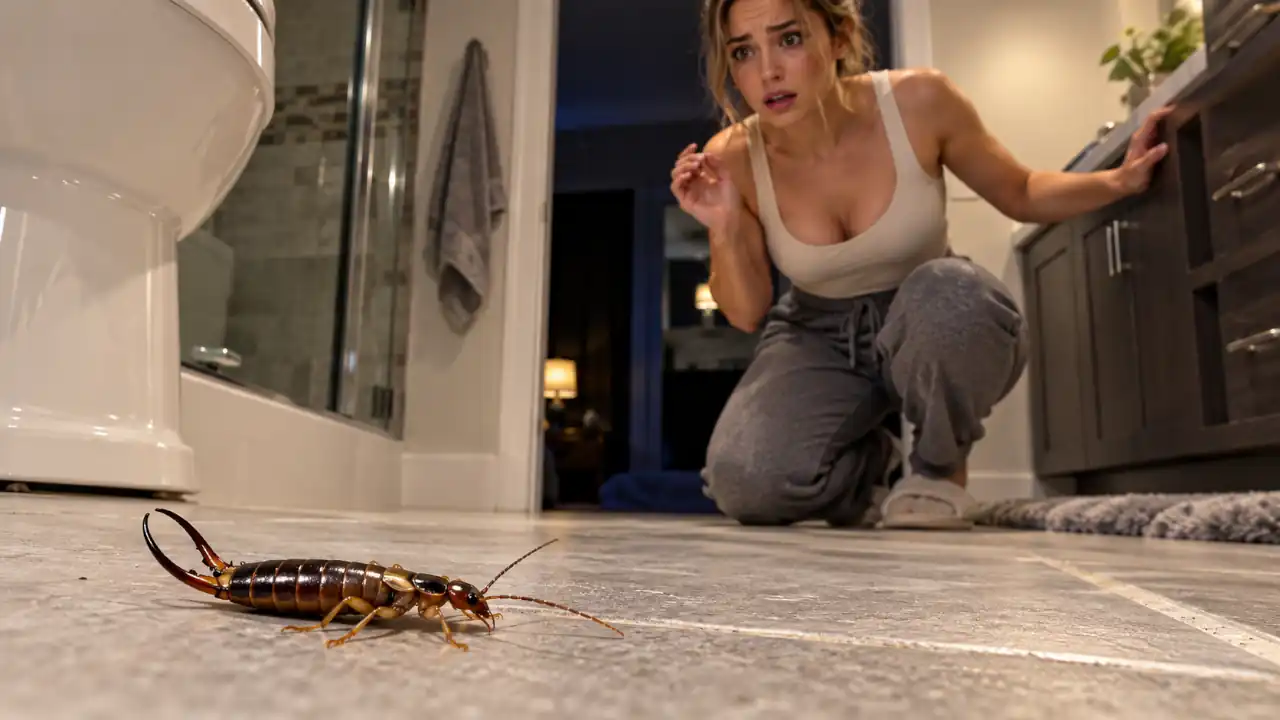
You flipped on the bathroom light and there it was, a shiny brown bug with a pair of pincers on its tail. Now you’re wondering if it can hurt you. So, do pincher bugs actually pinch? Yes, they can, but it’s nothing like the horror stories. Here’s what I’ve learned from years of dealing with them in real homes.
Also Read: 10 Eco-Friendly Pest Control Secrets Professionals Rarely Talk About
Do Pincher Bugs Actually Pinch?
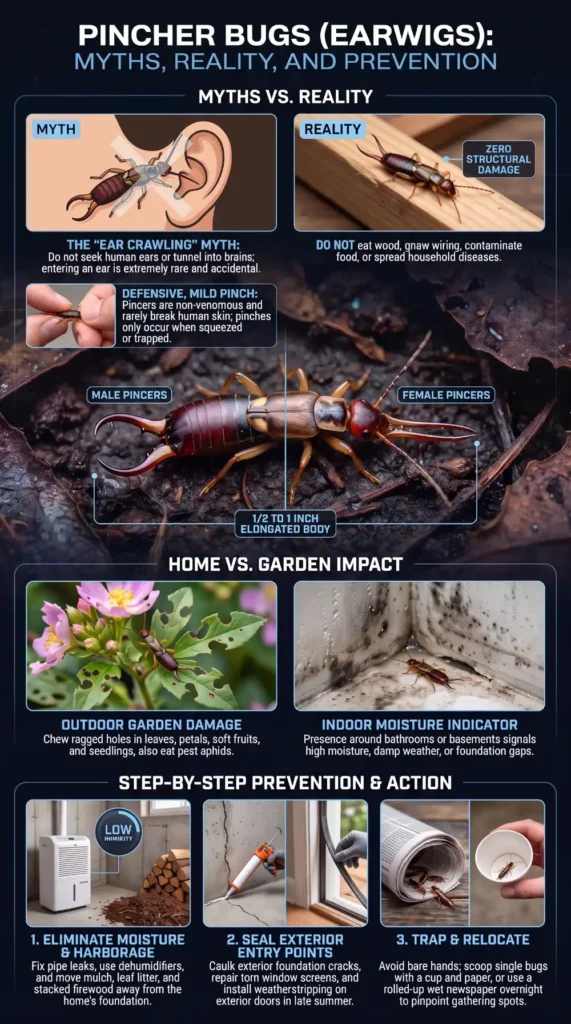
Yes, pincher bugs can pinch you, but the pinch is usually mild. Earwigs generally pinch when they are handled, squeezed, or trapped against the skin. Most people experience little more than a quick squeeze or small red mark, rather than a serious injury.
3 Facts to Know About Pincher Bug Pinches
Fact 1: They usually pinch when they’re handled or feel threatened. The pinch is defensive and is most likely to happen when you grab it, squeeze it, disturb it, or trap it against your skin, such as when one is stuck in a towel or a shoe. Leave it alone and it will generally try to get away.
Fact 2: The pinch is weak and rarely hurts. Those scary-looking pincers are far stronger on paper than in practice. On a human, the pinch might leave a small red mark for a short while, and sometimes there’s no mark at all. It doesn’t break the skin in most cases, and it doesn’t hurt for long. The University of Nevada, Reno Extension notes that earwigs can pinch with their jaws if handled but are not known to be aggressive or harmful to humans.
Fact 3: They aren’t venomous, and a pinch isn’t considered a health threat. Earwigs don’t have stingers or venom, and their pinch isn’t known to transmit disease. If one does grab you, wash the area with soap and water and leave it alone. In the unlikely event that the skin is broken, treat it like any other minor scratch or puncture and keep an eye out for signs of irritation or infection.
Pinch, Bite, or Sting?
Earwigs are best known for pinching with the forceps at the end of their abdomen. They aren’t stinging insects, and they aren’t known to bite people as a normal feeding behavior. If an earwig hurts you, the forceps are almost certainly responsible.
The important distinction is that an earwig’s pinch is a defensive response, not an attempt to feed on you. Most accidental pinches happen when someone grabs an earwig, traps it against their skin, or reaches into a dark hiding place without seeing it.
How Did Pincher Bugs Get Their Name?
“Pincher bug” is the nickname everyone uses, and it’s easy to see why. Those pincers at the back end are the first thing you notice. The proper name is earwig, and that one has a much stranger story. It comes from an old tale that earwigs sneak into your ear while you sleep and tunnel into your brain. People believed that for hundreds of years, and the name stuck even though the story never held up.
The name “earwig” comes from an old English word associated with the ear and an insect or creature. Over time, it became tied to the old belief that these insects crawled into people’s ears while they slept. That story is folklore, not normal earwig behavior.
I’ve been asked about this one more times than I can count. The truth is simple. Earwigs hide in tight, dark spaces during the day, and a human ear isn’t on their list of preferred hiding places. Could one wander into an ear by accident? Yes, in the same way almost any small crawling insect could, but it’s extremely uncommon. The pincers, by the way, are called forceps or cerci. Earwigs use them for defense and mating, and some species also use them when capturing or handling prey. They’re useful tools, not weapons aimed at people.
Are Pincher Bugs Dangerous to Your Home?
Not really. If I rank the pests I get called about, earwigs sit near the bottom of the danger list. They don’t chew through wood the way termites and carpenter ants do. They don’t gnaw wires, and they aren’t considered a household disease-spreading pest. Unlike roaches, they’re not known for contaminating food as they move around the home.
What they do is annoy you. A few earwigs in a basement are a nuisance. A big group in your bathroom is gross and stressful, especially when you step on one barefoot at midnight. They can also give off a bad smell when crushed or disturbed, which is one more reason not to squish them with your hand.
The real damage happens outside. In the garden, earwigs chew ragged holes in leaves, nibble soft flower petals, damage young seedlings, and feed on soft fruit. If you’ve got tender plants and a big earwig population, you’ll notice it fast. Inside the house, though, think of them as a sign that you have moisture somewhere, not as a threat to the building.
One important distinction: finding an earwig indoors doesn’t automatically mean you have a plumbing leak or serious moisture problem. Sometimes they’re simply coming in from damp landscaping, mulch, leaf litter, or wet soil around the foundation. The pattern matters more than a single bug. Repeated sightings in the same damp area are much more useful as a clue.
What If a Pincher Bug Actually Pinches You?
If an earwig does pinch you, don’t panic. The forceps can give a quick squeeze, but they’re not designed to inject venom or cause the kind of injury associated with a stinging or biting pest.
Wash the area with soap and water. If the skin isn’t broken, that’s generally all you need to do. If the skin is scratched or punctured, keep it clean and watch for increasing redness, swelling, warmth, drainage, or other signs that the area isn’t healing normally.
The bigger lesson is how the pinch happened. Earwigs generally aren’t interested in attacking people. Most accidental pinches happen when someone grabs one, traps it against their skin, or reaches into a dark hiding place without seeing it first. If you need to move one, use a cup and piece of paper rather than your fingers.
How to Get Rid of Pincher Bugs in the House
First, stay calm. One earwig in your house is not an infestation. Often it wandered in from the yard after rain or during a dry spell, looking for moisture.
I wouldn’t start spraying the house just because you found one or two. With earwigs, indoor chemical treatment often treats the symptom rather than the reason they’re getting inside. If the problem is mainly coming from outside, moisture control, exterior cleanup, and sealing entry points usually make more sense as the first move.
One of the more common mistakes is treating every earwig sighting as proof that the house itself is infested. If they’re coming in from outside, spraying the insects you see indoors won’t solve the entry problem. Find the harborage and entry route first.
If you spot a single bug, the easiest fix is to scoop it up with a cup and a piece of paper and put it outside. You can also use a vacuum or a rolled-up piece of tissue if you don’t want to get close. Don’t pick it up with your bare fingers, since that’s the moment it’s most likely to pinch.
If you keep seeing them, especially in groups, then you’ve got a bigger issue. Check the usual spots, which are under the bathroom sink, around the tub and shower, in the basement, near laundry areas, and under potted plants kept indoors. A cluster in one of those places tells you there’s a damp hiding spot nearby. That’s where you want to focus your attention.
A simple trick I use to find where earwigs are concentrating is a rolled-up newspaper. Leave it out overnight near the area where you’ve been seeing them. In the morning, check inside it or shake it over a bucket of soapy water. If earwigs are using it as a hiding place, you’ve found a spot worth investigating. It doesn’t prove there’s a leak, but it can help you pinpoint where they’re gathering.
How to Identify Pincher Bugs: Their Anatomy
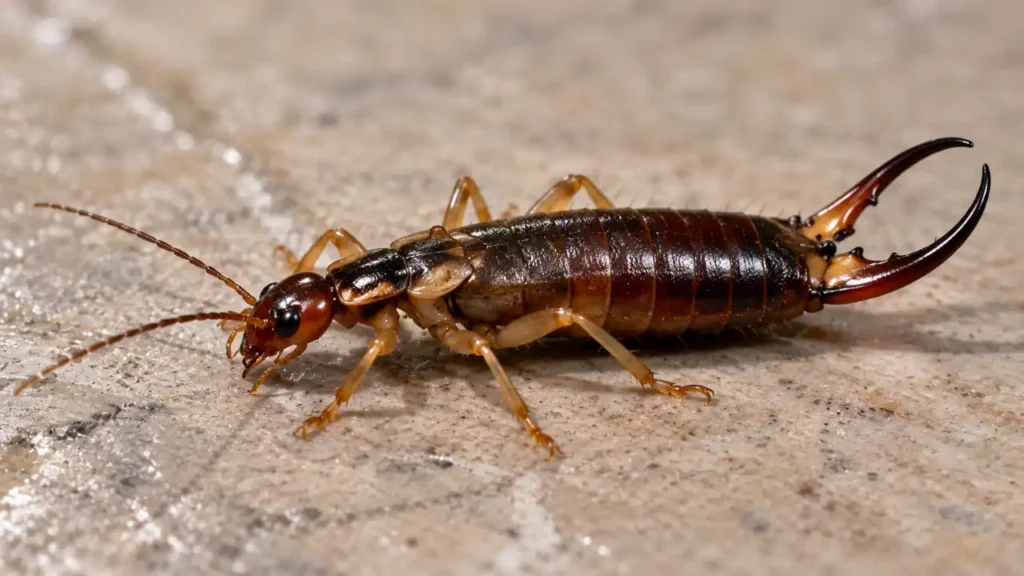
Earwigs are easy to recognize once you know what to look for. They have a long, flat body with a head, a middle section, and a segmented back end. They have six legs and two thin antennae on their head. Most are reddish-brown to dark brown, and the common European earwig is about half an inch long, though some species run a little bigger.
Earwigs belong to the insect order Dermaptera, a group recognized by the forceps-like cerci at the end of the abdomen. Adult earwigs commonly fall somewhere around half an inch to an inch long, although size varies by species.
The pincers are the giveaway. You can even tell males and females apart with them. Males have thick, curved pincers that bow outward. Females have straighter, thinner ones. Young earwigs, called nymphs, look like small adults without developed wings, and their pincers look more like the female’s.
Here’s a fun detail that surprises people. Earwigs do have wings. They’re folded up under a short pair of leathery covers, and many earwigs rarely fly or are reluctant flyers. Most of the ones homeowners encounter are crawling, so if an insect repeatedly flies around your porch light, it may be something else. Don’t use flight alone to identify an earwig; look at the pincers and body shape instead.
If you’re unsure, look at the tail first. Two tail pincers combined with a flat, elongated body are strong clues that you’re looking at an earwig. No pincers means you’re looking at something else, maybe a silverfish, a cockroach nymph, or a rove beetle, which people often mix up with earwigs.
The pincers are the easiest clue, but don’t rely on color alone. Earwigs can vary from reddish brown to nearly black depending on the species and age. If you’re trying to identify an unknown bug from a photo, the tail pincers, body shape, and size are much more useful than simply asking whether the insect is brown.
What Do Pincher Bugs Eat?
Earwigs eat almost anything, which is part of why they do so well. They’re omnivores, so they go after both plants and animals. Outdoors, they feed on decaying plant matter, soft leaves, flower petals, seedlings, fruit, and small insects like aphids and mites. They also scavenge on dead insects.
That’s why gardeners have mixed feelings about them. In a balanced yard, earwigs help by eating aphids and cleaning up rotting material. When their numbers climb, they start chewing the plants you wanted to keep. Dahlias, zinnias, marigolds, lettuce, and corn silks tend to take the hit.
Indoors, earwigs aren’t really looking for your pantry. They’ll feed on small amounts of organic material, dead insects, plant material, and other food sources they happen to encounter, but moisture and shelter are usually the bigger draw. If you’re finding them around a bathroom, basement, or other damp area, I’d look at the conditions first rather than assuming a food spill is attracting them.
Where Do Pincher Bugs Live?
Earwigs are found across much of the world, with well over a thousand species described. In North America, several species occur around homes and gardens, and the European earwig is one of the most commonly encountered species in the United States.
What they all have in common is a love of dark, cool, damp places. During the day they tuck themselves under rocks, boards, flower pots, mulch, leaf piles, and bark. They squeeze into cracks and crevices, and they love the gap between a fence and the ground. At night they come out to feed.
When they move indoors, they head for the same kind of place. Basements, crawl spaces, bathrooms, laundry rooms, and the area under kitchen sinks are the usual targets. They walk in through gaps in door frames, cracks in the foundation, and spaces around pipes. Heavy rain or a long dry spell often pushes them toward your house, because your damp foundation looks like a safe place to live.
One Pincher Bug vs. an Infestation: When Should You Worry?
Finding one earwig doesn’t necessarily mean you have an infestation. A single insect can wander inside through a door gap, window, crack, or other opening, especially after changes in weather.
A sudden increase can also happen when outdoor conditions change. Heavy rain can push earwigs out of saturated hiding places, while hot or dry weather can drive them toward irrigated soil and damp areas around buildings.
The pattern matters more than the first bug you see. Finding several earwigs repeatedly, seeing them in multiple rooms, or finding them concentrated around a particular damp area is a better reason to investigate. Start outside as well as inside. Look at mulch, leaf litter, irrigation, downspouts, foundation drainage, and gaps beneath exterior doors.
That distinction saves homeowners a lot of unnecessary work. One earwig is something to remove. A recurring pattern is something to investigate.
How to Prevent a Pincher Bug Infestation
Prevention is where you’ll make the biggest difference. Killing the bugs you see may provide temporary relief, but removing the conditions that attract them is what helps reduce recurring problems. There are two big jobs, and the first one is moisture.
Eliminate Moisture and Harborage
Moisture is one of the biggest things that keeps earwigs comfortable, so take away as much of it as you reasonably can. Fix leaky pipes and dripping faucets, especially under sinks. Run a dehumidifier in the basement or crawl space if humidity stays high. Make sure your bathroom fan works and actually runs after showers. Wipe down wet surfaces instead of letting them stay damp for hours.
Outside, look at what you’ve piled against the house. Mulch, leaf litter, firewood, old boards, and flower pots give earwigs perfect hiding places. Pull mulch back several inches from the foundation, stack firewood away from the walls, and clear out the debris. Check your gutters and downspouts too, because water pooling near the foundation draws them in. Water your garden in the morning when practical, so the surface has more time to dry before night.
Seal Entry Points
Once the damp spots are handled, close the doors they use. Walk around the outside of your home and look for gaps around door frames, window frames, utility pipes, vents, and cracks in the foundation. Seal small gaps with silicone caulk. Add or replace weatherstripping on the bottom of exterior doors, because a gap there is a wide-open invitation. Repair torn window screens and check that crawl space vents have tight screens.
Do this in late summer or early fall, before the bugs start looking for shelter. It’s a few hours of work that can save you months of annoyance.
When to Call a Professional
If you’ve cut the moisture, cleaned up the exterior, and sealed obvious entry points but you’re still finding earwigs throughout the house after two to three weeks, it’s worth looking more closely at the source. There may be a damp crawl space, poorly drained area, foundation gap, dense landscaping, or other harborage that you haven’t identified. The goal isn’t simply to kill the earwigs you see; it’s to figure out why they’re getting in repeatedly.
Call a pro if you’re seeing large numbers every night, if you can’t find where they’re coming from, or if you simply don’t want to crawl around your foundation. A trained technician can find the source, treat the outside perimeter correctly, and tell you if a hidden moisture issue needs repair.
How Pincher Bugs Reproduce and What Their Life Cycle Looks Like
The earwig life cycle is one of the more interesting parts of this whole story, because some earwig species show surprisingly strong maternal behavior. Unlike many insects, female earwigs can remain with their eggs and actively care for them.
In the common European earwig, mating typically occurs in the fall. The female makes a small nest or chamber in protected soil or debris and lays her eggs there. She stays with the eggs, cleaning them and guarding them from threats. That care continues after hatching for a period while the young nymphs develop.
Also Read:
When the eggs hatch, usually in spring, the nymphs look like small versions of the adults but lack fully developed wings. They molt several times as they grow, becoming darker and larger before reaching adulthood. The timing can vary with species and weather, but many common earwigs complete their life cycle in roughly a year.
That’s also why you may see more of them at certain times of year. Warm, damp weather can increase their activity, while dry conditions may push them toward irrigated gardens, damp landscaping, or sheltered areas around buildings. The exact timing varies by species and region, so a sudden increase doesn’t necessarily mean the insects have started breeding inside your house.
Final Thoughts
So, do pincher bugs actually pinch? They do, but usually when they’re handled, disturbed, or trapped, and the pinch is generally weak and brief. They aren’t venomous, they aren’t known to transmit disease through a pinch, and they don’t seek out people’s ears. They’re a nuisance, not a serious household danger.
What matters is the reason they came in. Pincher bugs are attracted to moisture and sheltered places to hide. Fix the leaks, dry out the damp corners, clear the clutter around your foundation, and seal the gaps. If you do that consistently, the number of earwigs getting into the house should start to drop as the conditions around the property become less favorable. And if they don’t, bring in a professional to find what you’ve missed. Now you know what you’re looking at, and you can get on with your evening.