
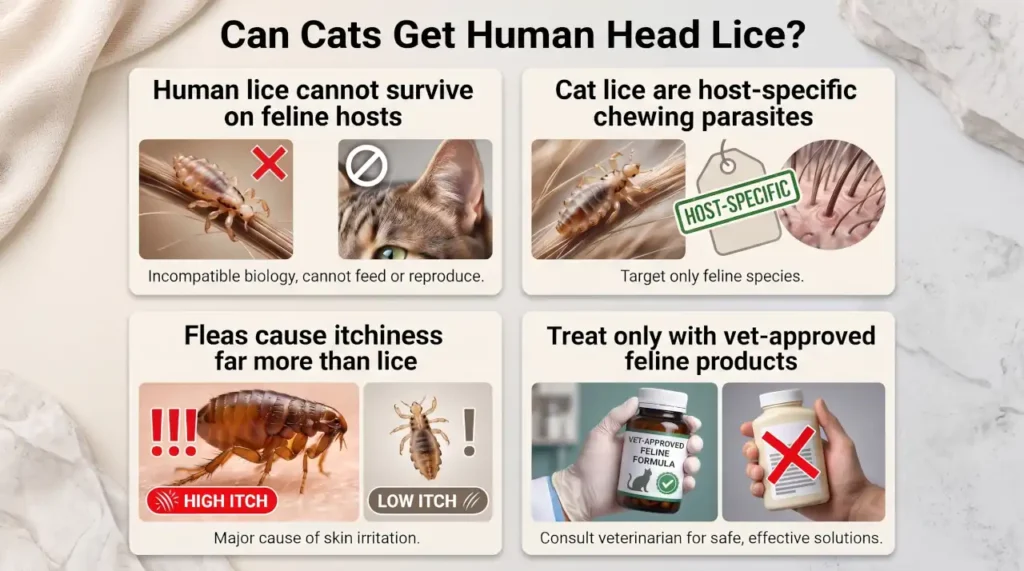
Do head lice live on cats? No, they don’t. Human head lice can’t survive on a cat’s fur, so your kid’s lice outbreak isn’t the reason your cat is scratching. Cats can get their own species of lice, though, and a few other parasites cause the same itch. Let me walk you through what’s really going on and what to do about it.
Also Read: Spadepestcontrol Blog
Quick Answer: Do Head Lice Live on Cats?
No, human head lice do not live on cats. Human head lice (Pediculus humanus capitis) need a human scalp and cannot survive or reproduce normally on a cat. Cats can get their own species of lice, called Felicola subrostratus, but these chewing lice are host-specific and cannot establish an infestation on people. If your cat is scratching, fleas, mites, or other skin conditions are more common possibilities.
Key Takeaways
What Are Head Lice?
Head lice are tiny, wingless insects that live on human scalps. The scientific name is Pediculus humanus capitis, and an adult is roughly the size of a sesame seed. They’re grayish-tan, crawl through the hair, and feed on small amounts of human blood several times a day.
Head lice are adapted to live on the human scalp, where they can grip hair, stay close to the skin, and feed on human blood. A cat’s coat and skin are not a suitable environment for them. Even if a human head louse ends up on your cat temporarily, it cannot establish a lasting infestation because it cannot survive and reproduce normally on a feline host.
The second reason is food. Human head lice need regular blood meals from a human scalp to survive. Away from their host, they become dehydrated and eventually die, generally within a day or two. They cannot establish a breeding population on a cat or survive there long enough to cause a genuine infestation.
Female lice glue their eggs, called nits, to hair shafts very close to the scalp. They need the warmth of a human head to hatch, which takes about a week. Even if a human head louse lays an egg on a cat’s coat, the cat is not a suitable host for the louse to complete its life cycle. Human head lice are adapted to human hair and blood, not feline skin and fur.
Head lice spread from one person to another through direct head-to-head contact. Sharing hats, brushes, pillows, or headphones can also pass them along, though that route is less common. They don’t jump or fly. They crawl.
The Centers for Disease Control and Prevention (CDC) also makes an important distinction here: household pets do not play a role in spreading human head lice. Transmission happens primarily through direct contact between people’s hair, not through cats or dogs. So there’s no reason to keep your cat away from a child who has head lice.
So when someone in your house has head lice and the cat is curled up on the same pillow, the cat isn’t in any real danger from those lice. A louse might wander onto your pet for a moment, but it can’t feed, can’t lay viable eggs, and won’t last long.
Can Cats Get Lice from Humans?
The short answer is no. Lice are highly host-specific parasites, meaning different species are adapted to survive on particular animals. Human head lice are adapted to humans, while the chewing louse found on cats, Felicola subrostratus, is adapted to cats. These parasites cannot simply switch hosts and establish a normal infestation on another species.
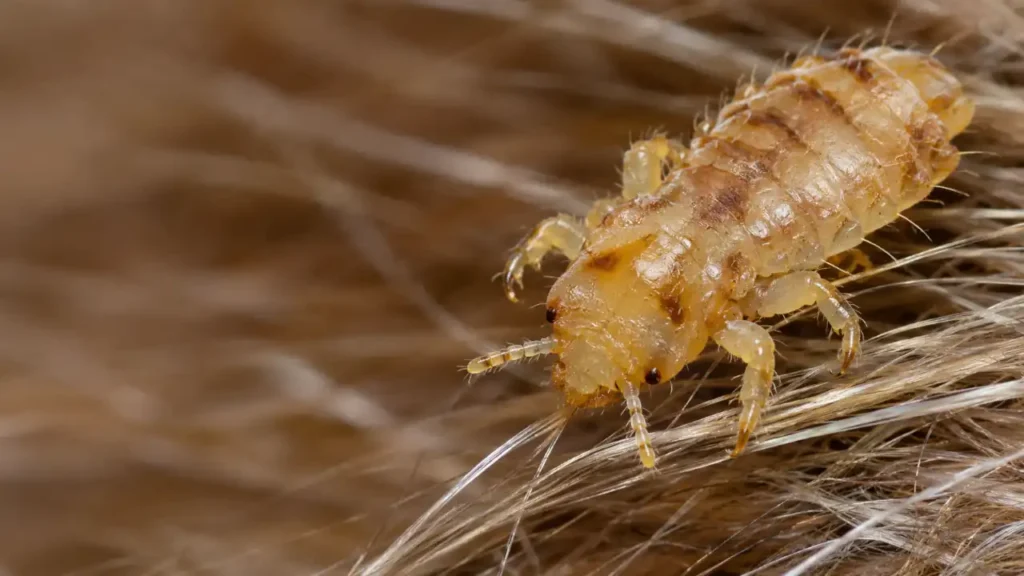
That’s why a child with head lice won’t give the family cat lice, and a cat with its own lice infestation won’t give those lice to the people in the house.
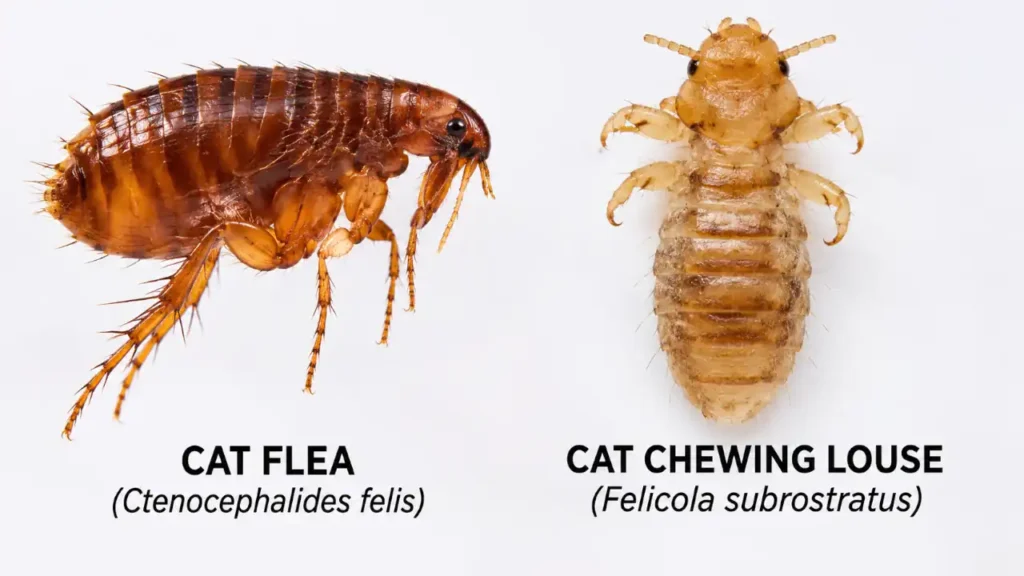
Cats do get their own lice, and there’s really only one species that matters. It’s called Felicola subrostratus, and it’s a chewing louse. Veterinary references list it as the main louse found on domestic cats. It has a broad, almost triangular head, and it’s built for gripping the thicker, rounder hairs of a cat.
A cat louse is adapted to the cat’s coat and skin, not human hair or skin. Petting an infested cat does not give you a cat lice infestation, and you don’t need to avoid normal contact with your pet.
Chewing lice also feed differently from head lice. They don’t drink blood. They chew on flakes of skin, scabs, and debris at the surface. That’s irritating to a cat, and it still causes real itching, but it’s a different problem from the one your child might have.
So if your family has head lice and your cat is scratching at the same time, treat them as two separate problems. It’s a coincidence, and the fix for each one is different. Treating your cat with a head lice shampoo meant for humans is a bad idea. Some of those products contain ingredients that can be harmful to cats, and they won’t solve the problem anyway.
Symptoms and Types of Lice in Cats
Cats are good at hiding discomfort, but lice are hard to hide. The first thing most owners notice is scratching. It might be more than the usual morning scratch. A cat with lice scratches, bites at its skin, and rubs against furniture and door frames. Some cats get restless and have trouble settling down. These are some of the common signs of lice in cats, although scratching and coat damage can also point to fleas, mites, allergies, or other skin problems.
The coat tells a story too. A cat with lice often looks scruffy, dry, and dull. You might see thinning patches or bald spots, especially around the ears, neck, shoulders, groin, and the area near the tail. In bad cases the fur can mat, and the skin underneath may look red or scabby from all the scratching.
Cat lice are tiny, pale-colored insects that crawl through the fur rather than jumping like fleas. Adult lice may be difficult to spot without parting the coat under good lighting. Their eggs, known as nits, are easier to recognize because they remain firmly attached to individual hair shafts. If you notice small insects or white specks that won’t brush away, have your veterinarian check whether they are actually lice.
A magnifying glass can make inspection easier, but don’t rely on appearance alone. Dandruff, skin flakes, and other debris can look like lice eggs. Your veterinarian can examine a sample and confirm whether lice are present.
Here’s something that matters a lot. Most cats that scratch don’t have lice at all. Fleas are a much more common cause of itching, and they can irritate the skin even when you don’t see many of them. Fleas are dark brown, move quickly, and jump. Lice are pale, move slowly, and cling to the hair. If you see tiny black specks in your cat’s fur that turn reddish when wet, that’s likely flea dirt.
Mites are another possibility, especially around the ears, and ringworm is a fungal problem that can cause patchy hair loss. Allergies cause scratching too. So the honest answer to “why is my cat scratching” has several possibilities, and lice sit near the bottom of the list.
That’s why a proper diagnosis matters so much. If you guess wrong and start treating for the wrong parasite, your cat keeps itching, and you’ve wasted time and money.
If your cat keeps scratching despite flea treatment, don’t keep switching products. Have your veterinarian check for lice, mites, allergies, or another underlying skin problem first.
What Causes Lice Infestations in Cats?
Cat lice spread primarily through close contact with an infested cat. They crawl from one animal to another when cats interact, groom each other, or sleep close together. Shared grooming tools and bedding may also contribute to transmission, although direct contact is the more important route.
Unlike fleas, lice cannot jump between animals. They depend on close contact to find another suitable host, which is why cats living together or sharing sleeping areas are more likely to spread an infestation.
Poor Grooming Habits
Healthy cats groom themselves constantly, and that keeps lice numbers low. Licking and chewing remove a lot of lice and eggs before they build up.
When a cat cannot groom properly, an existing lice infestation can become more difficult to control. Older cats with arthritis, overweight cats, and animals with long, matted coats may struggle to remove parasites through normal grooming.
Sick or weakened cats can also neglect their coats. This doesn’t mean poor grooming creates lice. A cat still needs to be exposed to an infested animal or another source of the parasite. However, once lice are present, reduced grooming can allow their numbers to increase more easily.
If your senior cat develops a lice infestation, ask your veterinarian to check for underlying health problems as well as the parasites themselves.
Stray and Outdoor Cats
Outdoor cats meet other cats. That’s just how it goes. They sniff each other, fight, share sleeping spots, and sometimes huddle together in cold weather. All of that gives lice a chance to move over.
Stray and feral cats may have more opportunities to encounter infested animals, particularly when they live or sleep in groups. Cats in poor health or with neglected coats may also have more difficulty keeping lice numbers under control. Close contact allows lice to move from one cat to another.
If you’ve recently adopted a stray or shelter cat, have it examined by a veterinarian before introducing it to other household cats. A routine intake examination can help identify lice, fleas, mites, and other parasites. This is especially important if the new cat has a rough coat, visible hair loss, or persistent scratching.
If your indoor cat slips outside or regularly comes into contact with stray cats, exposure to an infested animal is a possibility. Shared bedding or grooming equipment may occasionally contribute to transmission, but direct contact is the more important risk because cat lice don’t survive well away from their host.
Multi-Pet Households
If you have more than one cat, an infestation can spread to other animals through close contact. Cats that regularly groom each other, sleep together, or spend long periods sharing the same resting areas have more opportunities to exchange lice.
Yes, cat lice are contagious to other cats through close physical contact. An infested cat can pass lice to another cat during grooming, sleeping together, or other direct interactions. However, cat lice are host-specific, so they don’t establish infestations on humans or dogs.
If one cat is diagnosed, check every other cat in the household rather than assuming the problem is limited to one animal. Your veterinarian can advise whether exposed cats also need treatment.
Shared brushes, combs, and bedding should be cleaned before being used on other cats. This reduces the chance of transferring lice between animals.
How to Treat Lice on Cats
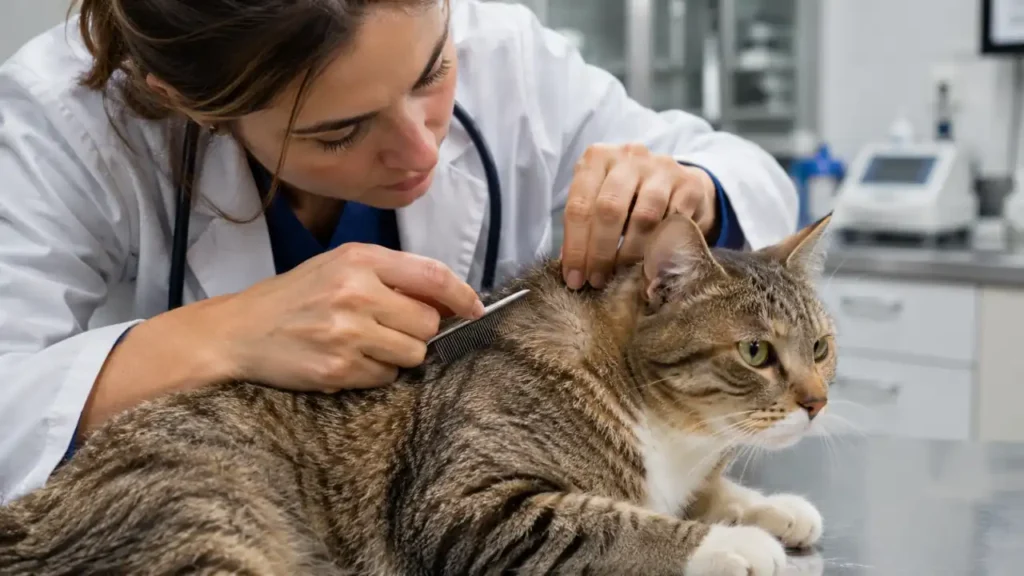
Once your veterinarian confirms that your cat has lice, the infestation is generally manageable with appropriate treatment. Your vet can identify the parasite and recommend a product formulated for cats, taking your pet’s age, weight, health, and the severity of the infestation into account.
Getting rid of cat lice also means checking other household cats and cleaning regularly used bedding and grooming tools. Avoid human lice shampoos and dog parasite products unless your veterinarian specifically approves them for your cat.
When to Take Your Cat to the Vet
I strongly recommend seeing a vet before treating anything. Cats are sensitive to certain ingredients used in parasite-control products, particularly concentrated permethrin formulations designed for dogs. Permethrin poisoning can cause serious neurological symptoms, including tremors and seizures, and can be life-threatening. Never apply a dog flea or lice treatment to your cat unless your veterinarian specifically confirms that the product is safe for feline use.
Your vet can confirm that it’s lice and not fleas, mites, or something else. They’ll look at the coat, check the skin, and sometimes look at a sample under the microscope. That step saves you from guessing.
Once the infestation is confirmed, your veterinarian can select an appropriate treatment based on your cat’s age, weight, health, and the severity of the infestation.
Veterinary treatment options may include certain topical parasite-control products containing ingredients such as fipronil, selamectin, or imidacloprid, depending on the product and its suitability for cats. Some treatments may be used off-label for lice, so don’t assume that every flea treatment will also eliminate cat lice.
Your veterinarian should confirm the correct product, application method, and repeat-treatment schedule. Some treatments require a follow-up application because newly hatched lice may survive the first round.
Home Care During Treatment
Treating your cat is the most important part of eliminating a lice infestation. Cleaning the items your cat regularly uses is a sensible additional precaution, especially in a home with several cats.
Cat lice spend their lives on their hosts, and they don’t survive well away from a cat. Their eggs are attached to individual hairs rather than freely scattered around the home. That’s why you don’t need to treat every room or disinfect every surface to get rid of cat lice.
Focus on cleaning your cat’s bedding, grooming tools, and other items that have recently been in close contact with its coat.
Wash your cat’s bedding, blankets, and other washable resting materials according to their care instructions. Clean grooming brushes and combs with hot, soapy water, and avoid sharing them between cats until the infestation has been resolved.
Vacuum the areas where your cat regularly sleeps or rests, particularly if there is loose hair or debris. Empty the vacuum afterward.
Items that cannot be washed can simply be set aside temporarily rather than subjected to unnecessary chemical treatments. Your veterinarian can advise whether additional cleaning is needed for a severe or recurring infestation.
Also Read:
If you have multiple cats, avoid close contact between the infested cat and untreated household cats until your veterinarian has started an appropriate treatment plan. Check the other cats for signs of lice and follow your vet’s advice about treating exposed animals.
You don’t necessarily need to keep cats in prolonged isolation. The goal is to prevent further transmission while ensuring every affected animal receives appropriate treatment.
Check your cat’s coat regularly during and after treatment. Pay particular attention to areas around the neck, ears, shoulders, and base of the tail, where lice and their eggs may be easier to find.
Ask your veterinarian when to perform follow-up checks and whether another treatment is necessary. Don’t assume the infestation has cleared simply because you no longer see adult lice immediately after the first application.
If you also find fleas, remember that they require a different control approach. Unlike cat lice, fleas can infest areas where your pet rests, so you may need to address both your cat and the affected parts of your home.
Common Mistakes Cat Owners Make When Dealing With Lice
A few common mistakes can make a cat lice infestation harder to manage:
To reduce the risk of lice, have newly adopted cats examined before introducing them to other pets, avoid sharing unclean grooming tools between animals, and keep an eye on changes in your cat’s coat. Regular grooming also helps you notice unusual scratching, attached eggs, or visible insects before an infestation becomes more established.
Final Thoughts
Human head lice don’t live on cats, and cats cannot develop an infestation from a child or adult who has head lice. Cats have their own species of chewing lice, but these parasites cannot establish themselves on people.
If your cat starts scratching, don’t automatically assume it has lice. Fleas are a much more common cause, although mites, allergies, and other skin conditions can produce similar symptoms. A veterinary examination can help identify the actual problem.
Once lice are confirmed, follow your veterinarian’s treatment instructions, check other cats in the household, and clean regularly used bedding and grooming tools. Avoid human lice shampoos and dog parasite products. Treating the correct parasite with an appropriate feline-safe product is the best way to resolve the problem.
Frequently Asked Questions
Latest Post