
You light a citronella candle, sit down with your dinner, and a fly lands on your potato salad anyway. Sound familiar? I have spent over 18 years dealing with flies in homes, patios, and kitchens, and I get this question constantly. So, does citronella really repel flies? The honest answer is that you shouldn’t count on it to keep common household flies away. Let me show you what the evidence tells us and what works better in real homes and backyards.
Also Read: How to Get Rid of Drain Flies Before They Take Over
Quick Answer
Citronella is not a dependable way to repel common household flies. Some citronella products may affect insect behavior, but effectiveness varies, and research on mosquitoes or sand flies does not establish how well they work against house flies, blow flies, or fruit flies. For better results, remove food and breeding sources, keep food covered, use a fan outdoors, and choose traps suited to the fly species.
Key Takeaways
What Is Citronella?
Citronella is a strong-smelling oil that comes from the leaves and stems of a tall, grassy plant in the Cymbopogon family. If you have ever walked through the insect aisle of a hardware store in summer, you already know the smell. It’s lemony, a little grassy, and a bit sharp. Companies have put it in candles, sprays, torches, and coils for decades, mostly because it smells decent and people trust anything labeled natural.
Two different plants usually get lumped under the citronella name. The first is citronella grass, and that’s where the real oil comes from. The second is the “citronella plant” sold at garden centers, which is usually a lemon-scented geranium. It looks nice in a pot on the patio, but it doesn’t carry the same oil, and there’s very little proof it keeps bugs away. Lemongrass is a close cousin of citronella grass and smells similar, but it’s its own plant with its own oil. Plenty of shoppers mix them up, and honestly, so do some product labels.
Citronella oil contains aromatic compounds, including citronellal and citronellol. Its chemical composition helps explain its characteristic smell, but the presence of these compounds doesn’t prove that a particular citronella product will repel common household flies. The finished formulation and the insect being tested both matter. Here’s the catch, though. These aromatic compounds can disperse into the air, and their concentration changes over time. That helps explain why a noticeable citronella scent doesn’t necessarily provide lasting protection against flies. Keep that idea in your back pocket, because it explains almost everything else in this article.
Does Citronella Repel Flies?
The honest answer is that citronella has limited evidence as a practical repellent for common household flies. Some citronella products may affect insect behavior, but results depend on the formulation, concentration, distance, and conditions. Research involving mosquitoes or sand flies cannot tell us exactly how well a candle works against house flies, blow flies, or fruit flies. In a real backyard, I wouldn’t rely on citronella to keep flies off dinner. It may be worth trying as an extra, but food covers, airflow, and proper sanitation are more dependable ways to reduce the problem.
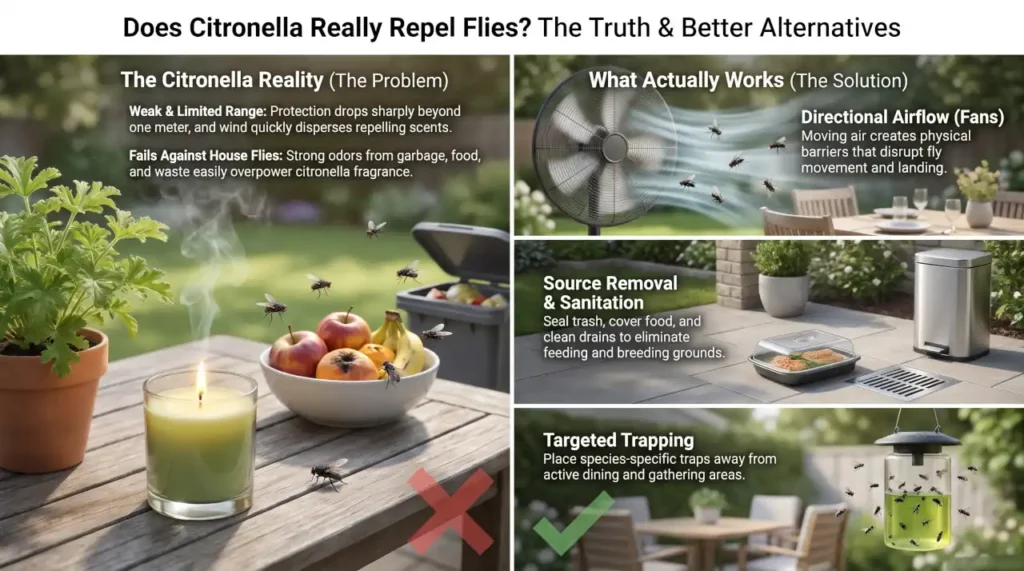
There’s some real science behind this. Researchers tested 5 percent citronella candles outdoors and counted how many biting insects showed up near people. At about one meter from the candle, citronella cut sand flies by roughly 15 percent and mosquitoes by about 35 percent. Move out to two or three meters and the protection dropped off sharply. Sand flies are tiny biting flies, not house flies, so I won’t pretend those numbers copy over perfectly. Still, they show what a citronella candle can actually do. You get a small bubble of weak protection that shrinks the moment you step out of it.
Depending on the species, flies may also be attracted to body odors, moisture, or other cues associated with people and animals. That’s another reason not to assume that a citronella candle will keep every type of fly away from an outdoor gathering.
A common situation in residential fly-control work is a patio where the homeowner has tried scented candles but still sees flies landing on uncovered food. I wouldn’t judge the candle by how strong it smells or whether a few flies appear to move away. I’d check the nearby garbage, outdoor recycling, pet-waste areas, and access points first. If the homeowner then adds a fan and keeps food covered, those changes provide a more dependable starting point for reducing fly contact. The lesson is simple: don’t confuse a pleasant scent with a solved fly problem.
It also depends on which fly you’re dealing with. House flies and blow flies follow the smell of food, garbage, and pet waste. A citronella scent should not be assumed to mask the odors that attract these flies. If garbage, food scraps, or pet waste are accessible, remove the source rather than trying to cover up its smell.
Biting flies such as stable flies and deer flies use a range of cues to find hosts, including carbon dioxide, visual signals, and other host-related cues. A citronella candle is not a dependable way to prevent them from approaching or biting. Fruit flies are often attracted to fermenting produce and sugary residues, while drain flies can breed in organic buildup inside drains. There isn’t enough evidence here to recommend citronella as a dependable way to control either problem. Remove the food source or breeding material instead.
Identify the Fly Before Choosing a Control Method
Not every fly problem has the same cause. Large gray house flies often enter from outside or gather around garbage and animal waste. Shiny blow flies may indicate rotting organic material, including a dead animal or neglected waste. Green bottle flies are a type of blow fly with a distinctive metallic green body. Like other blow flies, they may be attracted to decaying organic material, garbage, or animal remains. If they suddenly appear in large numbers indoors, check for a nearby breeding source rather than relying on citronella.
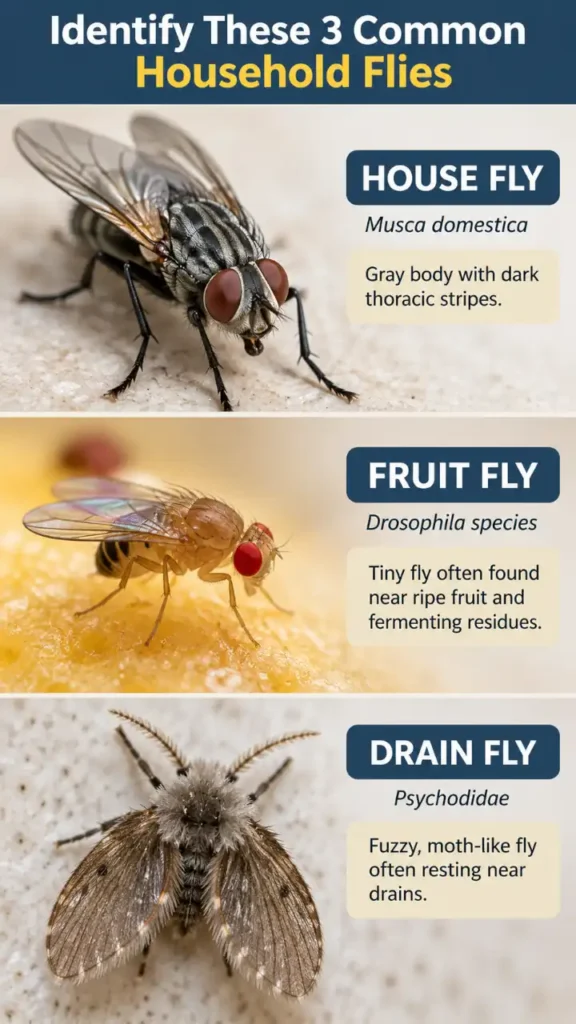
Tiny fruit flies commonly gather around fermenting produce, beverage residue, and other sugary material. Drain flies are small, fuzzy insects that often rest near sinks and breed in organic buildup inside drains.
This distinction matters more than the scent you choose. A fan may help keep flies off an outdoor meal, but it won’t remove a breeding source. A vinegar trap may catch some fruit flies, but it won’t solve a drain-fly problem if the buildup remains. If you suspect drain flies, here’s how to get rid of drain flies by addressing the material where they breed. Identify the fly, find the source, and match the control method to the problem.
Expert Tip: Don’t judge a fly repellent by whether flies avoid the candle. Judge it by whether flies stay off your plate and your skin. If you’re still waving them away every thirty seconds, the product isn’t doing its job, no matter how nice it smells.
Is Citronella Worth Trying for Flies?
After all that, you might expect me to tell you to skip citronella completely. I won’t, because it does have a place. You just need to know what that place is.
First, it’s cheap and easy to find. You can grab a candle, a torch, or a bottle of oil at nearly any store, and you don’t need a license or a special sprayer. If you want to try something this weekend, citronella is the lowest-effort option on the shelf.
Second, some homeowners prefer natural fly repellents because they don’t want to use insecticide sprays around outdoor dining areas. That’s understandable, but a botanical ingredient isn’t automatically harmless, and citronella shouldn’t be treated as a proven substitute for an effective repellent. The same principle applies to eco-friendly pest control: choose methods based on what they actually do, not simply because they’re described as natural.
Third, if you’re wondering whether citronella keeps flies away, treat it as an optional extra rather than the foundation of your fly-control plan. The practical combination is source removal, exclusion, and appropriate trapping. Those measures address the conditions that allow flies to enter, feed, and breed instead of relying on a scent to discourage them.
Finally, some people simply enjoy citronella’s scent and the atmosphere it creates outdoors. That’s a perfectly reasonable reason to use it, as long as you don’t mistake a pleasant fragrance for dependable fly control.
A quick word on safety before we move on. Citronella isn’t harmless to everyone. The oil can irritate skin if you put it on undiluted, and the lemon-scented geranium plant can upset dogs and cats if they chew it. Strong scents can also bother people with asthma or sensitive airways. Use it with some common sense and you’ll be fine.
How To Use Citronella To Keep Flies Away Indoors
This is where I slow people down. Flies inside your home are almost always a sanitation or entry problem, and citronella can’t fix either one. Still, if you want to try it, here’s how to do it without making things worse.
I wouldn’t recommend an indoor citronella diffuser as a fly-control method. There is not enough practical evidence here to justify dispersing citronella oil through your home, especially when the source of the flies can usually be addressed directly. Start by identifying the fly, removing its breeding material or food source, and blocking entry points. If you use any essential-oil product for another purpose, follow its label and consider the needs of children, people with respiratory sensitivities, and household pets.
A citronella-scented geranium can be an attractive windowsill plant, but don’t count on it to keep flies out. Its fragrance is not a substitute for intact window screens, closed doors, or proper food storage. If pets tend to chew houseplants, check whether the particular plant is safe for them before bringing it indoors.
I generally wouldn’t use a citronella candle indoors for fly control. Unless the product is specifically labeled for indoor use, don’t burn it inside. Even when indoor use is permitted, an open flame creates a fire risk, and burning candles can release combustion particles. For indoor flies, focus on finding the source, improving screens and door seals, cleaning affected areas, and using appropriate traps.
Now here’s what I’d actually do about indoor flies. Find where they’re coming from. House flies breed in garbage, pet waste, and rotting food. Fruit flies commonly breed in fermenting produce, spilled juice, and other sugary residues. Drain flies breed in organic buildup inside drains and pipes.
Identify the fly before choosing a control method, because removing the wrong source won’t solve the problem. Once you know which one you have, the fix gets obvious. Take the trash out, wipe the counters, rinse the recycling, and scrub the drain. If you’re not sure which fly you’re looking at, our guide to the kinds of flies that show up in homes can help you sort it out.
Then close the doors. Tight screens, a door sweep, and a quick check for torn mesh stop more flies than any scent ever will.
How To Use Citronella To Keep Flies Away Outdoors
Outdoor use is generally more appropriate for products specifically labeled for outdoor use, but that doesn’t mean citronella will reliably repel flies. Wind, placement, and product formulation can affect performance, and a scented product won’t remove the food, waste, or breeding material attracting flies. If you choose to use citronella outdoors, treat it as an optional extra while focusing on the measures that address the fly problem directly.

You may also see citronella bracelets marketed as wearable insect repellents. Don’t assume a bracelet will protect you from flies simply because it contains citronella. Its effectiveness depends on the formulation and the insect being targeted, so check the product’s claims and supporting evidence before relying on it.
Candles
Citronella candles for flies are popular because they’re easy to find and simple to use outdoors. If you want to try one, follow the product’s directions for placement and outdoor use. Wind, distance, product formulation, and the type of fly all affect the result. Keep flames away from food packaging, dry vegetation, children, and pets, and never leave a burning candle unattended.
Check the label before buying a candle. Look for its intended use, ingredient information where available, and safety directions. A stronger fragrance or a higher advertised citronella content does not, by itself, prove better fly control.
Tiki Torches
Citronella torches are often used in larger outdoor spaces, but burning more fuel or producing more scent doesn’t establish that they will repel common household flies effectively. They require careful placement and fuel handling because an open flame can create a fire hazard, particularly in windy conditions or near combustible materials.
Place torches only where the manufacturer permits, maintaining the specified clearance from buildings, fences, overhanging branches, furniture, and other combustible materials. Check local fire restrictions and wind conditions before lighting them. Set each torch securely, use only the specified fuel, and never refill it while lit or hot. Keep children and pets away, and have an appropriate means of extinguishing a fire available.
Citronella Oil
Citronella oil is sold in several forms, but concentrated essential oil is not automatically more effective than a formulated product. I wouldn’t rely on oil-soaked cotton balls or dishes of exposed oil to control flies; their effectiveness is uncertain, and they create avoidable exposure risks for children and pets. If you want to try citronella outdoors, choose a product labeled for the intended use and follow its directions for placement, duration, and handling. Keep concentrated oil away from flames and hot surfaces, and don’t apply it directly to skin unless the product is specifically formulated and labeled for that purpose.
Citronella coils and sprays vary in formulation, intended use, and effectiveness. Use coils only in the manner specified on the label, in a suitable outdoor location, and away from combustible materials. Don’t modify a coil with foil unless its manufacturer specifically instructs you to do so. For sprays, follow the labeled application method and reapplication interval rather than assuming all products work for the same length of time.
Some scents are marketed as natural fly deterrents, but their effectiveness varies by insect and formulation. Read our guide to [smells flies hate] for a closer look at the evidence and limitations.
Do Citronella Candles Work For Flies?
Sort of. Lots of people swear by them, and I understand why. A candle gives you light, a nice smell, and the feeling that you’re doing something. But when I look at how they perform in real backyards, a handful of problems keep showing up.
The first is product formulation. Citronella candles vary in their ingredients and formulation, and a stronger smell doesn’t necessarily mean better fly control. Without reliable evidence for the particular candle and fly species, you can’t judge effectiveness by fragrance strength or the amount of scent you notice. Two candles that look similar can also differ in composition and performance.
The second is distance. A repellent effect, when present, depends on the product and the conditions around it. The research discussed earlier involved mosquitoes and sand flies, so it cannot establish how far a citronella candle protects against house flies or blow flies.
The third is wind. Air movement can disperse a candle’s scent, and stronger gusts can make an open flame unsafe or extinguish it. Wind can disperse the scent and make an open flame unsafe, so positioning a candle upwind doesn’t guarantee protection from flies.
The fourth is the type of fly. Different species respond differently to environmental cues, and results for one insect cannot automatically be applied to another. A candle that has been tested against mosquitoes, for example, hasn’t necessarily been shown to repel house flies or blow flies.
Should you throw your citronella candles out? Not necessarily. If you enjoy using them, follow the label and treat them as an optional outdoor extra rather than dependable fly protection. Cover food, keep garbage sealed, and use a fan near the seating area. Those measures address the problem more directly than relying on candle fragrance.
Does Citronella Kill Flies?
Citronella products are generally used as repellents, not as a dependable way to kill flies. You shouldn’t expect a candle, diffuser, or dish of citronella oil to eliminate adult flies or destroy eggs and larvae in a trash can or drain.
Some essential oils have shown insecticidal effects in laboratory tests, often under conditions that differ substantially from ordinary household use. Those findings don’t establish that a citronella candle, diffuser, or oil dish will kill flies in a home or yard. If you need to reduce fly numbers, focus on eliminating breeding sites and use traps or labeled insect-control products appropriate for the location and fly species.
If flies keep appearing in large numbers after cleaning, look for a breeding source. It could be a dead animal in a wall void, a clogged drain, a dirty bin, or accumulated pet waste. If you can’t locate the source, a pest professional can help track it down.
What Actually Works Better Than Citronella
I promised you some cheap swaps, so here are the three I recommend over and over. None of them cost much, and all of them beat a candle.
The first is a fan. Flies have difficulty landing and flying steadily in strong, moving air, so a fan aimed across an outdoor dining table can help keep them away from food and people. Position it to move air across the seating area rather than simply blowing toward an open doorway. A fan won’t eliminate the source of a fly problem, but it can make an outdoor meal more comfortable while you address sanitation and other attractants.
Also Read:
The second is cleanup and covers. Flies show up because something is attracting them. Put lids on bins, rinse cans and bottles, scoop pet waste daily, wipe spills right away, and cover food with mesh food tents or lids. Flies are looking for a meal and a place to lay eggs. Take both away and they move on. For kitchen flies in particular, a good scrub of the sink drain and a look at your fruit bowl solves most cases, and our guide to getting rid of fruit flies and drain flies walks through it step by step.
The third is traps, placed smartly. Hang sticky traps in suitable indoor locations near fly activity, but keep them away from food-preparation surfaces and out of reach of children and pets. For fruit flies, a small bowl of apple cider vinegar with a drop of dish soap can help catch adults, but you still need to remove the breeding source. Outdoors, baited bag traps can attract certain flies, so follow the label and place them well away from patios, doors, windows, and other gathering areas. If you want help choosing a trap, see our roundup of the best fly traps for home and yard.
Final Thoughts
So, does citronella really repel flies? It may affect some insects under certain conditions, but there isn’t enough evidence here to promise reliable protection against common household flies. It’s not a dependable way to keep flies off your food, and it won’t eliminate a breeding source. If you enjoy citronella candles outdoors, use them according to their labels, but put your effort into covered food, sealed garbage, a fan, and appropriate traps first.
Try the simple fixes first. You’ll spend less, and your dinner will stay a lot cleaner.