
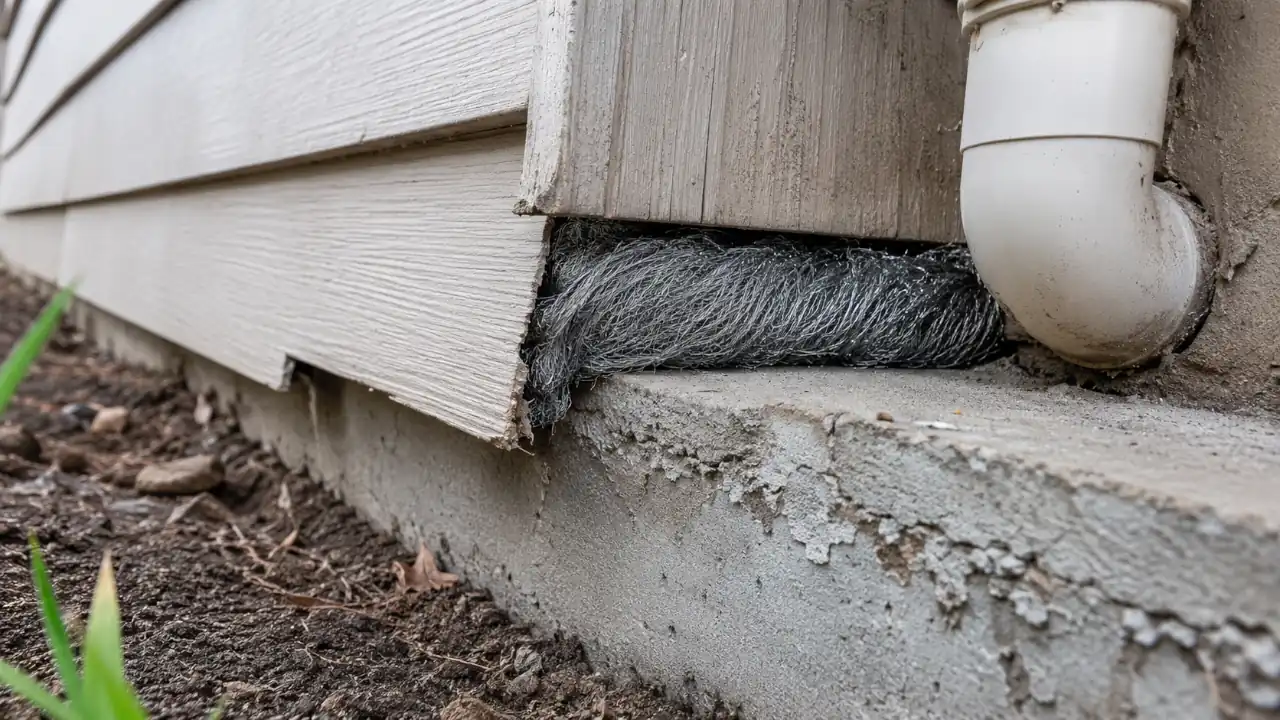
If you’ve ever heard scratching in the wall at 2 a.m., you already know how fast a mouse problem can wreck your peace of mind. Steel wool for mice is one of the cheapest, quickest fixes a homeowner can use to block small entry gaps before rodents get inside. It won’t fix everything, but when used the right way, it can close off a mouse entry point and create a much stronger barrier against future activity. Here’s exactly how to make it work.
Also Read: How to Keep Mice Out of a Shed: 8 Effective Ways
Quick Answer
Steel wool can help keep mice out when it is tightly packed into small entry gaps and secured with an appropriate sealant. It works as a physical exclusion barrier, not as a mouse repellent or treatment for mice already inside. For long-term control, seal every accessible entry point and address any mice that have already entered the home.
How Effective Is Steel Wool for Mice?
Let’s get straight to it, because this is the question everyone actually wants answered. Steel wool is genuinely effective at stopping mice, but only for one specific job: blocking the holes they’re using to get in. It is not a repellent, it’s not bait, and it won’t do anything about mice that are already living in your attic or behind your kitchen cabinets. In that sense, steel wool can deter mice from using a specific entry point, but it shouldn’t be confused with a whole-home mouse repellent. Think of it as a lock, not a trap.
Here’s why it works so well as a lock. A mouse’s front teeth, the incisors, grow continuously throughout its life, so gnawing is basically a daily necessity for them. But those teeth are built for wood, drywall, plastic, and soft insulation, not for chewing through dozens of thin, tangled steel fibers packed tight into a hole. A tightly packed mass of steel fibers is difficult for mice to gnaw through and can discourage them from continuing to work at that particular opening.
Steel wool is difficult for mice to chew through compared with softer materials, which is why it can be useful as part of an exclusion repair. But it isn’t an impenetrable barrier. Mice are persistent animals, and a poorly fitted plug can be pushed, pulled, or bypassed at its edges. The goal is to eliminate the opening rather than rely on the steel fibers alone. Rodent-exclusion guidance from the Internet Center for Wildlife Damage Management likewise emphasizes closing openings and using materials that resist rodent gnawing.
The catch, and this is the part a lot of DIY guides gloss over, is that “correctly” is doing a lot of heavy lifting in that sentence. Loosely stuffed steel wool with gaps around the edges is basically an invitation. Mice will find the weak spot, and if the wool isn’t packed dense enough, they can sometimes work it loose over a few nights of persistent chewing and clawing. So the material itself isn’t the variable that matters most. How you pack it in is what decides whether it holds.
Expert Tip: Don’t just wad the steel wool into a loose ball and shove it in the hole. Pull a strand out, twist it tightly like you’re braiding rope, and pack it into the gap in layers, pushing each layer in firmly with a flathead screwdriver or a putty knife before adding the next. A properly packed hole should feel almost solid when you press on it. If you can wiggle a pencil into any part of the gap around the wool, mice can too, so go back and add more.
What Type of Steel Wool Is Best for Mice?
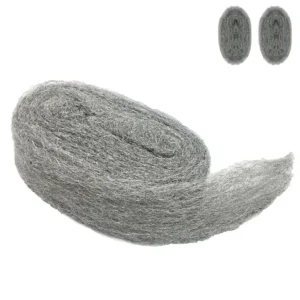
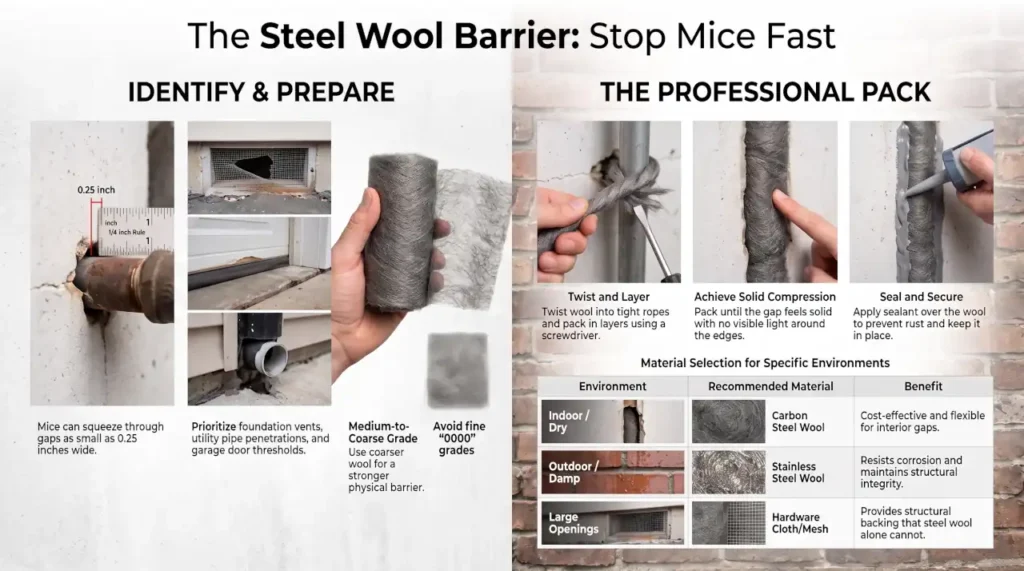
Walk into any hardware store and you’ll notice steel wool comes in different grades, usually labeled with numbers such as 0000, 00, 0, 1, 2, and 3. The very fine grades, such as 0000 and 00, are primarily intended for polishing and finishing rather than filling rodent entry gaps. For mouse exclusion, I prefer a medium-to-coarse grade because it is easier to pack tightly and provides a more substantial physical barrier. The exact grade matters less than completely filling the opening and securing the material so mice cannot work around its edges. If the packaging doesn’t list a grade, avoid anything extremely fine, fluffy, or easy to pull apart.
A quick note on stainless versus regular carbon steel wool. Regular steel wool is cheaper and works fine indoors, but it will rust if it gets wet, and rusted steel wool loses a lot of its rigidity over time, which weakens the barrier. For outdoor or consistently damp locations, stainless steel wool is worth considering because it is more resistant to corrosion than ordinary steel wool.
For damp or exposed locations, stainless steel wool is worth considering because it is much more resistant to corrosion than ordinary carbon-steel wool. Regardless of the material, outdoor exclusion repairs should still be secured and protected from moisture rather than treated as a maintenance-free fix. Avoid using steel wool that has been treated with cleaning chemicals, soap, or other additives. You’re looking for plain steel wool intended as a raw material, not a kitchen scouring pad. Plain steel wool pads or rolls can both work; choose whichever allows you to pack the material tightly into the particular opening you’re repairing.
Can You Use Soap-Filled Steel Wool for Mice?
It’s better to use plain steel wool without soap, detergent, fragrances, or other cleaning additives. Soap-filled scouring pads are designed for cleaning dishes and surfaces, not for filling gaps in a home. The cleaning ingredients aren’t intended to be packed into wall cavities or building gaps and can create an unnecessary mess or residue. For mouse exclusion, plain coarse steel wool is the simpler choice.
Can Mice Chew Through Steel Wool?
This is the question people ask right after they’ve packed a hole and are lying in bed wondering if it actually worked. The honest answer is that steel wool should not be treated as completely chew-proof. A mouse may damage or pull apart a poorly installed barrier, particularly if it can reach the edges. The more common failure, however, is that the mouse finds a gap beside or behind the material rather than chewing directly through a tightly packed plug.
Mice are persistent, and if there’s food or warmth on the other side of that barrier, they’ll try. What usually happens with a badly packed job is the mouse doesn’t chew through the wool fibers themselves, it works around the edges instead, finding a soft spot where the packing is thin or where the wool wasn’t pushed all the way to the back of the hole. That’s a packing failure, not a material failure. When steel wool is compressed tightly enough that there is no significant space around the edges, it creates a physical barrier that is much more difficult for a mouse to gnaw through or work around.
Moisture is another consideration. Ordinary steel wool can corrode in damp locations and gradually lose its structural integrity. That’s why exposed steel wool shouldn’t be treated as a maintenance-free repair. In outdoor or consistently damp areas, use a corrosion-resistant material where appropriate and inspect the finished repair periodically. The same principle applies to chemical or scent-based deterrents: products such as ammonia for mice shouldn’t be treated as a substitute for physically closing an entry point.
This is exactly why pairing steel wool with a sealant, which we’ll get into next, matters so much for anything meant to last more than a season. The result is less a chemical mouse repellent than a physical deterrent: the mouse encounters a barrier that makes that particular route difficult to use.
Where Mice Most Often Get In
Before we get to the steps, it helps to know where you’re actually likely to find these gaps, because most homeowners check the obvious spots and miss the ones that matter most. Foundation vents and crawl space openings are a huge culprit, especially on older homes where the mesh covering has rusted out or bent at a corner. Utility penetrations are another big one. If you’re unsure how to safely seal an opening around a gas line or other utility, have the appropriate qualified professional handle that repair.
Garage doors are a sneaky one too. Even a quarter inch gap under a garage door, which is extremely common once the rubber seal starts to wear down, is more than enough room. Dryer vents also deserve attention, but don’t simply stuff steel wool into the vent opening. The vent needs to remain open so the dryer can exhaust properly. Instead, inspect the exterior vent cover and surrounding wall penetration for damage or gaps and repair the opening without obstructing airflow.
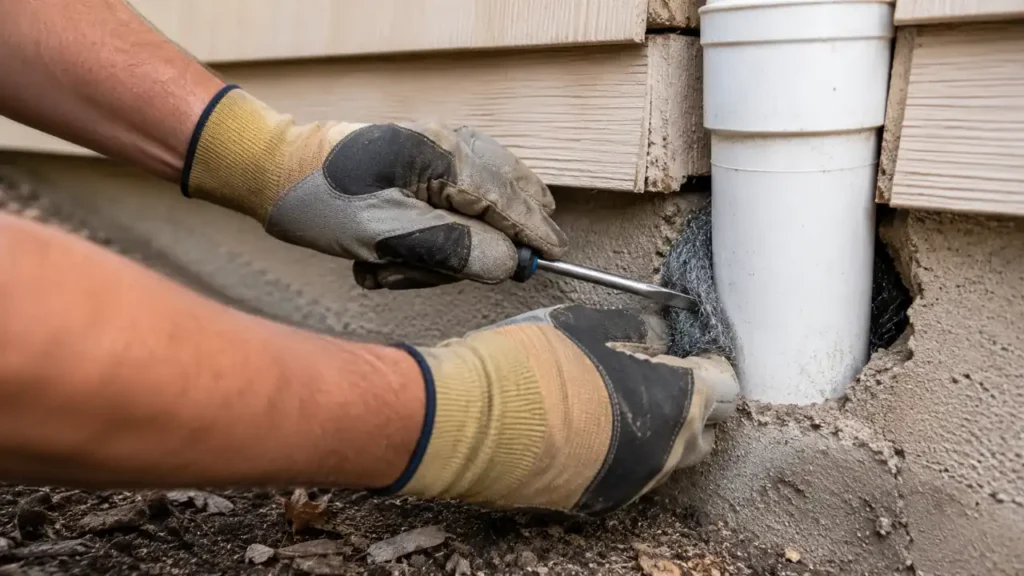
The reason steel wool is so well suited to all of these spots is that they’re rarely a clean, uniform circle. They’re jagged, irregular, and often at awkward angles, which is exactly the kind of gap that a rigid patch or a pre-cut plug can’t handle well but a moldable material like steel wool handles easily.
These same exclusion principles matter in outbuildings, too. If you’re dealing with a detached storage area, it’s worth learning how to keep mice out of a shed because sheds often have more gaps around doors, siding, foundations, and utility penetrations than the main house.
How To Plug Mouse Holes with Steel Wool: Step by Step
Now let’s walk through the actual repair. The material matters, but the way you install it is what determines whether the barrier holds.
Find Every Entry Point First
Before you touch a single steel wool pad, walk the entire perimeter of your home, inside and out, and look for gaps. Remember, mice can squeeze through surprisingly small openings. A gap around 1/4 inch is large enough to be a potential entry point for a mouse, so don’t dismiss small cracks simply because they look insignificant. Pay particular attention to transitions between different building materials, such as where siding meets the foundation or where pipes and cables pass through walls. These locations often develop small gaps that are easy to overlook during a quick inspection.
Check around pipes under sinks, gaps where cables or wires enter the house, dryer vents, foundation cracks, gaps around window frames, exterior doors, and door thresholds, and the corners where your siding meets the foundation. Look for dark smudge marks too. Those dark, greasy rub marks along baseboards, walls, or other travel routes can be a sign of repeated mouse activity, although they aren’t proof of an entry point by themselves.
If you are actively hearing mice or finding fresh droppings indoors, don’t assume that sealing exterior gaps alone will solve the problem. You may need to address the mice already inside while completing the exclusion work.
If the opening is clearly an exterior entry point and you are not dealing with an animal trapped inside a wall or other enclosed space, sealing it is an important part of exclusion. But if you suspect mice are currently using a wall, ceiling, or other inaccessible void, first determine how they are getting in and out before sealing an opening that could leave an animal trapped inside.
Clean The Area Before You Pack It
Wipe away dust, debris, or old caulk around the hole so the steel wool has something solid to grip against, and so you can actually see the true size and shape of the gap you’re dealing with.
Prepare Enough Steel Wool to Fill the Opening
Don’t use a piece that’s roughly the same size as the hole. Prepare enough steel wool to completely fill the opening after it has been compressed and packed tightly. You want a piece noticeably bigger than the gap, because you’re going to compress it down as you pack it in. Use enough material to completely fill the opening after compression. For a larger opening, don’t rely on a loose wad of steel wool alone; use a more substantial repair material or backing appropriate for the size and location of the gap.
Twist It Before You Push It In
Loosely packed, fluffy wool leaves pockets of empty space inside the hole, and empty space is exactly what a mouse needs. Twist the wool into a tight rope shape first. This makes it denser and easier to control as you push it into an irregular gap.
Pack It in Firmly, Working from the Back Forward
Use a flathead screwdriver, pliers, a putty knife, or even a thick wooden dowel to push the wool deep into the hole first, then keep adding and packing until the material is flush with or slightly bulging past the surface. Press on it once you’re done. It should feel solid, almost like packed clay, with zero give at the edges. If you can see daylight or a visible gap around the packed material, keep adding steel wool until the opening is completely filled.
Seal It for a Longer-Lasting Repair
Steel wool is best viewed as part of an exclusion repair rather than a permanent standalone solution. Once the gap is tightly packed, secure the repair with an appropriate sealant or patching material for the surface and location. The added material helps hold the steel wool in place, reduces moisture exposure, and closes small gaps around the edges. For larger structural openings, use a repair material suited to the size of the opening rather than relying on steel wool alone.
Recheck It in A Few Weeks
Especially outdoors, take a look at your packed holes after the first heavy rain or after a month has passed. Press on them again. If anything has shifted, sunk in, or started to rust and crumble, redo it while the gap is still small and manageable.
A Common Mouse-Exclusion Mistake I’ve Seen
One of the most common problems with steel-wool repairs is that homeowners find one obvious hole, seal it, and assume the problem is solved. In a typical older home, there may be several small openings within a few feet of each other—around a utility line, beneath siding, at a foundation transition, or around a vent. The first sealed hole can look perfect while the mouse simply shifts to the next opening. That’s why I always treat steel wool as part of a larger exclusion inspection rather than a one-hole fix.
The Benefits of Using Steel Wool for Mice
The appeal is pretty simple: steel wool is inexpensive, easy to shape, and useful for closing small, irregular gaps where mice may enter. First, it’s genuinely cheap. A small amount can cover multiple minor gaps, making it an inexpensive material for basic exclusion work.
Second, it doesn’t rely on rodenticide. That can make exclusion appealing in homes where homeowners want to reduce the use of toxic pest-control products. However, exposed steel wool can still cause cuts or irritation, so it should be installed where children and pets cannot easily reach it and secured as part of the finished repair.
It’s also incredibly flexible to work with, literally. Steel wool bends and molds into whatever oddly shaped gap you’re dealing with, whether that’s a round pipe opening, an irregular crack in a foundation, or a gap behind a cabinet. You don’t need to cut it to a precise size the way you might with a rigid patch material. It’s also easy to find. Hardware and home-improvement stores commonly carry several grades and forms of steel wool, so homeowners can usually find a suitable material without special equipment.
Maybe the biggest benefit, though, is that it addresses the actual root of a mouse problem instead of just managing the symptoms. Traps and bait deal with mice that are already inside. Steel wool, when used correctly as part of exclusion, can stop mice from entering through the specific openings you’ve sealed. Pest control professionals will tell you that exclusion is the foundation of any long-term rodent strategy, because you can trap and remove mice all season long, but if the entry points stay open, you’re just running on a treadmill while new mice keep replacing the ones you caught.
Common Mistakes People Make with Steel Wool
A few things tend to trip people up, so it’s worth calling them out directly. The biggest one is using too little material and packing it loosely, which we’ve already covered, but it’s worth repeating because it’s the number one reason steel wool “fails” for people. The second mistake is skipping smaller gaps because they seem too tiny to matter. A quarter inch gap doesn’t look like much to us, but to a mouse, that’s a wide-open doorway.
Another common slip up is forgetting to check less obvious spots, like where a cable box or satellite line enters the exterior wall, gaps around exterior faucets, or the small space where an AC line runs through the wall. These out-of-the-way spots are actually favorites for mice because homeowners rarely inspect them.
Also Read: The Cost Of Mouse Extermination: A Complete Price Guide
Lastly, some people treat steel wool as a finished, long-term repair without securing or protecting it. That works fine for a while, but exposed steel wool left bare for a year or two, especially outdoors, will eventually rust, loosen, or get tugged at by weather and wildlife. Securing the material with an appropriate sealant or patch can make the repair more durable, but outdoor and high-moisture repairs should still be inspected periodically.
Final Thoughts
Steel wool isn’t a magic fix, and anyone who tells you it solves an entire infestation on its own isn’t giving you the full picture. What it is, though, is a practical and affordable material for the specific job of closing small mouse entry points, and that job matters more than most people realize. Combine exclusion with appropriate trapping and sanitation measures when mice are already active indoors. Keep food sealed, reduce accessible food and nesting materials, and continue monitoring for signs of activity.
Do that consistently, and you can significantly reduce the opportunities for new mice to enter. If scratching, droppings, nesting material, or other signs continue after the accessible entry points have been sealed, assume that mice may still be inside and address the active infestation separately. If you’re dealing with an infestation that feels bigger than a few sealed gaps can handle, it’s worth taking a broader look at your overall mouse control approach, or bringing in a local pro to walk the property with you.
Safety Note: Wear gloves and eye protection when handling steel wool, particularly when packing it into tight or overhead spaces. Keep loose steel wool away from children and pets. Never use steel wool or sealant to block a vent, flue, dryer exhaust, combustion-air opening, or any other opening that is required for safe operation of an appliance or building system. Do not use steel wool as a substitute for repairing damaged electrical wiring, gas-line penetrations, structural openings, or other building components that require a specific repair method.