If you’ve ever walked into your kitchen at 6 a.m. and found a thin, determined line of ants marching across your counter, you already know how annoying this problem is. Knowing how to get rid of ants in the kitchen isn’t just about killing the ants you can see. You need to figure out what is attracting them, where they’re getting inside, and whether there’s a colony nearby.
In many cases, a kitchen ant problem can be handled with careful cleaning, baiting, exclusion, and a little patience. But the right approach depends on the species and where the colony is nesting, and some infestations are much harder to eliminate than others. After years of dealing with ant calls from frustrated homeowners, I can tell you the fix usually comes down to a handful of simple, safe steps done in the right order.
Also Read: How To Get Rid of Sugar Ants (Fast & Easy Fix)
Quick Answer
The most reliable way to get rid of kitchen ants is to remove food and water sources, follow active trails to identify entry points, and use an appropriately labeled ant bait when needed. Bait is generally more useful for eliminating a colony than simply killing visible ants. Once activity drops, seal cracks and gaps to reduce the chance of ants returning.
How Did Ants Get into Your Kitchen?
Ants don’t just appear out of nowhere. Somewhere nearby, there may be a colony going about its business. Depending on the species, that nest could be outside near the foundation or somewhere inside the structure itself.
A few scout ants wander off looking for food and water, and when one of them stumbles onto something worth eating in your kitchen, it heads straight back to the nest and lays down a scent trail for the rest of the colony to follow. If you’re trying to figure out what attracts ants to your house in the first place, food and moisture are usually the first things worth checking.
From there, it’s a numbers game. Ants can squeeze through gaps you’d never even notice, things like a hairline crack in a window frame, a gap under a door sweep, or a loose seal around a pipe that runs into your kitchen wall. Once that scent trail is established, more ants show up, and what started as two or three ants can turn into dozens within a day or two.
Ant activity can also increase after periods of heavy rain, although the exact reason depends on the species and where the colony is nesting. Saturated soil can disrupt outdoor nesting areas, while wet conditions can change where ants search for food and shelter. If ants suddenly appear indoors after a storm, check exterior walls, doors, windows, and plumbing penetrations for possible entry points.
Check the full route from the kitchen to the exterior: window frames and screens, door thresholds and weatherstripping, siding or foundation cracks, utility penetrations, and gaps where cabinets meet walls. If you also notice visible colonies outside, knowing how to get rid of ant hills can help address the source rather than only treating the ants that make it indoors. Don’t assume the opening has to be directly beside the ants you see.
Quick Tip: Ants are small enough to use surprisingly narrow gaps around windows, doors, baseboards, plumbing penetrations, and other openings. Rather than looking for one specific gap size, inspect areas where different building materials meet or where pipes and wires enter the kitchen. Run your hand along baseboards, window sills, and areas where pipes or cables enter the wall. Those are common places to find an entry point, although the actual source may be outside or somewhere inside the structure.
How To Get Rid of Ants in the Kitchen
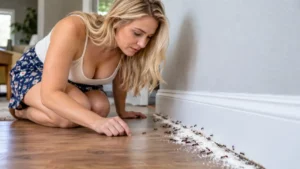
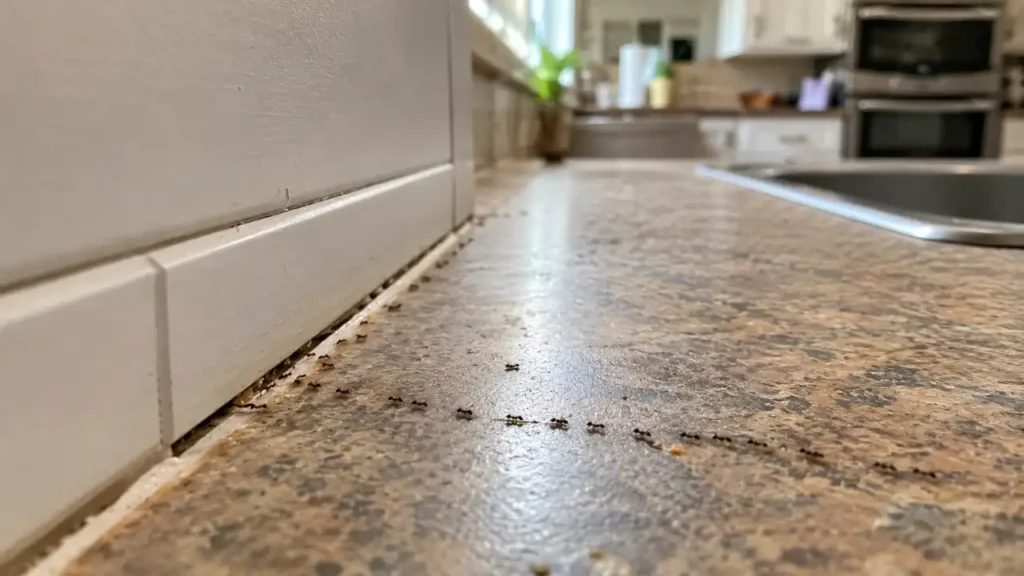
Before you start treating an active ant trail, spend a few minutes watching where the ants are going. Follow the trail in both directions and look for places where ants disappear beneath baseboards, behind appliances, around windows, under cabinets, or through gaps around plumbing.
Also look at the other end of the trail. The ants may be traveling to a food or moisture source rather than entering directly where you first noticed them.
Field Tip: When tracing an ant problem, pay attention to where the ants disappear rather than where you first notice them. A trail across your countertop may lead back to an entry point several feet away—or even to a nest somewhere inside the structure.
Don’t start opening walls or drilling into cabinets just because ants disappear into a crack. Mark the location, continue monitoring the trail, and use that information to decide what to do next.
1. Clean Up the Kitchen
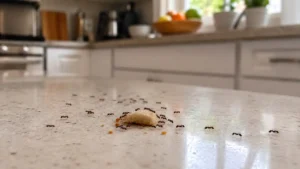
This is where every ant treatment plan should start, and it’s more important than most people give it credit for. Your kitchen is basically an all-you-can-eat buffet from an ant’s point of view, and even a spotless-looking counter can have enough residue to keep a colony fed.
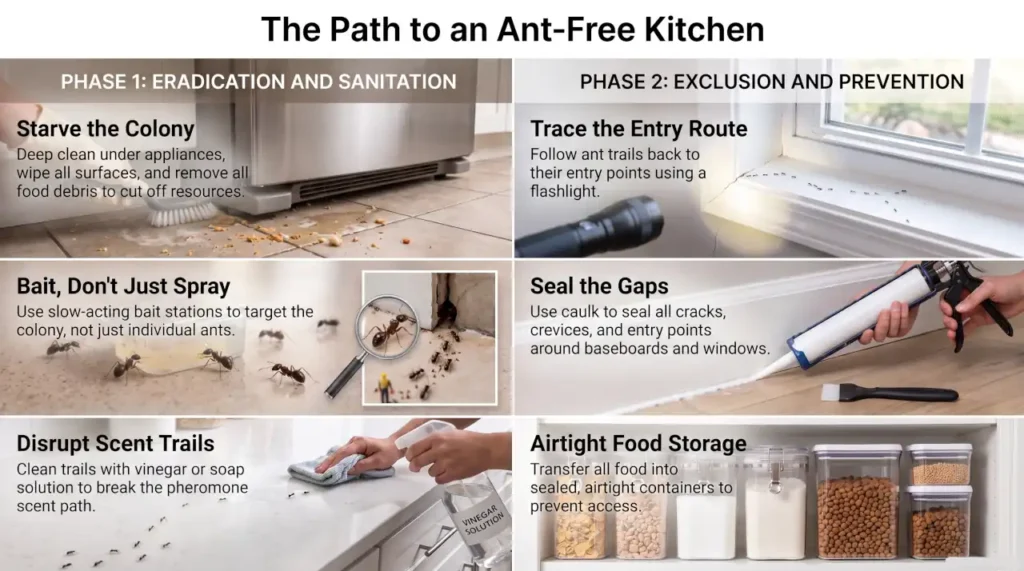
Don’t settle for a quick wipe-down. Sweep and mop the floors, scrub the counters, and get into the corners where crumbs like to hide. Pull out the trash can and clean underneath it, since that spot collects more grime than people expect. Check inside cabinets too, especially the ones where you store cereal, snacks, or pet food, because a single spilled kernel can be enough to attract a scout ant.
Also check the corners and seams of pantry shelves, especially around sugar, honey, syrup, cereal, pet food, and opened packages. If you find ants inside a food package, don’t simply wipe the outside and put it back; discard contaminated food and clean the surrounding storage area.
The sink deserves special attention here. Standing water, food particles caught in the drain, and greasy residue on dishes left overnight all pull ants in fast. If you’ve been dealing with ants in your kitchen sink, that’s usually the first spot to deep clean, since a wet, food-covered drain is basically an open invitation.
One important point: cleaning can reduce ant activity without eliminating the colony. If ants already have an established trail into the kitchen, removing crumbs and spills may simply make the remaining food source harder to find. Keep cleaning as part of the control process, but don’t assume a spotless kitchen means the colony is gone.
Quick Tip: Move your stove, toaster oven, and refrigerator away from the wall at least once and clean behind and underneath them. People are always shocked at what’s collected back there, and it’s often the exact food source keeping an ant trail alive long after the counters look spotless.
2. Don’t Leave Food Out
Once your kitchen is clean, the next job is keeping it that way, and that starts with how you store food. Leaving fruit in a bowl on the counter, cookies in an open container, or cereal boxes with the top folded but not sealed all give ants something worth coming back for.
Get in the habit of putting things away as soon as you’re done with them. Keep foods that attract ants, especially sweets, bread, sugar, pet food, and opened packages, in sealed containers whenever practical. Anything else, snacks, bread, sugar, pet food, should go into airtight containers. It’s not just about keeping ants physically out. Sealed containers also trap the scent, so scouts can’t pick up on it in the first place.
Water matters just as much as food. Don’t let dishes soak in the sink overnight, and wipe down the area around your pet’s water bowl, since that’s a spot people rarely think about but ants love.
3. Place Ant Bait
Cleaning and food storage stop new ants from getting interested, but if you already have an active trail, you need to deal with the colony itself, and that’s where bait comes in. This is honestly one of the most useful tools you have because it can reach ants you don’t see rather than simply killing the workers in front of you.
Ant bait works by taking advantage of the ants’ normal food-sharing behavior. Workers consume or collect the bait and may carry it back to the nest, where it can be shared with other ants. Because effective baits are designed to work slowly enough to allow this behavior, bait can reach ants you never see rather than simply killing the workers walking across your counter.
The important part is choosing a bait that the ants will actually accept and following the product label. Ant food preferences can change with species and colony needs, so a bait that attracts one infestation may be ignored by another.
One mistake I see often: homeowners spray the entire trail as soon as they see it. That can kill the workers in front of you, but it can also disrupt the trail and prevent ants from reaching bait. If you’re using bait, give the ants a chance to find and feed on it before using a repellent spray in the same area.
You’ll find bait in gel, liquid, and station form at almost any hardware or grocery store. Some ants are strongly attracted to sweet foods, while others may prefer protein or greasy foods. Preferences can also change over time. If the ants ignore one bait, don’t assume baiting itself has failed; the formulation may simply not be attractive to that colony. Give an accepted bait time to work rather than repeatedly moving or replacing it simply because ants are still visiting.
Don’t keep moving stations around every few hours or immediately replace bait simply because ants are still active. Continued feeding can actually be a good sign that workers are accepting the bait.
Safety note: Commercial ant baits are pesticides, even when they are sold as convenient household products. Use only products labeled for the intended indoor location, follow the directions on the label, and keep bait away from children, pets, food, dishes, and food-preparation surfaces unless the product label specifically permits otherwise.
If the ants ignore one bait, don’t immediately assume the colony can’t be controlled with bait. The formulation may simply not be attractive to that colony. Follow the product label and consider a different appropriately labeled bait if necessary. Place bait stations where ants are actively foraging and where the product label permits their use. Avoid placing bait directly on food-preparation surfaces, and don’t apply more than the label recommends.
4. Sprinkle Diatomaceous Earth
If you choose to use diatomaceous earth, understand what it can and cannot do before applying it. Diatomaceous earth is a finely powdered material made from fossilized remains of diatoms. Its insecticidal effect is primarily physical: when susceptible insects contact the powder, it can damage the waxy outer layer that helps prevent water loss. The University of Minnesota Extension explains how diatomaceous earth works and the important distinction between different types of diatomaceous earth.
If you choose to use a diatomaceous-earth product, apply it only where the product label permits and use the smallest effective amount. Avoid spreading loose powder across exposed kitchen surfaces or anywhere it could become airborne, contaminate food, or be easily disturbed.
You generally don’t need a heavy application. Apply only the amount directed on the product label, because excessive loose powder can create unnecessary mess and airborne dust. Keep in mind this method needs to stay dry to work, so it’s not the best choice right on a damp countertop or near the sink.
5. Use Vinegar to Clean Ant Trails
Vinegar is useful primarily as a cleaning option for areas where ants have been traveling. A diluted vinegar solution can help remove food residue and may disrupt the scent trails ants use to navigate. It is better viewed as a cleanup and trail-disruption method than as a reliable way to eliminate an established colony.
If you use vinegar around the kitchen, apply it to an appropriate surface and follow normal food-preparation hygiene. A common choice is equal parts white vinegar and water, although you should use a dilution appropriate for the surface you’re cleaning. Don’t spray any household cleaner directly onto food, dishes, appliances, or surfaces where the product isn’t appropriate. Also avoid mixing vinegar with bleach or other cleaning chemicals.
6. Be Careful with Homemade Borax Baits
Homemade borax ant baits are a commonly recommended DIY remedy, but there are some important safety considerations if you’re thinking about using borax to kill ants. I wouldn’t make it the first choice in a kitchen where children or pets have access. Borax-containing mixtures can be harmful if swallowed, and homemade formulations don’t have the same product-specific directions and safeguards as a labeled ant bait.
If you decide to use a borax-based product, keep it completely inaccessible to children and pets and follow the product’s directions. For most homeowners, a properly labeled commercial ant bait in a tamper-resistant or enclosed station is the more straightforward option.
Important: Don’t place loose homemade bait beside food, on countertops, or anywhere a child or pet could reach it. Never assume that a household chemical is safe simply because it is commonly used as a DIY pest-control remedy.
7. Seal Up Openings
The last step, and honestly one people skip too often, is closing off the gaps ants are using to get in. You can treat the ants inside your kitchen all day long, but if the entry point is still open, you’re just going to deal with a new wave eventually.
Walk the perimeter of your kitchen, both inside and outside if you can, and look closely at doors, windows, and anywhere pipes or cables pass through the wall. Check weatherstripping for wear, since rubber and foam break down over time and leave gaps that are easy for ants to exploit. Small cracks in exterior siding or foundation walls are worth checking too, especially if your kitchen backs up to an exterior wall.
Once you’ve identified the entry point, seal an appropriate crack or gap with a suitable caulk or sealant. Larger openings may need a different repair method, while worn door sweeps or damaged weatherstripping should be replaced rather than simply caulked. If the opening involves plumbing, electrical wiring, structural damage, or a building component you’re not comfortable modifying, have the appropriate professional handle the repair.
Kitchen Ant Treatment Safety
The kitchen is one place where more pesticide isn’t necessarily better. Keep pesticides and homemade bait mixtures away from food, dishes, children’s reach, and pet-accessible areas. Never mix cleaning chemicals together, and don’t apply a pesticide to a food-preparation surface unless its label specifically permits that use.
If you’re using a commercial ant product, read the entire label before applying it. The label determines where the product can be used, how much should be applied, and what precautions are required. When in doubt, use less intervention rather than combining several different products.
Ways To Keep Them Off Your Kitchen Counter
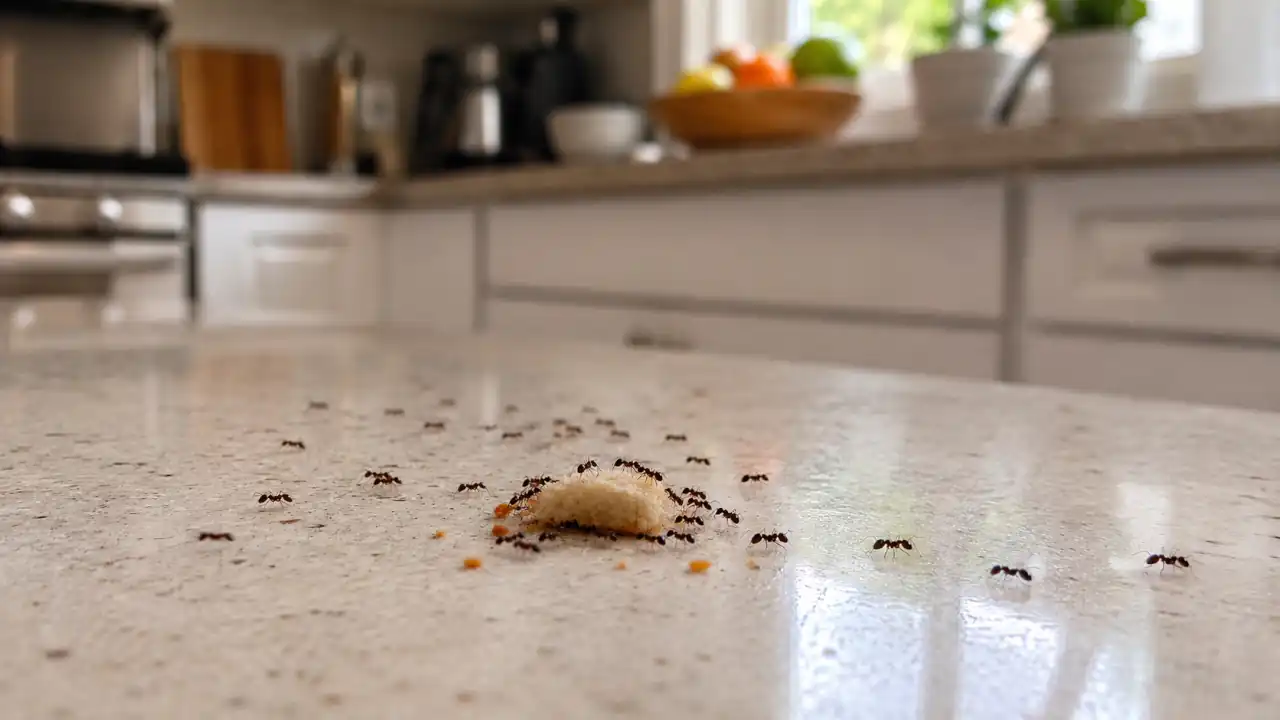
Counters get a lot of ant traffic because that’s where food prep happens, and even careful cleaning can miss the small stuff that draws ants in. Because kitchen counters are food-preparation surfaces, the priority should be cleaning and preventing contamination rather than spraying an insecticide onto the counter. Wipe up food and spills promptly, clean the trail with an appropriate household cleaner, and keep pesticides away from food-contact surfaces unless the product label specifically allows that use.
A diluted vinegar solution can be useful for cleaning some suitable surfaces, while dish soap and water can help remove ants and food residue. Neither should be treated as a substitute for colony control when an established infestation is present.
Neither of these sprays will solve a bigger infestation on their own. Think of them as your quick-response tool for the ants you actually see, while the bait, diatomaceous earth, and sealing work handle the bigger picture.
Quick Tip: The single best way to keep ants off your counters long term is to give them nothing to find there. Wipe up spills the moment they happen, rinse cutting boards right after use, and avoid leaving dishes with food residue sitting out, even for what feels like just a few minutes.
What Attracts Ants to Your Kitchen?
Ants aren’t in your kitchen because they’re trying to bother you. They’re usually in your kitchen because they’ve found resources worth returning to, most commonly food, moisture, or both. It’s essentially a buffet with a water source attached, and once scouts find it, the rest of the colony follows.
Food is the obvious draw. Crumbs on the floor, spills on the counter, an open bag of sugar, even pet food left out overnight, all of it sends a signal. Different species have different preferences, with some going after sweets and others chasing grease or protein, but almost everything in a typical kitchen appeals to one type of ant or another.
Water matters just as much, and it’s often overlooked. A leaky pipe under the sink, condensation around a window, or a damp sponge left sitting out can be enough to keep a colony coming back even after you’ve locked down the food.
Once ants find a reliable source of food or moisture, they may continue using the same route and, depending on the species, may establish additional nesting sites nearby. Some species are much more likely than others to spread through multiple nests, so persistent activity can be a clue that the infestation needs closer identification rather than simply more cleaning.
Types of Ants Found in the Kitchen
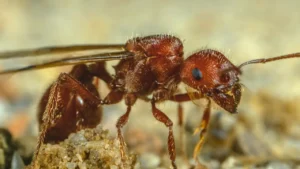
Not all ants behave the same way, and knowing which species you’re dealing with can help you pick the right bait and treatment. Common kitchen invaders include odorous house ants, pavement ants, Argentine ants, pharaoh ants, and carpenter ants, although the species you’ll encounter depends heavily on your region.
If the ants you’re seeing are especially small and seem drawn to greasy foods around the kitchen, you may be dealing with grease ants in the kitchen, which can behave differently from the more commonly discussed sweet-feeding ants.
Which ants are most common depends heavily on where you live. Odorous house ants and pavement ants are widespread, while Argentine ants are particularly important in warmer regions. Pharaoh ants can occur indoors in many areas, and carpenter ants are more likely to become a concern where suitable nesting wood and moisture are available. Identification matters because behavior and bait preferences can vary by species.
Odorous House Ants
Odorous house ants are small, dark brown to black, and get their name from the rotten coconut smell they give off when crushed. They commonly forage for sweet foods, so a sweet bait may be attractive. If you’re dealing with a persistent sweet-feeding infestation, learning how to get rid of sugar ants can also help you narrow down the right approach. The best bait, however, is ultimately the one the colony accepts.
Pavement Ants
Pavement ants look fairly similar and are often confused with odorous house ants, but they tend to nest in or near concrete, sidewalks, and foundations. They can feed on a wide range of foods, so their bait preferences can vary. If one formulation is ignored, another appropriately labeled bait may be more attractive.
Argentine Ants
Argentine ants are small, usually light to dark brown, and commonly follow established trails into homes in search of food and moisture. They are especially common in warmer regions and can form large, interconnected colonies, which can make recurring indoor activity frustrating to control. They often accept sweet foods, but bait preference can change, so the most useful approach is to offer an appropriately labeled bait and see whether the ants actually feed on it rather than assuming one formulation will work.
Pharaoh Ants
Pharaoh ants are tiny, pale yellow to light brown, and tend to go after grease, meat, and other protein sources, though they’ll take sweets too when available. Pharaoh ants can be particularly difficult to manage because disturbing a colony can contribute to budding and the formation of additional colonies. For that reason, indiscriminate spraying can be counterproductive, and careful baiting is generally a better approach.
Carpenter Ants
Carpenter ants are the largest of the bunch and stand out because of their size alone. Contrary to what a lot of people believe, they don’t actually eat wood. Carpenter ants do not eat wood for nutrition; they excavate it to create nesting galleries.
Finding carpenter ants indoors therefore deserves more attention than simply treating the visible workers, especially if there is evidence of moisture-damaged or softened wood. Bait may help with foraging workers, but identifying the nesting area and correcting moisture or structural problems can be important parts of long-term control.
If you find repeated carpenter-ant activity around damp wood, window frames, plumbing areas, or wall voids, don’t assume the ants are simply passing through. The location can provide a clue to an underlying moisture problem that deserves investigation.
When DIY Ant Control Isn’t Enough
A few ants around a kitchen window are very different from ants appearing throughout multiple rooms every day. If you’ve cleaned the kitchen, removed obvious food and water sources, sealed accessible entry points, and used an appropriate bait correctly but activity continues, it’s time to look more closely at the species and nesting location.
Pay particular attention if you see large carpenter ants, ants emerging from wall voids or damaged wood, repeated activity from several areas of the house, or tiny ants appearing in large numbers despite repeated treatments. Some species are difficult to control with casual spraying, and disturbing certain colonies can make the problem harder to manage.
Also Read: How To Get Rid Of Harvester Ants Fast (Simple 4-Step Fix)
Also take persistent activity seriously when ants repeatedly emerge from an electrical outlet, wall voids, window frames, cabinets, or other locations where you can’t see an exterior entry point. That pattern doesn’t automatically mean there’s a nest inside the wall, but it is a reason to investigate further rather than simply spraying the ants you can see.
At that point, the goal isn’t simply to kill more ants. It’s to determine where they’re nesting, why they’re getting inside, and which control method is appropriate for that species and location. If you’re wondering what an ant exterminator actually does before deciding whether professional help is necessary, the inspection process is often more informative than simply having someone spray the visible ants.
Conclusion
Getting rid of ants in the kitchen isn’t complicated once you understand what’s actually drawing them in and how to break that cycle. Clean up thoroughly, cut off food and moisture sources, use an appropriately labeled bait when colony control is needed, and seal the gaps they’re using to get inside. Cleaning methods such as vinegar can help with trails and food residue, while targeted exclusion helps prevent new ants from getting in.
When the infestation is responding to treatment, activity often decreases over the following several days, but the timeline varies considerably by ant species, colony size, bait acceptance, weather, and whether the entry point has been corrected. Don’t keep adding products simply because you still see a few ants after a day or two.
If the problem keeps coming back despite your best efforts, it may mean the species hasn’t been identified correctly, the colony is nesting somewhere inaccessible, the bait isn’t being accepted, or an entry point or moisture source remains unresolved. That’s when professional inspection may be worthwhile.