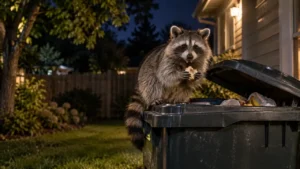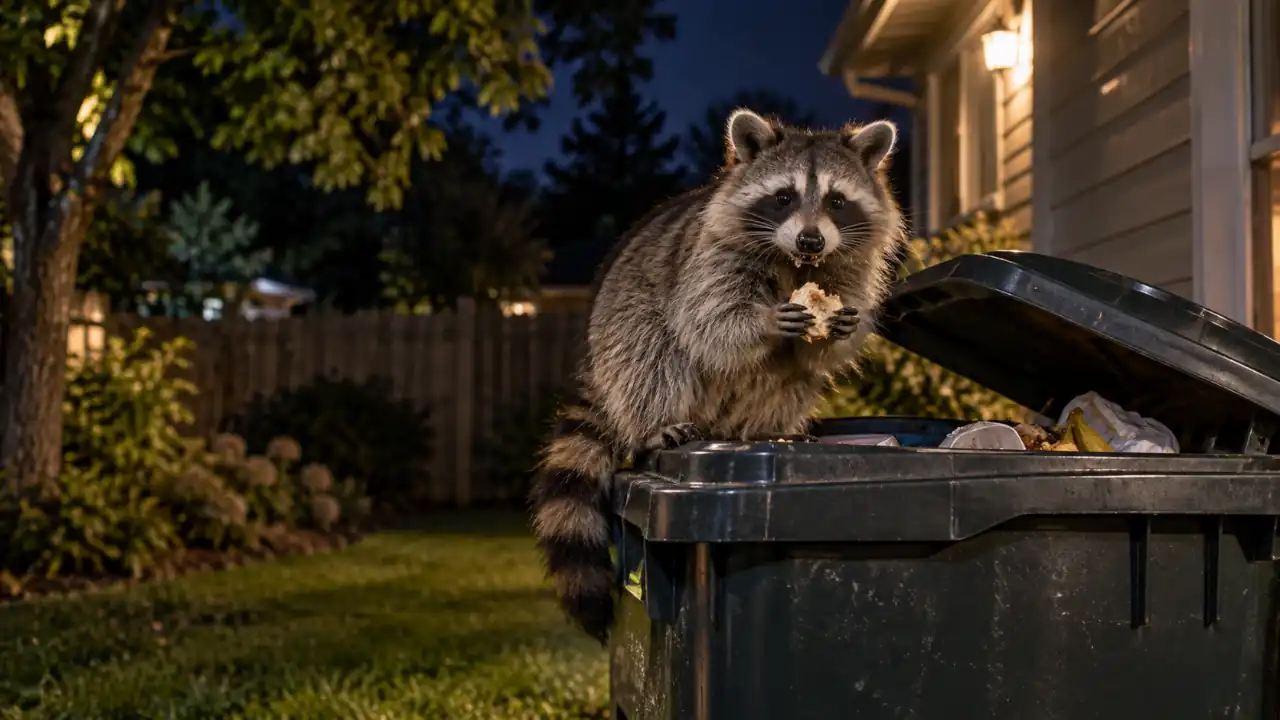
If you’ve ever walked outside to find your garbage can knocked over and trash scattered across the lawn, you already know raccoons have a serious thing for your leftovers. It’s tempting to assume they’re just hungry, but that’s only part of the story. The real answer involves how raccoons forage, what they’re naturally willing to eat, and how much easier we’ve made finding food without even realizing it. Let’s get into why do raccoons eat trash and what actually works to make your property less attractive to them.
Also Read: What Animals Do Raccoons Eat? The Surprising Creatures on Their Menu
Quick Answer
Raccoons eat trash because it offers an easy, dependable source of food, and their omnivorous diet allows them to eat a wide variety of foods. To stop attracting them, secure your garbage with a sturdy latch or enclosure, prevent the bin from tipping over, reduce food odors, and remove other attractants such as pet food, fallen fruit, compost, and spilled birdseed.
Why Do Raccoons Eat Trash?
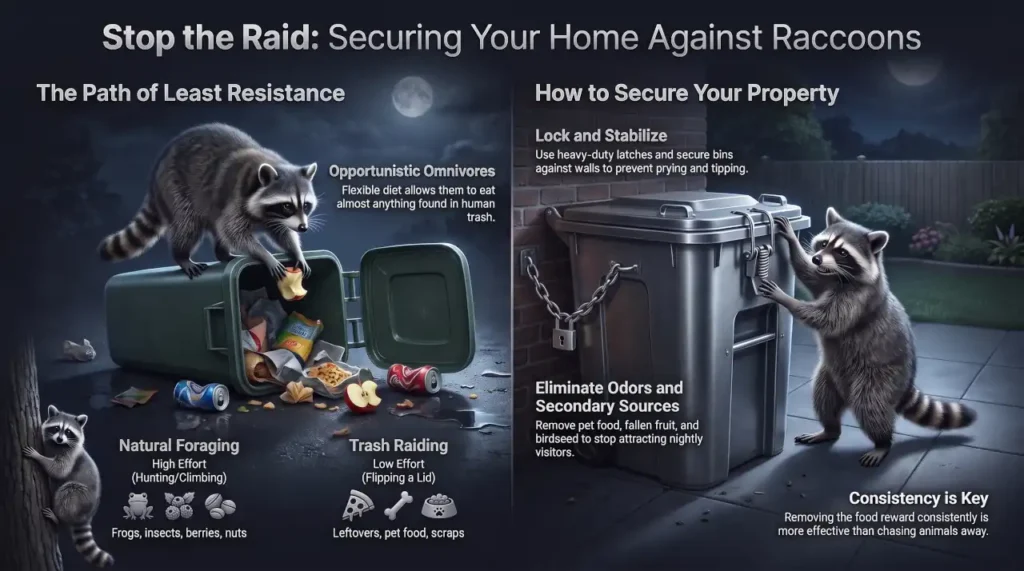
Raccoons eat trash mainly because it combines two things they are very good at taking advantage of: easy access to food and a flexible, omnivorous diet. A garbage bin can contain meat, fruit, pet food, eggs, cooked leftovers, and other odors that signal a potential meal. When food is consistently available with little effort, a raccoon has a practical reason to keep checking the same area.
Garbage Is Easily Accessible
The simplest explanation is also the most honest one: household garbage can put an easy meal within reach. If a bin is unsecured or easy to tip over, a raccoon doesn’t have to spend much energy finding food.
In a natural setting, raccoons spend a good chunk of their night working for food. They wade through creeks hunting crayfish, dig through soil for grubs, and climb trees for fruit. That’s real effort. Compare that to a trash can sitting at the curb with a loose-fitting lid, and it’s not even close. One option requires hours of foraging. The other requires flipping a lid.
As neighborhoods and subdivisions expand into areas used by wildlife, urban raccoons can take advantage of food and shelter that people unintentionally provide. Garbage, pet food, compost, fallen fruit, and other human-associated food sources can be easier to reach than some natural foods. Once a raccoon finds a dependable food source, there is little reason for it to ignore that opportunity.
This is especially noticeable in urban and suburban neighborhoods, where garbage, compost, pet food, and other human-associated food sources can be available much closer together than they would be in a less developed landscape.
That’s one reason a garbage problem can become a repeat problem. If a raccoon successfully gets into a bin, the animal has learned that the location is worth checking again. The exact frequency will vary by animal, food availability, weather, and what else is available in the surrounding area, but the basic lesson is simple: a successful food reward can reinforce repeated visits.
This is really a story about convenience. Raccoons aren’t lazy, but like most animals (humans included), they’ll always choose the path that costs less energy for the same reward.
Expert Tip: In my experience responding to raccoon calls, repeat visits are much easier to understand once you look at the food source from the raccoon’s perspective. If a raccoon gets into the same garbage can several times, that location has effectively become a proven feeding opportunity. That’s why I put more emphasis on consistent prevention than on chasing the animal away one night. If the bin becomes accessible again, the raccoon has a reason to come back.
What I See on Real Raccoon Calls
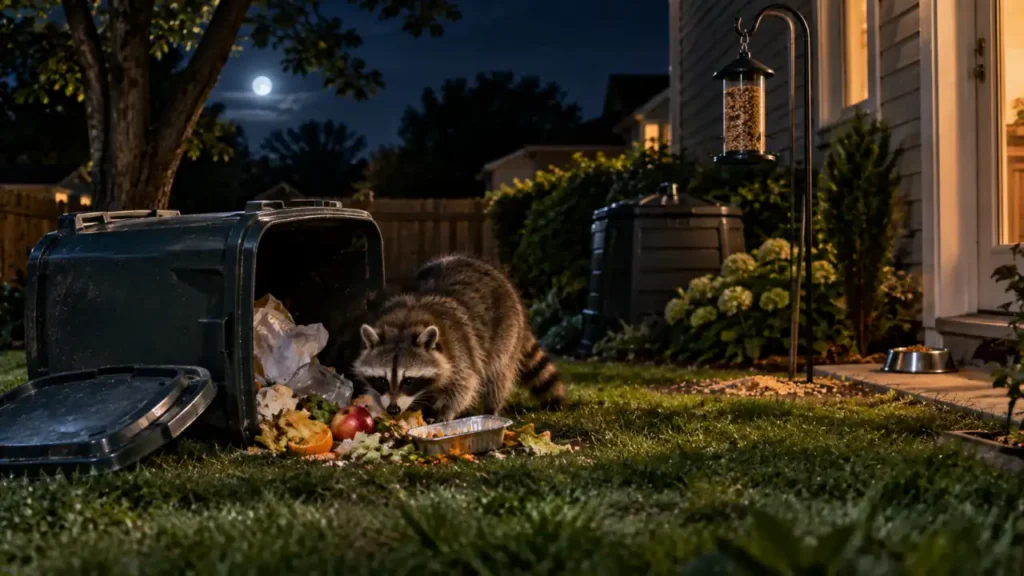
One pattern I’ve seen repeatedly is the homeowner who thinks the raccoon problem started because there are simply “too many raccoons” in the neighborhood. Then we look around the property and find an overflowing garbage can, pet food on the porch, fallen fruit under a tree, or an unsecured compost bin.
The raccoon doesn’t need every one of those food sources. One dependable source can be enough to keep the property on its nightly route. Another thing I look for is whether the homeowner has solved the garbage problem but left another food source untouched. I’ve seen people secure the trash can and still have raccoon activity because pet food, birdseed, fallen fruit, or compost was providing an easier meal somewhere else on the property.
I’ve also seen the opposite: homeowners who make the garbage completely inaccessible and remove the other easy food sources, then notice that the raccoon activity drops without them ever having to chase the animal around the yard. That’s the lesson I keep coming back to—control the attractant first.
Raccoons Are Omnivores
The second piece of the puzzle is what raccoons are built to eat in the first place. Raccoons are true dietary generalists. They’re omnivores and highly opportunistic feeders, so their normal diet can include both plant and animal foods. Raccoons are omnivores and highly opportunistic feeders. Their normal diet can include both plant and animal foods, so household garbage can contain many things that resemble foods they would naturally encounter.
In the wild, a raccoon’s diet already includes frogs, fish, insects, eggs, nuts, seeds, berries, and even carrion. They’re not picky eaters by nature. You can see just how broad their diet is when you look at what animals raccoons eat, from small prey and eggs to whatever plant foods happen to be available.
Many of the food scraps in your trash resemble foods raccoons would naturally encounter, such as meat, fruit, eggs, or other plant and animal material. The difference is that household garbage can also contain things they should never consume, including packaging and toxic household products.
Why Do Raccoons Seem Able to Eat Garbage Without Getting Sick?
One thing that can be misleading about raccoons is how casually they appear to eat food that most people would throw away. Seeing a raccoon pull spoiled leftovers from a garbage bag doesn’t mean the animal is immune to foodborne illness or poisoning.
Raccoons can tolerate a much broader range of foods than people normally eat, but that should not be confused with immunity to stomach problems, foodborne illness, or poisoning. Spoiled food and contaminated garbage can still expose a raccoon to harmful microorganisms or substances.
The better explanation is that raccoons are opportunistic omnivores. Their normal diet already exposes them to a wide variety of foods, including insects, fruits, nuts, eggs, fish, amphibians, and carrion. They may investigate unfamiliar food by sniffing, handling, and manipulating it before eating.
Raccoons are also well known for dipping or manipulating food in water. Despite the common idea that they’re “washing” their food, the behavior isn’t proof that they’re disinfecting it or testing whether it’s safe to eat.
Most importantly, don’t confuse an animal’s ability to consume a wide variety of foods with an ability to safely eat anything people put in the garbage. Spoiled food, chemicals, medications, pesticides, and other household materials can still pose serious risks.
That’s also why intentionally feeding raccoons is a bad idea. The more predictable the food source becomes, the more likely raccoons are to continue using the area.
Expert Tip: When homeowners tell me, “The raccoon eats everything and never gets sick,” I remind them that we’re usually seeing the successful part of the story. You can’t tell from one night’s behavior whether an animal has been harmed by something it ate. Treat garbage as an attractant, not as a safe food source for wildlife.
What Trash Can Be Dangerous to Raccoons?
Raccoons don’t have a special ability to recognize every dangerous substance in household garbage. A trash bag can contain much more than food, and some of those materials can be harmful if eaten.
Household food waste can also include ingredients that are known to cause problems for pets and other animals, such as chocolate, onions, garlic, grapes or raisins, and foods containing large amounts of fat or salt. Because toxicity varies by species and dose, don’t assume a food that is dangerous to a dog or cat has exactly the same effect on a raccoon. The safer approach is to keep potentially hazardous food and non-food materials inaccessible to wildlife.
The biggest concern isn’t necessarily a particular list of human foods. It’s the wide range of household materials that can end up in garbage, including medications, cleaning products, pesticides, automotive chemicals, and other substances that wildlife should never consume.
For homeowners, the practical concern is less about memorizing a list of “bad foods” and more about keeping hazardous household materials out of wildlife-accessible garbage. Keep medications, pesticides, automotive fluids, cleaning chemicals, and other toxic products in their original containers and dispose of them through the appropriate local waste or hazardous-material program rather than putting them where wildlife can get to them.
Food waste can also create physical or digestive hazards when it is heavily spoiled, contaminated, or mixed with packaging and other debris. Bones, packaging, sharp cans, plastic, and other discarded materials can cause physical injuries or digestive problems if swallowed.
This is one reason I wouldn’t recommend deliberately leaving “safe scraps” out for raccoons. Even if the food itself doesn’t appear dangerous, it teaches the animal that your property is a dependable feeding location and increases the opportunity for it to encounter something harmful.
If you suspect a raccoon has consumed a chemical, medication, pesticide, or other potentially poisonous substance, don’t try to make the animal vomit or handle it yourself. Keep people and pets away from the animal and contact a wildlife professional, local animal-control authority, or veterinarian for guidance.
The practical takeaway is simple: don’t assume that because raccoons can eat a broad range of natural foods, everything in your garbage is safe for them.
How To Stop Them From Eating Your Trash
Now for the part you actually came here for. The most effective approach is to remove or restrict the food sources and easy access points that make your property attractive to raccoons in the first place. The University of California Statewide Integrated Pest Management Program’s raccoon guidance likewise emphasizes preventing access to garbage and reducing other food attractants around homes.
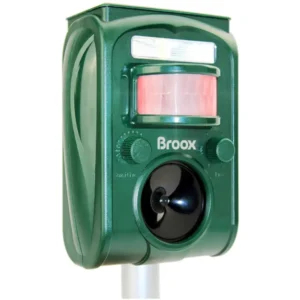
The principle is straightforward: make your garbage difficult to access, reduce strong food odors, and clean up other dependable food sources around the property. Once those basics are handled, a motion-activated deterrent can provide an additional layer around areas where raccoons continue to pass through.
Start with the trash can itself. A lid that simply rests on the bin may not be enough if a raccoon can pry it up or tip the container over. Raccoons have dexterous front paws and can manipulate unsecured lids, so look for a container with a secure latch or use a sturdy strap specifically designed to keep the lid closed. If buying a new can isn’t in the budget right now, improving the existing lid’s security can make a significant difference. The goal is to prevent both prying and tipping.
Weight matters too. A lightweight bin is easy to tip over, and once it’s on the ground, the lid becomes irrelevant. A stable bin is also harder to raid. If your container is lightweight and routinely gets tipped over, secure it against a wall or other stable structure, use a suitable enclosure, or choose a heavier container. A brick or loose weight may help with stability, but it shouldn’t create a new hazard for children, pets, sanitation workers, or anyone moving the bin.
Smell is another part of the equation. Raccoons have a strong sense of smell, so food residue around a garbage container can make a property more interesting even when the animal can’t immediately see a food source. Keep food waste in tightly closed bags or containers, clean obvious food residue from the inside and outside of the bin, and avoid leaving meat, fish, or other strongly scented scraps exposed. Where local waste rules allow it, storing particularly odorous food waste in a sealed container until collection can also help.
Smell can also be useful as a secondary part of prevention. Some homeowners try raccoon repellents and scents they hate when they’re dealing with repeat activity, but I wouldn’t rely on scent alone. If the garbage or another food source is still easy to access, a raccoon has a much stronger reason to stay than a smell has to leave.
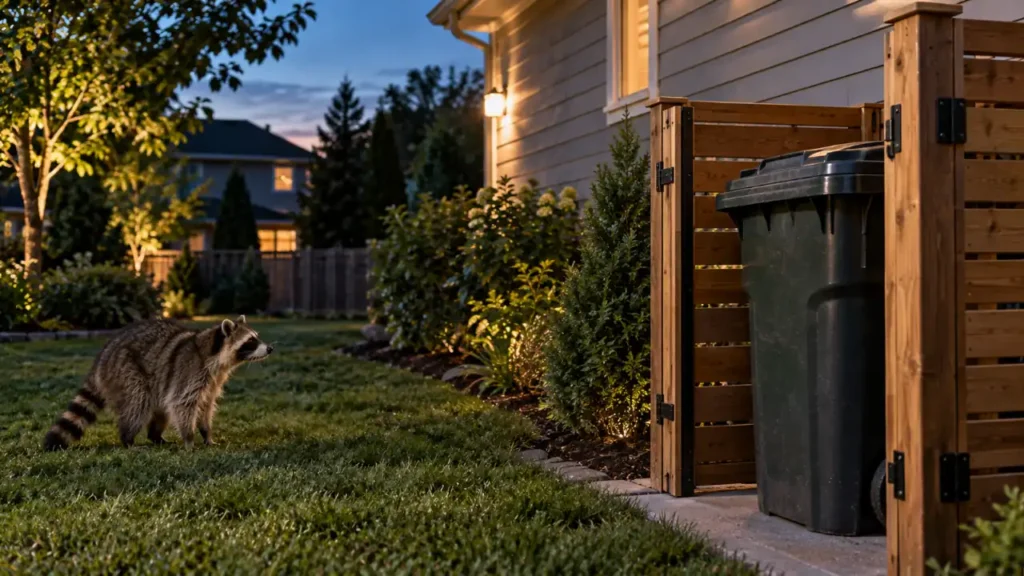
Where you store your bins plays a role as well. If possible, keep them in a garage, shed, or enclosed area until the morning of pickup rather than leaving them out overnight. If storage space is limited, a simple enclosure or fenced area around your bins adds another layer that raccoons have to work around.
If your local collection schedule allows it, avoid putting the garbage at the curb several nights before pickup. Put it out as close to collection time as practical, because a secure bin can still become an attractant once it’s sitting outside with food waste inside.
It’s also worth looking beyond the garbage can. Fallen fruit, unsecured compost, pet food, spilled birdseed, and accessible outdoor food can all provide another reason for raccoons to keep visiting. Secure compost, bring pet food indoors before night, clean up fallen fruit, and position bird feeders so spilled seed is easier to manage. Securing the garbage but leaving several other food sources available can make the trash-can fix less effective.
If you’re dealing with a raccoon that’s already established a routine at your house, don’t expect the behavior to change overnight. Consistency is what gives the prevention strategy a chance to work. Keep the same measures in place every night rather than repeatedly chasing the animal away after it arrives.
Also Read:
When to Call a Professional
If raccoons keep returning after you’ve secured the garbage and removed obvious food sources, it’s worth looking beyond the trash can. Repeated activity may mean the animal has found another food source, is getting into a garage, attic, crawl space, chimney, or shed, or has already established a den nearby. Signs such as damaged vents, torn soffits, scratching sounds, droppings, or repeated attempts to enter a structure are good reasons to have the situation assessed rather than simply trying another deterrent.
You should also contact a qualified wildlife professional or your local animal-control authority if a raccoon is inside your home, trapped in an enclosed area, injured, or behaving aggressively. Avoid cornering or handling the animal yourself. A professional can help determine how the raccoon is getting access, whether young may be present, and what exclusion or removal steps are appropriate for your situation.
A Quick Safety Note
Don’t approach or corner a raccoon to protect your garbage. Keep children and pets away from wildlife, especially if the animal is trapped, injured, or acting aggressively. If a raccoon has entered a home or other enclosed structure, avoid handling it and contact the appropriate wildlife or animal-control professional for advice. After cleaning up scattered garbage, wash your hands thoroughly and clean contaminated surfaces appropriately.
Final Thoughts
Raccoons eat trash because it can provide an easy, energy-efficient source of food, and their flexible diet allows them to take advantage of many foods people throw away. That doesn’t mean raccoons are immune to spoiled food, toxins, or other hazards found in garbage.
The most practical way to reduce repeat visits is to remove the reward: secure the bin, keep food odors and residue under control, and clean up other food sources around the property. These measures won’t guarantee that a raccoon will never cross your yard, but they can make your home a much less attractive feeding location.
If you’ve tried securing your trash and you’re still finding raccoons entering your home, denning in a structure, repeatedly causing property damage, or behaving aggressively, contact a qualified wildlife professional or your local animal-control authority. The right approach depends on whether you’re dealing with a food attractant, an entry point, or an animal already using part of the property as shelter.