

Where to place mouse traps matters more than most homeowners realize. The obvious spot is the middle of the floor, right where you saw the mouse dart out. That makes sense at first, but it usually isn’t where I’d start. Mice tend to travel along edges, walls, stored items, and other areas that give them cover. I’ve done this work for over 18 years, and the biggest difference I see between traps that work and traps that sit untouched is usually placement.
Instead of trying to make a mouse come to your trap, put the trap directly in the path the mouse is already using. Look for droppings, gnaw marks, rub marks, food activity, and narrow travel routes along walls and behind objects. Once you find that route, your trap has a much better chance of intercepting the mouse.
Also Read: Will a Dog Keep Mice Away? 4 Breeds That Hunt Mice
Where Should You Place Mouse Traps?
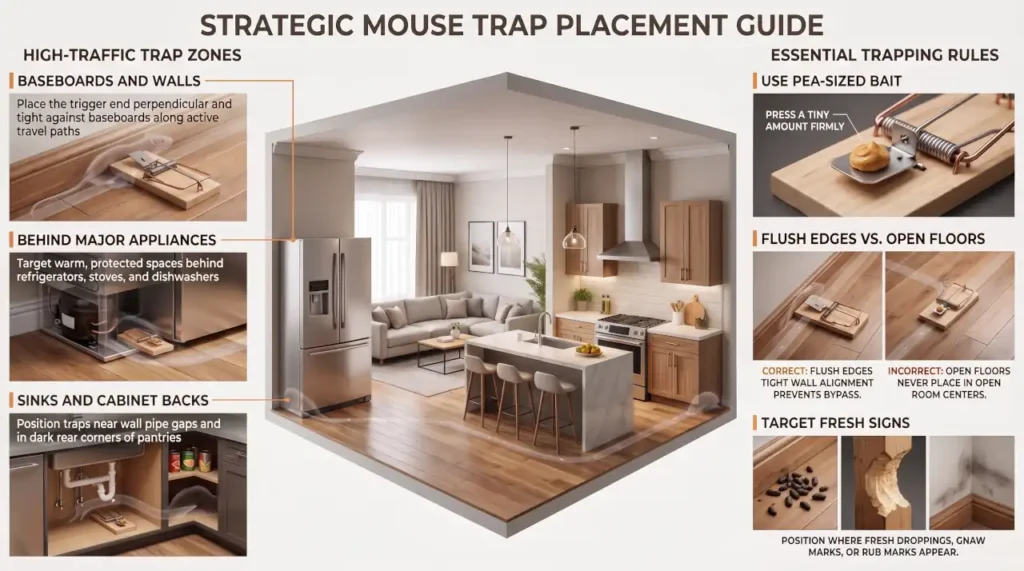
The best place to put mouse traps is along walls, behind appliances, under sinks, and in other protected areas where you find fresh signs of mouse activity. Position the trap so a mouse following its normal route encounters the trigger. Corners, cabinet backs, and narrow travel routes can also work when there is evidence mice are using them.
How Mice Really Move (And Why This Matters)
Picture the way you walk through a dark room. You probably put a hand out and follow the wall until you find the light switch. A mouse does something similar. It generally prefers protected routes where walls, cabinets, appliances, stored boxes, and other objects give it some cover.
That’s why I don’t start by putting a trap in the middle of an open room. I look for evidence of the route the mouse is already using. Droppings, gnaw marks, damaged food packaging, and rub marks can all help identify active areas.
If you find several fresh droppings along the back edge of a counter or cabinet, treat that location as a clue. Follow the signs toward the nearest protected area and look for the route the mouse is using.
Mice can stay surprisingly close to their food, water, and shelter. If everything they need is concentrated in the kitchen, garage, basement, or another part of the home, their activity may be concentrated there too. The University of California Agriculture and Natural Resources notes that house mice commonly nest in protected areas and forage close to their shelter.
The goal isn’t to attract a mouse from across the house. It’s to intercept a mouse that is already using that part of the house. Find the active route, and you’ve found the place to start trapping.
If you keep finding fresh droppings even after placing traps on active routes, there may be an active nest, inaccessible mouse activity, or an entry point allowing the infestation to continue. At that point, the problem becomes less about finding one more place for a trap and more about finding out why the mice are still getting into the home.
Where to Place Mouse Traps: The Spots That Actually Work
Quick rule: Don’t place a mouse trap where you saw the mouse once. Place a mouse trap where you find fresh signs of mouse activity, not simply where you happened to see a mouse once.
Look for:
Then position the trap so the mouse encounters it while using that route.
Before we get into mistakes, let me walk you through the places I check first in every home. Think of this as a tour of the mouse highway.
Start with the walls in the room where you noticed the problem. Look along the baseboards for fresh droppings, gnaw marks, rub marks, or other signs of activity.
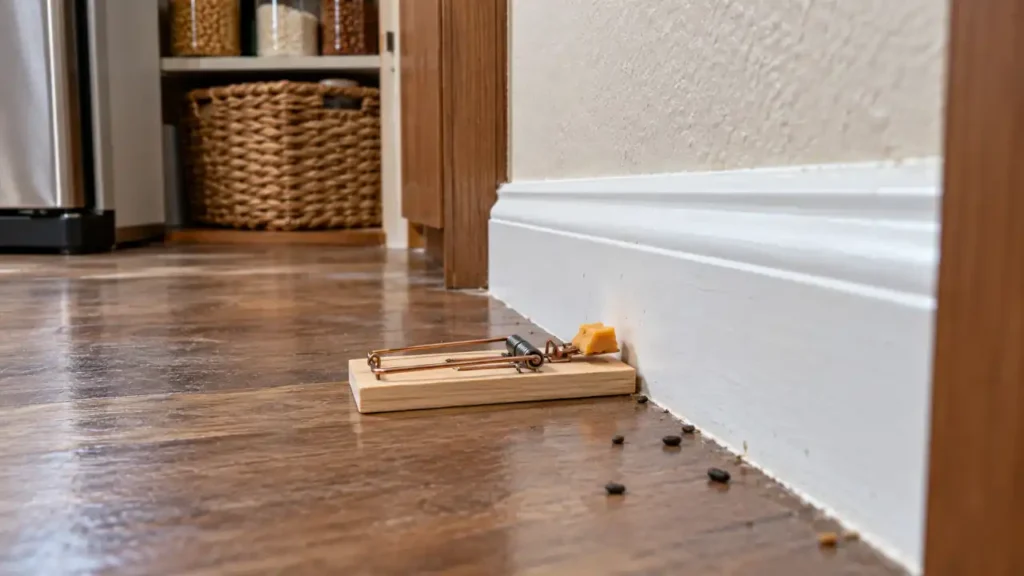
For a standard snap trap, position it so a mouse following the wall has to pass over the trigger. One effective setup is to place the trap perpendicular to the wall, with the trigger end against the baseboard. If you’re using a trap designed for a different orientation, follow the manufacturer’s placement instructions.
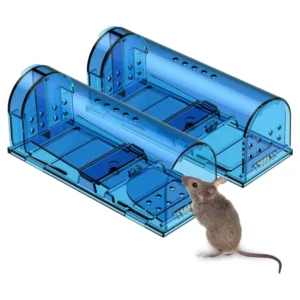
If you prefer a reusable catch-and-release option, this type of trap is worth considering. Just remember that placement still matters more than the trap itself. Check a live-catch trap regularly, and handle any captured mouse according to local wildlife and animal-control guidance.
The important part isn’t memorizing one universal angle. The important part is making the trap part of the mouse’s existing path rather than leaving an easy way around it.
Next, check behind large appliances. The spaces behind refrigerators, stoves, and dishwashers can provide darkness, shelter, warmth, and access to food debris.
Before moving an appliance, make sure it can be moved safely and that you aren’t putting yourself at risk from electrical connections, gas lines, water lines, or the appliance’s weight. If you can safely access the area, look for droppings and other signs before deciding where to put the trap.
If the appliance can’t be moved safely, place the trap along the accessible edge where mice are entering or leaving the area instead. The goal is to intercept the route without creating a safety problem for yourself.
Under sinks come next. Pipes going through the cabinet floor usually leave a small gap, and mice love those gaps. Look at the back of the cabinet under your kitchen sink. If you see droppings or a dark rub mark around a pipe hole, set a trap right beside it.
Deep cabinets and pantries matter too. The back corner of a lower cabinet is a favorite hangout, especially if you store cereal, pasta, or pet food nearby. Place the trap at the back, along the wall, not near the door where you open it. Mice are more likely to use the darker, protected back portion when it provides a safer travel route.
Then think about the garage, basement, and utility room. These spaces often have stacked boxes, stored furniture, and water heaters, all of which create tunnels and shelter. Set traps along the walls behind boxes and in the gaps between stored items. Attics and crawl spaces work the same way. Set traps along the joist lines and near any pipe or wire that passes through a wall.
Finally, don’t forget elevated areas. Mice can climb, so if you’re hearing scratching or finding droppings above floor level, investigate shelves, storage areas, ledges, and other accessible surfaces.
Don’t place traps simply because an area is high. Look for actual signs of activity first. In attics and crawl spaces, concentrate traps near walls, edges, stored materials, and other locations where you find fresh evidence of mice.
4 Major Mouse-Trapping Mistakes That Waste Time
Even the best trap fails if it’s set the wrong way. Here are the four mistakes I see most often, and fixing any of them can speed up your results.
The first mistake is putting traps out in the open. I mentioned this already, but it’s worth repeating because it’s the number one reason people give up. A trap in the middle of a room is a trap that mice walk around. Keep every trap tight to a wall, a corner, or an object the mouse already follows.
The second mistake is moving traps too often. I understand the urge. You set a trap, nothing happens by the next morning, and you think the spot is wrong. So you pick it up and move it across the room.
That can make it harder to tell what’s actually happening. Instead of moving a trap every day, give the setup enough time to produce useful information. If fresh signs continue in the same area, leave the trap there and troubleshoot the placement before moving it.
The third mistake is leaving a gap between the trap and the wall. Even an inch or two can matter. A mouse that feels a gap will often squeeze through the space beside the trap instead of over it. A trap positioned tightly against the wall makes it harder for the mouse to simply pass around the trap while following the edge.
The fourth mistake is using old, weak, or dirty traps. Springs lose strength over time, especially if you’ve reused a trap that was stored in a damp garage. Rust can interfere with the trap’s operation, while old bait can become dried out or less appealing. If a trap looks worn, or the trigger sticks, replace it.
Traps are cheap compared to the time you lose with a bad one. If you’re handling traps, clean hands are sufficient. The bigger concern is placing the trap correctly and keeping it in an area where children and pets can’t reach it.
How Fast Should Mouse Traps Work?
Here’s the honest answer. A properly placed trap can catch a mouse quickly, but there is no reliable universal timeframe. Some mice investigate traps quickly, while others take longer or use a different route. If a trap has been sitting untouched for several nights, look for fresh signs elsewhere before simply adding more bait.
It’s also worth dealing with the problem early because house mice can reproduce quickly. If fresh activity continues, don’t rely on trapping alone; keep looking for the entry point and conditions allowing the mice to remain in the home.
If the trap is on an active route and the mouse encounters it, you may get a quick catch. Other situations take longer, especially when the trap isn’t on the main route or mice have plenty of alternative food and shelter.
If you’ve had traps out for several nights on a wall with fresh signs and nothing has happened, don’t automatically assume the trap is bad. Recheck the location first. Look for newer droppings elsewhere, check whether food is still readily available, and make sure the trap is positioned across the mouse’s route.
If the signs have moved, move the trap with them. If the signs remain but the trap is being avoided, change the setup rather than simply adding more bait.
Also watch for new signs. Fresh droppings are generally darker and softer, while older droppings become drier and may fade with time. You don’t need to touch them to figure this out.
If you find new droppings in an area you haven’t trapped, that’s useful information. Add or reposition a trap near that activity rather than continuing to trap an area that has gone quiet.
Finally, know that a few catches doesn’t always mean you’re finished. Catching one mouse also doesn’t prove that the problem is over. Continue monitoring for fresh droppings, gnawing, and other signs for several nights after a catch. If new signs continue, there may still be additional mice or an unresolved entry point.
How to Make Mouse Traps Work Faster
This is the part where 18 years of experience helps most, because small changes make a big difference.
Use more than one trap. One trap is rarely enough when mice are active in several areas. Rather than following an arbitrary spacing rule, use the signs in the home to decide where traps belong. Put multiple traps along active routes, especially near corners, wall intersections, appliance edges, and other places where mice are forced to pass through a narrow area. The objective is simple: give the mouse more than one opportunity to encounter a trap while following its normal route.
Use corners and turns to your advantage. Corners, wall intersections, and places where a wall meets furniture or cabinetry can create natural pinch points in a mouse’s travel route. If you find fresh signs there, they’re worth prioritizing when you’re deciding where to place a trap. The key is the evidence of activity. Don’t put a trap in a corner simply because it’s a corner. Put it there because the mouse has a reason to use that route.
Check traps in the morning. Checking every few hours can drive you nuts and makes it harder to establish a consistent routine. Mice are primarily active at night, so checking traps in the morning gives you a practical opportunity to see what happened overnight and reset or reposition traps as needed.
Behind Appliances, Deep Cabinets, and Why Less Bait Works Better
Let’s get into the three details that catch the most mice in real homes.
Behind appliances is the first. Pulling a refrigerator or stove out a few inches is a hassle, and I know most people skip it. But the space back there is like a mouse hotel. It’s warm from the motor, close to food, and hidden from view. A trap set behind the fridge can be very effective when you have evidence that mice are using that space. You’re not relying on the bait to pull the mouse across the kitchen; you’re putting the trap directly into an area where the mouse is already traveling.
For a simple snap-trap setup, a basic wooden trap can work well when it’s positioned directly on an active mouse route.

Deep cabinets are the second. The important detail isn’t simply that the cabinet is deep. It’s that the back edge often combines shelter, food access, and a protected travel route. If you’ve found fresh signs there, that’s where I’d concentrate the trap rather than placing it near the cabinet door.
Less bait is the third, and this one trips people up. Most folks pile peanut butter onto the trigger, thinking a stronger smell means a faster catch. It’s the opposite. A big blob lets the mouse lick the bait from the edge without pressing the trigger. It gets a free meal and leaves. What you want is a small amount, about the size of a pea or even a bit smaller. Press it firmly into the bait cup so the mouse has to work at it. That forces it to put weight on the trigger.
Peanut butter is a classic bait choice, but you don’t need much. A small amount pressed firmly into the bait cup is usually enough. You can also try another food that the mouse is already eating if peanut butter isn’t getting attention.
If you’re also wondering what scents mice hate, remember that smells alone aren’t a substitute for trapping and exclusion. Repellents may have a limited role, but they don’t solve an active mouse entry problem by themselves.
If a cautious mouse repeatedly investigates a trap without triggering it, you can try pre-baiting. Leave the trap unset with a small amount of bait for a short period, then arm it once you see evidence that the bait is being taken.
This isn’t necessary for every mouse, but it can be useful when you’re dealing with an animal that is clearly investigating the trap without committing to it.
Finally, if you have children or pets, treat trap placement as a safety issue, not just a mouse-control issue. Dogs may catch or disturb mice in some situations, but they shouldn’t be treated as a dependable replacement for proper trapping and exclusion. Put traps where children and pets cannot reach them, or use an appropriate protective trap station.
Don’t place a snap trap in an exposed walkway simply because you’ve seen a mouse there. Find a protected position along the same route whenever possible. Never assume a child or pet won’t investigate a trap just because it is only there overnight.
Smart Mouse Trap Placement Beats Everything
You don’t need expensive gadgets, and you don’t need to guess. Good trap placement starts with understanding where mice are already active.
Follow the walls and edges. Check corners, behind appliances, under sinks, and inside the back of cabinets. Look for fresh signs before deciding where to place each trap, use only enough bait to get the mouse interacting with the trigger, and keep traps where children and pets can’t reach them.
A properly positioned basic snap trap can be very effective. In many homes, good placement matters more than buying a more complicated trap and putting it somewhere the mouse rarely travels. That’s the real secret: put the trap where the mouse is already using the space.
Once you’ve caught the mice, take a few minutes to look for how they got in. Sealing gaps around pipes and other openings can help prevent another round of activity, especially when you use the right material for the size and location of the gap. Traps solve the problem you have today, while sealing stops the next round from starting.
Also Read:
When Should I Call a Pest Control Professional?
Consider getting professional help if you continue finding fresh droppings or other signs after several nights of properly placed trapping, if mice are getting into areas you can’t safely access, or if you hear repeated activity inside walls, ceilings, or other inaccessible spaces.
Seeing a mouse during the day can also be worth paying attention to, but it isn’t enough by itself to determine how large an infestation is. Look at the overall pattern: how often you’re seeing mice, where the signs are appearing, whether new droppings continue, and whether you can identify and seal the entry points.
If you do decide professional help makes sense, it can also help to understand the cost of mouse extermination before you schedule an inspection. Pricing can vary depending on the size of the problem, accessibility, and whether exclusion work is needed in addition to trapping.
Final Thoughts
Mice aren’t clever in some mysterious way. They’re just careful, and they follow simple habits. They hug walls, use the same paths, and avoid open spaces. Once you match your trap placement to those habits, your chances of getting a quick catch improve.
Start with the walls where you see droppings. Set traps so they intercept the mouse’s route along the baseboard, add a few at active corners, and don’t forget behind the fridge and in the back of your cabinets. Use a small amount of bait, leave the traps in place long enough to see whether the setup is working, and check them each morning.
If you’ve done all that and mice keep showing up, don’t feel bad about calling for help. A hidden nest or a large entry gap can keep an infestation going no matter how many traps you set. In that case, a professional inspection saves you time, stress, and sleepless nights.