If you’ve got mice in the house, chances are someone has already told you to try ammonia for mice. It’s one of those old home remedies that sounds convincing because ammonia has such a strong smell. But after nearly two decades of dealing with rodent calls, I can tell you the real story is a lot messier than the internet forums make it sound. Ammonia may temporarily change where a mouse travels, but it doesn’t solve the reason mice are inside your home. Let’s look at what ammonia actually does, what it doesn’t do, and what works better when you’re dealing with mice.
Also Read: What Scents Do Mice Hate? The Surprising Odors Mice Avoid Most
Does Ammonia Repel Mice?
No, ammonia is not a reliable way to repel or get rid of mice. Its strong odor may temporarily discourage a mouse from entering a particular area, but it does not seal entry points, remove food sources, or eliminate mice already inside a home. Concentrated ammonia fumes can also create a serious exposure risk for people and pets. For an active mouse problem, exclusion, sanitation, and properly placed traps are much more dependable.
How Does Ammonia Repel Mice?
Let’s start with the question everyone actually wants answered. Sometimes, but not reliably, and usually not for long.
Mice rely heavily on their sense of smell when locating food and responding to unfamiliar odors. A strong chemical smell such as ammonia can make an area unpleasant and may temporarily change where a mouse travels. That’s part of why ammonia has developed a reputation as a mouse repellent. Mice hate the scent of ammonia, but temporary avoidance is not the same thing as reliable mouse control.
There is a common explanation online that ammonia works because its odor supposedly resembles predator urine. That explanation is often repeated as fact, but I wouldn’t rely on it when advising a homeowner. The important point is simpler: a strong chemical odor can make an area temporarily unpleasant, but that does not mean the odor creates a dependable fear response or keeps mice out of a house.
In the field, the bigger problem is that mice usually have options. If an odor makes one route unpleasant, a mouse may simply use another gap, travel along a different wall, or shift toward another food source. That’s why a smell-based deterrent can appear to work in one spot without actually solving the infestation.
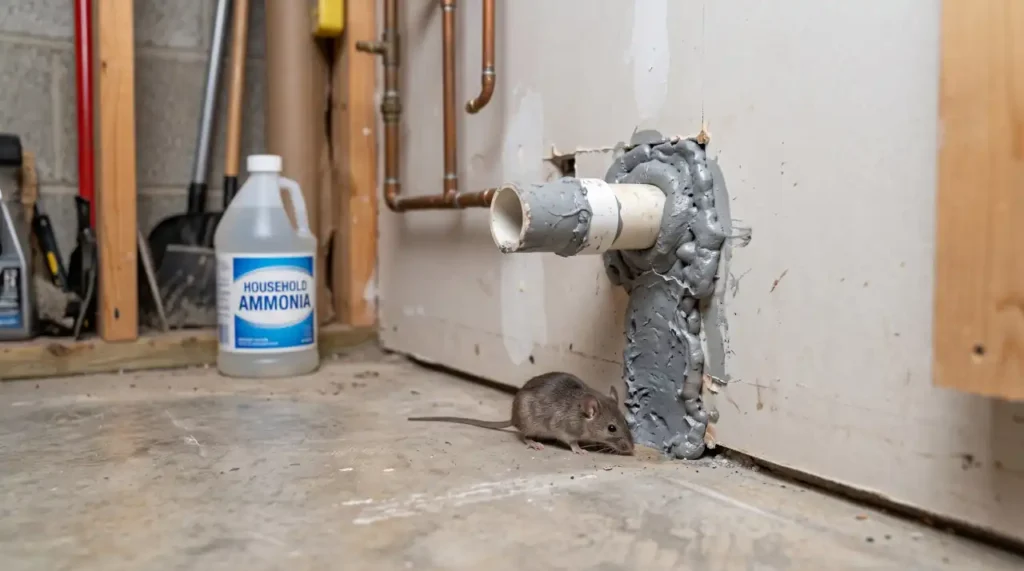
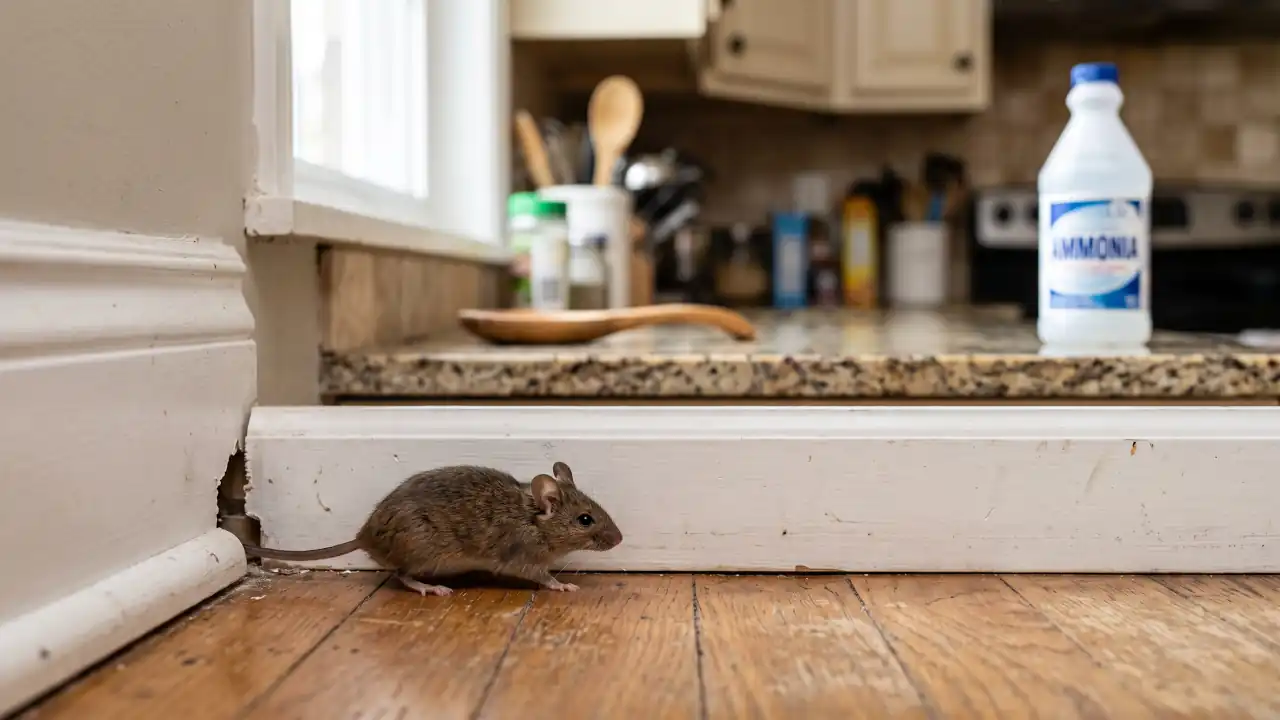
There’s also the practical side of things to think about. Your house isn’t a sealed box. Ammonia fumes are strong right when you apply them, but they fade fast, especially in a spot with any airflow at all. Mice are also incredibly resourceful. If one entry point smells bad, they’ll often just find another gap, crack, or opening because a house that already has mice may have more than one route they’re using. You might push them out of one corner of the kitchen for an evening, only to have them show up under the stove the next night.
So does ammonia repel mice? It may make a particular area temporarily unpleasant, but that is very different from actually getting mice out of a home. As a long-term solution for an active infestation, it falls short because the odor doesn’t close entry points, remove food, or eliminate mice already inside.
Bottom line: Ammonia may temporarily change where mice travel, but it doesn’t solve the reason they’re inside your home.
Why Ammonia Seems to Work at First
One thing worth understanding is why this myth has so much staying power in the first place. A lot of home remedies for pests get passed down through word of mouth, and ammonia’s reputation probably comes from a mix of half-true science and confirmation bias. If someone sprays ammonia near a hole and doesn’t see mice there again for a week, they naturally assume it worked.
What they don’t usually account for is that mice may vary their travel routes and food sources from one night to another. So the absence of activity for a few days doesn’t always mean the repellent did its job. It might simply mean the mouse was active somewhere else in the house that week, which is a pattern I’ve seen play out repeatedly on service calls where a homeowner swears a remedy worked, only for activity to pick back up a week or two later once I located the real entry points.
House mice often stay relatively close to their nest when food, water, and shelter are readily available. That’s part of why a repellent can seem effective at first. If one route becomes unpleasant, the mouse may simply shift its travel path instead of leaving the building. Compare that with sealing an entry point completely: exclusion removes the route rather than asking the mouse to tolerate a bad smell.
Quick Tip: If you want to know whether mice are still active, don’t use the smell of ammonia as your test. Look for fresh droppings, new gnaw marks, or nighttime activity, then focus on finding and closing the entry points responsible. A mouse that disappears from one corner may simply have moved to another part of the house.
Does Ammonia Kill Mice?
Yes, concentrated ammonia exposure can be harmful or fatal to mice, but that does not make household ammonia a practical, safe, or reliable way to control them. In a home, the fumes can also create a serious exposure risk for people and pets, while mice can simply move away from the source.
That is the important distinction. A chemical can be hazardous without being a dependable pest-control treatment. In a normal home, ammonia fumes disperse, mice can move away from the source, and the underlying entry points remain open.
There is also a much more important safety issue for homeowners: ammonia itself can irritate or damage the eyes, throat, and respiratory system. The CDC’s Agency for Toxic Substances and Disease Registry provides additional information about ammonia exposure and its health effects.
For that reason, I would not recommend using ammonia as a homemade mouse poison or deliberately creating concentrated ammonia fumes in an occupied building. If mice are the problem, the goal should be to remove their access to the home and control the population with methods intended for rodent control.
Should You Use Ammonia to Keep Mice Away?
If you’re considering ammonia because you’ve heard it will drive mice out, I’d treat it as a home remedy rather than a proven control method. I would not recommend deliberately filling an occupied room, wall cavity, cabinet, or other enclosed space with ammonia fumes.
I also wouldn’t recommend using pure ammonia as a mouse repellent. Household ammonia products vary in concentration, and stronger ammonia creates greater exposure risks without turning the method into a reliable way to remove mice.
Ammonia can irritate the eyes, skin, throat, and respiratory system. Keep ammonia products away from children and pets, follow the product label, and never mix ammonia with bleach or other cleaning chemicals. If a cleaning product is being used, use it for its intended purpose rather than creating a stronger homemade mixture.
For mice, put your effort into the things that actually change the situation: finding entry points, removing accessible food, and controlling mice already inside.
I also wouldn’t recommend leaving open containers of ammonia around the home. Besides providing an unreliable deterrent, an open container creates an unnecessary chemical-exposure and spill hazard.
Why Ammonia Spray Isn’t a Good Mouse Fix
I don’t recommend making a homemade ammonia spray specifically for mice. The concentration of household ammonia products varies, and mixing cleaning chemicals can create unnecessary exposure risks. If you are using an ammonia-containing product for an ordinary cleaning purpose, follow the product label and never mix it with other cleaners.
You may also see ammonia-based sprays, foams, or scent products marketed for mouse control, but a different product format doesn’t change the basic limitation: the odor does not seal entry points or eliminate mice already inside.
More importantly, spraying ammonia around mouse travel routes doesn’t solve the reason the mice are there. If you find droppings or gnaw marks, use those signs to identify where mice are traveling, then concentrate on sealing openings, removing accessible food, and using appropriate traps.
That approach addresses the problem instead of repeatedly adding chemicals to the same area.
What About Ammonia-Soaked Rags?
Some homeowners place ammonia-soaked rags or cotton balls near suspected mouse routes because they want a stronger, longer-lasting odor than a spray provides. I don’t consider this a reliable control method, and I would not put ammonia-soaked material inside wall cavities, cabinets, crawlspaces, or other enclosed areas.
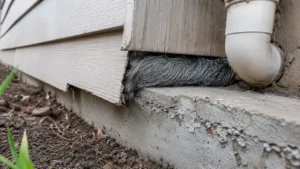
Besides the limited evidence that the odor will solve an infestation, the chemical exposure becomes harder to control once the material is tucked into an inaccessible location. If you’ve identified a gap where mice are entering, the better move is to address the opening itself. Materials such as steel wool can be useful as part of an appropriate exclusion repair.
Should You Make Homemade Ammonia Poison?
I don’t recommend mixing ammonia with food ingredients, borax, or other substances to make homemade mouse poison. Apart from being unreliable, it creates an unnecessary poisoning hazard for children, pets, and anyone handling or cleaning around the mixture.
If lethal control is appropriate for the situation, use a rodent-control product according to its label rather than improvising a chemical mixture. Keep any rodent-control product away from children, pets, food, and areas where accidental contact is possible.
For many household mouse problems, exclusion and properly placed traps are a better starting point than experimenting with homemade poisons.
What I Look For on a Mouse Call
When I’m looking at a mouse problem, I pay much more attention to where the evidence is than to which repellent the homeowner has tried. Fresh droppings along a wall, grease marks around a pipe opening, gnawing near stored food, and repeated activity behind an appliance can tell you much more than whether a particular smell seems to be working.
A fresh dropping along a wall is more useful to me than an old dropping inside a cabinet because it can tell me where the mouse is currently traveling.
One of the most common patterns is a homeowner treating the place where they see the mouse instead of the place where the mouse is getting in. If the entry point is still open, the next mouse has the same invitation. That’s why I put exclusion ahead of scent remedies almost every time.
What Works Better Than Ammonia for Mice
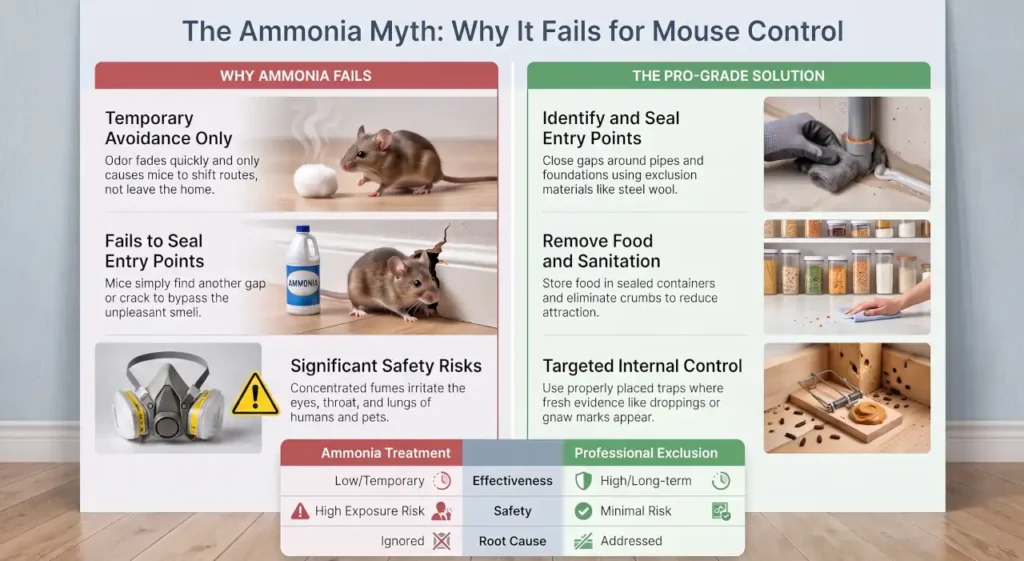
If you’re trying to figure out how to get rid of mice, focus on the conditions that allow them to live inside the home. Ammonia may temporarily change where mice travel, but finding the entry points, removing accessible food, and controlling mice already inside are much more dependable approaches.
1. Find the Entry Points
Check around plumbing and utility penetrations, doors, garage openings, foundation gaps, vents, and other transitions between the house and outdoors. Pay particular attention to areas where you find fresh droppings or gnaw marks.
2. Look for Fresh Evidence
Fresh droppings, new gnaw marks, grease marks along walls, nesting material, and repeated nighttime activity can help show where mice are currently traveling.
3. Remove Accessible Food
Store food in sealed containers and clean up crumbs, spills, pet food, and other accessible food sources. Reducing available food makes the home less attractive to mice.
4. Seal Entry Points
Once you’ve identified how mice are getting inside, close the openings with appropriate exclusion materials. Sealing the route is more effective than repeatedly making the route smell unpleasant.
5. Control Mice Already Inside
Use properly placed snap traps or other appropriate rodent-control methods in areas where mice are actively traveling. The goal is to control the mice already inside while preventing additional mice from entering.
6. Recheck for Activity
Don’t rely only on whether you happen to see a mouse. Check for new droppings, gnawing, and other signs of activity after making changes.
7. Know When DIY Isn’t Enough
If fresh evidence keeps appearing, activity is occurring in multiple rooms, mice are getting into inaccessible areas, or you cannot determine how they’re entering, the problem may need a more thorough inspection and control plan.
Pros and Cons of Using Ammonia for Mice
Potential Advantages
Disadvantages
Bottom line: Ammonia may change where a mouse travels temporarily, but it doesn’t address the reason mice are inside the home.
Also Read: How to Keep Mice Out of a Shed: 8 Effective Ways
When Should You Call a Pest Control Professional?
You may be able to handle a small amount of mouse activity yourself, especially if you can identify where the mice are entering and address the problem promptly. But professional help becomes more worthwhile when the activity keeps returning, fresh droppings appear in multiple areas, mice are getting into inaccessible spaces, or you cannot determine how they’re entering the home.
A professional inspection can help identify entry points, active travel routes, and areas where mice may be nesting or gaining access. This can be particularly useful when you’ve already tried basic exclusion and trapping but continue to find fresh evidence of activity.
If you’re dealing with an ongoing or difficult-to-locate mouse problem, getting an inspection can help you understand what needs to be addressed rather than continuing to experiment with repellents that only change where mice travel.
Final Thoughts
Ammonia isn’t a dependable mouse-control solution. A strong odor may make a particular area less attractive for a short time, but it doesn’t close the opening a mouse is using, remove the food attracting it, or deal with mice already established inside the home.
After years of dealing with mouse problems, my advice is to treat scent remedies as a distraction from the main job rather than the solution. Find the entry points, remove accessible food, and use an appropriate control method for the mice already inside.
If you’re finding fresh droppings in several rooms, hearing repeated activity in walls or ceilings, or seeing mice despite your efforts to seal and trap, that’s a sign to stop experimenting with home remedies and have the situation properly assessed.