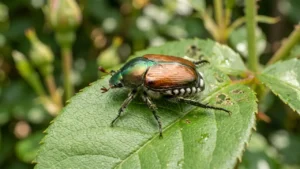
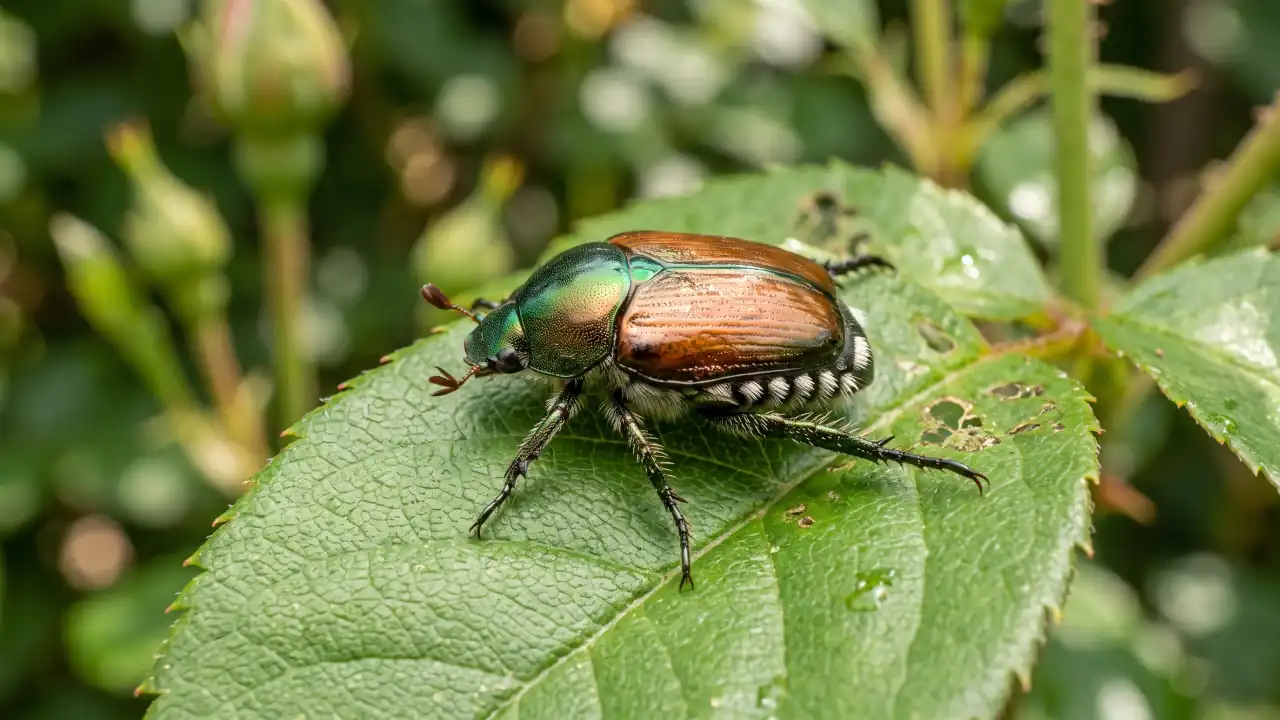
If you’ve ever watched Japanese beetles cover your roses, grapevines, or other favorite plants during the afternoon, you’ve probably noticed how quickly they seem to disappear after sunset. That naturally raises the question: where Japanese beetles go at night. The good news is that adult beetles usually haven’t gone far. As temperatures cool and daylight fades, they become less active and typically remain on or around nearby vegetation rather than flying and feeding as they do during the day.
If you’re looking for them after dark, start with the plants that had the heaviest activity that afternoon. Check underneath leaves, inside dense foliage, and along sheltered branches. Knowing where they tend to remain at night can make morning inspections and hand-picking much easier.
Also Read: How To Keep Bats Away & Deter Them: 8 Proven Tricks
Quick Answer
Japanese beetles usually don’t go far at night. As temperatures fall and daylight disappears, adult beetles become less active and commonly remain on or within nearby vegetation. Check the undersides of leaves, dense foliage, and branches on plants that were heavily infested during the day. Early morning is often the easiest time to find and remove them before they become active again.
If you’re wondering where Japanese beetles go at night, start with the plants that had the heaviest beetle activity that afternoon. Inspect the undersides of leaves, sheltered foliage, inner branches, and nearby plant canopies before looking anywhere else. Adult Japanese beetles are above-ground insects, so finding fewer beetles at night doesn’t necessarily mean they’ve left the area.
Why Japanese Beetles Change Their Behavior at Night
Japanese beetles are primarily daytime-active insects. Their feeding, mating, and most of their flying activity happen during daylight, especially when temperatures are warm and conditions are relatively calm.
As evening temperatures fall and darkness sets in, adult beetles become much less active. They typically stop flying and settle into vegetation or other protected locations rather than continuing to move around the yard.
Temperature is a major part of the explanation. Japanese beetles are ectothermic, meaning their body temperature and activity are strongly influenced by the surrounding environment. Flight becomes increasingly difficult as their body temperature drops, so a beetle that was actively flying around a rose bush during the afternoon may be nearly motionless a few hours later.
That’s why a yard can look dramatically different after sunset. The beetles usually haven’t disappeared. Many are simply sitting quietly on or within nearby vegetation until conditions become favorable for activity again the following day.
For homeowners, this distinction matters. You’re generally better off looking for stationary beetles and planning hand removal around cool, low-activity periods than assuming the insects have left the property.
For a useful overview of the Japanese beetle’s biology, seasonal development, and host plants, NC State Extension’s Japanese Beetle publication is a good reference.
Where Japanese Beetles Go at Night
Once temperatures drop, adult Japanese beetles become less active and are more likely to remain on or around vegetation rather than continue flying through the yard. The exact resting location can vary with the plant, weather, temperature, and surrounding conditions.
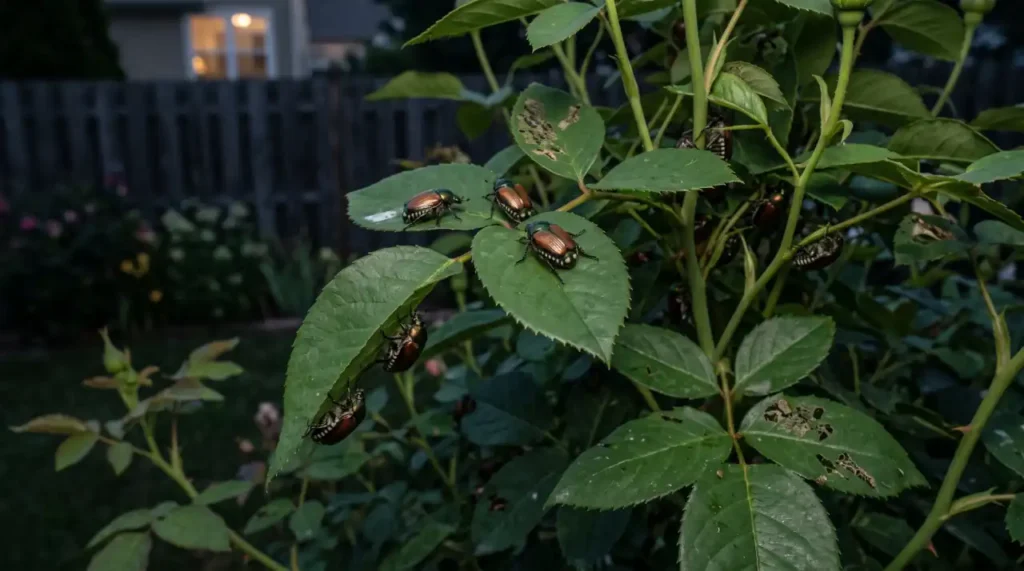
Protected Vegetation
This is the most useful place to look for adult Japanese beetles after dark.
Rather than disappearing underground every evening, adult beetles commonly become inactive while resting on plants. They may settle on the undersides of leaves, within dense foliage, or on branches and other protected parts of their host plants.
This is especially noticeable on plants that have been heavily fed on during the day. Roses, grapes, lindens, fruit trees, and other favored hosts can hold beetles after daytime activity winds down.
Don’t assume every beetle is sitting in an obvious cluster, though. Some will be tucked into foliage where they’re difficult to spot. A flashlight and a slow inspection of the most heavily damaged plants can reveal beetles that were almost invisible during the day.
The important distinction is that the adult beetle’s nighttime shelter should not be confused with the underground grub stage. Japanese beetle larvae live in soil and feed on grass roots; adult beetles are above ground and primarily associated with vegetation.
Outdoor Lighting: Don’t Overestimate Its Role
Outdoor lighting can make beetles more noticeable around a house, but it shouldn’t be treated as a primary explanation for where Japanese beetles spend the night.
Japanese beetles are mainly daytime-active, so their nighttime behavior is not comparable to strongly light-attracted nocturnal insects such as many moths. A porch light may illuminate beetles resting on nearby vegetation, making it seem as though the light has caused the infestation when the insects may already have been in the area.
If beetles are consistently gathering around an entryway or lighted area, it’s reasonable to reduce unnecessary lighting or redirect fixtures away from plants. But this is a secondary adjustment, not a standalone Japanese beetle control method.
What Japanese Beetles Actually Do All Night
Japanese beetles are generally far less active after dark than they are during the day. Some movement can continue during a warm evening, but nighttime behavior is much less conspicuous because adults spend more time stationary and sheltered.
Limited Nighttime Activity
Japanese beetles generally do most of their feeding during daylight. As temperatures fall and darkness arrives, feeding and movement typically decline sharply.
That doesn’t mean every beetle becomes completely motionless at the exact moment the sun disappears. Warm evenings can extend activity somewhat, and individual beetles may still move or feed after sunset. But the heavy feeding that produces most of the obvious leaf damage is primarily a daytime phenomenon.
If you notice additional damage in the morning, don’t automatically assume the beetles spent the entire night eating. Damage can be difficult to attribute to a particular time period, and other insects may also be feeding after dark.
For control purposes, the useful takeaway is simple: look for beetles when they’re inactive rather than trying to chase them while they’re actively flying and feeding.
What They’re Doing Overnight
There’s no need to think of Japanese beetles as following a human-style sleep schedule. Once temperatures and light conditions become less favorable, adults simply become much less active and remain in protected locations.
That makes nighttime and early morning useful periods for homeowners. Beetles that are relatively stationary are easier to remove than beetles that are actively flying between plants.
The practical advantage is their reduced mobility. Stationary beetles are easier to find and remove before daytime activity begins again. It’s that their reduced mobility gives you a better opportunity to find and remove them before daytime activity begins again.

Using Nighttime Behavior to Fight Back
This is where understanding beetle behavior actually pays off. Once you know that adult beetles become less active and easier to find on or around vegetation after dark, you can time some control efforts around those lower-activity periods.
Best Timing for Hand Removal
Hand-picking is one of the simplest ways to reduce adult Japanese beetles on individual plants, particularly when the infestation is concentrated on a manageable number of shrubs or garden plants.
Early morning is usually the easiest time to collect them because overnight cooling leaves the beetles less active than they are during the heat of the day. Gently shake or brush them from the plant into a container of soapy water.
You can also collect them during the cooler part of the evening. The important factor is temperature and beetle activity—not a particular clock time.
The goal is to remove adults before they warm up and begin flying freely. If you’re dealing with a heavily infested tree, however, hand-picking every beetle may not be practical. Focus this method on high-value plants where removing dozens of adults can make a noticeable difference.
What to Check the Morning After
A quick morning inspection can tell you more than simply counting beetles.
Start with the plants that showed the most damage the previous afternoon. Check the undersides of leaves, sheltered branches, and dense foliage for adults that remained overnight. Then look at the newest feeding damage, especially on tender foliage and flowers.
If beetles are still present, remove as many as practical before the plants warm up and adult activity increases. If you find very few beetles but continue seeing fresh damage, inspect the plants again later in the day rather than assuming the insects have moved underground.
Keeping track of which plants consistently attract beetles can also help you focus your control efforts where they’ll have the greatest payoff.
During the active beetle season, repeating this quick inspection each morning can help you spot population changes before feeding damage becomes severe. You don’t need a complicated record—simply noting which plants have beetles and where damage is increasing can help you decide where to focus your efforts.
Habitat Modifications
Habitat changes can help with the next generation of Japanese beetles, but they should not be oversold as a way to eliminate adult beetles hiding in mulch at night.
Japanese beetle larvae develop underground and feed on grass roots. Moist soil can be favorable for their development, which is one reason lawn irrigation and soil conditions matter when you’re dealing with a recurring infestation.
Keep susceptible plants healthy, remove beetles when practical, and make heavily infested plants easier to inspect. Reducing unnecessary irrigation can also help address conditions that favor the grub stage.
If Japanese beetles repeatedly overwhelm the same ornamental plants, plant selection can also become part of the long-term strategy. Where practical, favor landscape plants that show less feeding damage in your area and reserve highly susceptible plants for locations where they’re easy to inspect and protect. Habitat modification works best as part of a broader plan rather than as a standalone solution.
Temperature Tricks and Timing
Because beetle activity is so tightly tied to temperature, you can actually use weather patterns to predict when they’ll be easiest to manage.
Morning Collection Strategy
Early morning can be an excellent time to hand-pick Japanese beetles because adults are often less active after cooling overnight. Check the plants that showed the heaviest feeding damage the previous day, particularly the foliage and branches where beetles tend to remain.
Carry a container of soapy water and gently shake or brush the beetles from the plant into it. If the morning is already warm and the beetles are active, don’t worry about missing a precise sunrise window. Cooler conditions are the real advantage.
Weather-Based Predictions
Weather can give you a useful indication of when Japanese beetles are likely to be most active.
Warm, sunny, relatively calm conditions generally favor adult activity and feeding. Cooler weather, strong wind, and rain can reduce flying and feeding activity, making beetles easier to find and sometimes easier to remove.
That doesn’t mean a rainy day eliminates the population. It simply changes what the beetles are doing and how easy they are to catch.
A practical approach is to watch the weather rather than follow a rigid treatment schedule. After a cooler or rainy period, check susceptible plants once conditions improve. During a run of warm, calm weather, expect heavier daytime feeding and inspect vulnerable plants more frequently.
If using an insecticide, follow the product label for application timing, permitted plants, weather restrictions, and precautions rather than assuming that nighttime application is automatically better.
Why Japanese Beetles Are Harder to Find at Night
Understanding why Japanese beetles become less active and harder to spot after dark helps explain why a plant that looked covered with beetles in the afternoon can appear almost empty at night.
Japanese beetles are much easier to observe during daylight because that’s when adults are most active. Once darkness and cooler temperatures reduce their movement, they can become surprisingly difficult to spot.
A beetle resting on the underside of a leaf may be nearly invisible from above. Dense foliage makes the problem even worse.
This is why a quick nighttime glance at a plant can give you the wrong impression. If you want to determine whether beetles are still present, inspect the undersides of leaves, interior branches, and the plants showing the heaviest feeding damage.
For control, you don’t need to understand every detail of Japanese beetle vision. You simply need to recognize the behavioral pattern: active and obvious during favorable daytime conditions, then increasingly stationary and concealed as conditions become less favorable.
Seasonal Changes in Night Behavior
Nighttime behavior also changes somewhat over the course of the Japanese beetle season, as adult populations emerge, build, and eventually decline.
Early Season Patterns
When adult beetles first emerge in early summer, activity on individual plants may be lighter simply because the local adult population is still building. As more adults emerge and begin feeding and mating, heavily favored host plants can become increasingly crowded during the active part of the season.
Peak Season Activity
By midsummer, adult populations can be much more noticeable, particularly on highly attractive host plants. This is when feeding damage can accumulate quickly because large numbers of adults may be concentrated on the same plants during their active daytime period.
Late Season Activity
As the adult season progresses, beetle numbers eventually decline as individual adults reach the end of their relatively short adult life span.
At the same time, females have been laying eggs in suitable soil throughout the summer. Those eggs develop into grubs that feed on grass roots below ground.
This is why a recurring Japanese beetle problem can’t always be solved by treating the adults you see on plants. If the goal is to reduce future generations, the lawn and surrounding soil need to be considered separately from the adult beetles feeding above ground.
The timing of grub management matters. Treatments intended for grubs work best when the larvae are present in the appropriate soil zone and are susceptible to the particular control method. Local extension recommendations and the product label should guide the timing rather than a blanket “late summer” rule.
Common Mistakes in Beetle Management
Creating a Beetle-Unfriendly Night Environment
Once you know where beetles are likely to remain after dark, you can make a few practical changes that reduce favorable conditions and make management easier.
Moisture Management
Moisture matters more to the Japanese beetle life cycle underground than it does as a special nighttime hiding strategy for adults.
Japanese beetle grubs develop in soil and feed on grass roots. Consistently moist lawn conditions can favor their development, which is why unnecessary irrigation can contribute to recurring problems in suitable areas.
That doesn’t mean you should let desirable plants or lawns become dangerously dry. Instead, avoid unnecessary watering, correct drainage problems where appropriate, and follow the watering needs of the plants and turf you actually want to maintain.
The goal is to make the environment less favorable for developing grubs without damaging your lawn or landscape.
Physical Barriers
Floating row covers or fine mesh netting over especially vulnerable plants during peak beetle season can physically block adults from landing and settling in for the night. This works particularly well on smaller garden beds or prized plants where you’re willing to put in the extra effort, though it’s less practical for larger trees or shrubs.
Natural Predator Support
Birds and other predators may eat Japanese beetles, but attracting wildlife should be viewed as supplemental rather than a dependable way to control an established infestation.
Biological controls can also play a role in managing the grub stage. Beneficial nematodes, for example, are used against certain soil-dwelling insect larvae, but results depend on the nematode species, soil conditions, application timing, and adequate soil moisture.
If you choose a biological control, identify the target pest and follow the product directions carefully. Biological products are not interchangeable, and simply adding a general-purpose nematode product to a lawn does not guarantee Japanese beetle grub control.
Planning Your Anti-Beetle Strategy
The most effective approach combines everything above into a routine rather than a one-time fix. Start your mornings with a quick hand-picking pass while beetles are still cold and slow from the overnight temperature drop. Keep an eye on soil moisture so you’re not creating conditions that favor the grub stage.
Pay particular attention to plants that are flowering or producing fresh, tender growth, since Japanese beetles can concentrate heavily on favored host plants when those food sources are available. If one plant consistently attracts far more beetles than everything around it, prioritize that plant for morning inspection and protection.
Also Read: Are Opossums Dangerous? Key Facts Before You Panic
If a recurring infestation suggests that grub management is appropriate, evaluate the lawn and soil separately from the adult beetles on your plants. Grub treatments are highly timing-dependent, so use local extension guidance and the product label to determine whether and when treatment is justified. None of these steps alone will solve a serious infestation, but layered together over a full season, they add up to real, measurable control.
Final Thoughts
Japanese beetles don’t disappear when the sun goes down. Their activity simply drops as darkness and cooler temperatures make flying and feeding less favorable.
For homeowners, that creates a useful opportunity. Instead of chasing active beetles around the garden during the warmest part of the day, inspect heavily damaged plants during the cooler morning or evening hours when adults are easier to find and remove.
Look through foliage rather than assuming the beetles have gone underground. Keep adult management separate from grub management, because the two stages live and behave very differently. And don’t expect a single tactic—whether traps, lighting changes, hand-picking, or lawn treatment—to solve every infestation.
The best approach is to match the control method to the life stage you’re actually dealing with. Once you do that, Japanese beetle management becomes much less of a daily guessing game.