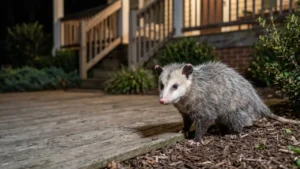
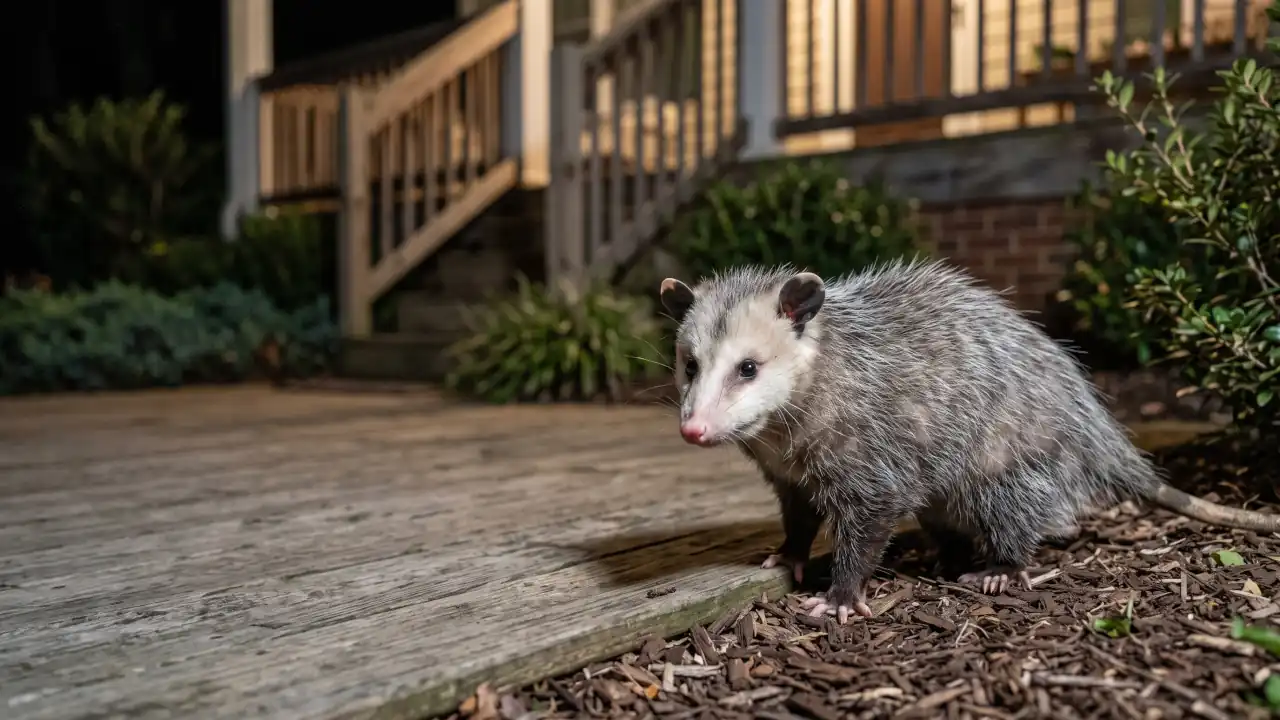
Are opossums dangerous? That’s probably what brought you here, and it’s a fair question if you just found one rooting through your trash can or frozen under your porch light, hissing at you like it means business. The good news is that opossums generally pose little danger to people. The bigger concerns are a bite if the animal is cornered, contact with wildlife waste or contaminated nesting material, and nuisance problems if one starts denning under a structure. Here’s what their behavior actually means, when an encounter deserves caution, and what to do if one has taken up residence around your home.
Also Read: Where Japanese Beetles Go at Night: A Homeowner’s Guide
Quick Answer
Opossums are generally not dangerous to people. They are shy, mostly nocturnal animals that usually avoid confrontation. However, an opossum can bite or scratch if it is cornered, handled, or unable to escape. The bigger concerns are direct contact, wildlife waste, pets, and an opossum getting into an attic or crawl space.
Understanding Opossum Behavior
Before we get into the danger question, it helps to know what you’re actually dealing with. The Virginia opossum is North America’s only marsupial, and it’s been wandering backyards and alleys for longer than most of the wildlife we consider “normal” neighbors. They’re nocturnal, so most of your encounters will happen at night, usually near a food source like an open trash can, a pet food bowl left outside, or a compost pile.
Opossums are also loners. They don’t build packs, they don’t defend territory the way raccoons or skunks do, and they don’t stick around to fight if they can help it. When startled, an opossum may freeze, hiss, bare its teeth, and then either move away or enter its famous playing-dead response. That open-mouthed hissing display looks aggressive on camera, but it’s primarily defensive. An opossum generally has more to gain by intimidating a threat and getting away than by engaging it.
Opossums aren’t built for speed, which is one reason avoidance is such an important part of their defense. When escape isn’t possible, they rely on hissing, baring their teeth, and eventually playing dead rather than chasing or pursuing a threat. That can look aggressive when you’re standing a few feet away, but the behavior is primarily defensive.
Are Opossums Dangerous?
An opossum’s defensive display can look much more threatening than it actually is. When one feels trapped, it may hiss, bare its teeth, or stand its ground to discourage whatever is approaching. These behaviors are usually meant to create distance, not start a fight.
Direct attacks on people are uncommon. A bite is much more likely when an opossum is cornered, handled, or unable to escape. That’s why the safest response to an opossum that is hissing or showing its teeth is not to test whether it’s bluffing—give it a clear path away and keep people and pets back.
That said, “not dangerous” doesn’t mean “risk-free.” Like other wild mammals, opossums can be exposed to parasites, bacteria, and other pathogens, so direct contact and contact with wildlife waste should be avoided. The real risk with opossums isn’t a home-invasion movie scenario. It’s more about nuisance, mess, and the occasional pet scuffle.
What to Do If an Opossum Is in Your Yard
If you spot an opossum outside at night, the best response is usually to leave it alone. Bring pets indoors or keep them away from the animal, remove accessible food when you can do so safely, and give the opossum a clear path away from the property. Don’t chase it, corner it, or try to make it leave by poking or spraying it.
If the animal is inside your house, trapped in a window well, injured, or behaving abnormally, that’s a different situation. Keep people and pets away and contact local animal control or a qualified wildlife professional for guidance.
Do Opossums Attack Pets?
This is the question I get asked the most, especially from people with dogs or outdoor cats. The honest answer is that opossums generally don’t seek out fights with pets. If your dog corners one in the yard, the opossum may freeze, hiss, bare its teeth, or attempt to play dead. Actual biting or scratching is more likely when the animal cannot escape.
The scuffles that do happen are usually one-sided, with the dog doing the attacking and the opossum trying to get away or protect itself. A cornered opossum can and will scratch or bite if it truly has no escape route, so it’s smart to call your dog off rather than let a standoff continue.
What About Chickens and Eggs?
Opossums are more likely to create problems around backyard poultry than around dogs or cats. They may raid nests for eggs and can prey on chicks or other very small animals when they have the opportunity. If you keep chickens, secure the coop at night, collect eggs regularly, and don’t leave feed scattered around the enclosure.
One important distinction is that an opossum may defend itself even when it isn’t the animal that started the encounter. A dog that corners an opossum can turn a harmless wildlife sighting into a bite or scratch incident very quickly. Don’t let dogs chase, pin, or sniff at a trapped opossum, and don’t reach between a pet and the animal to separate them.
If you want to avoid these run-ins altogether, keep pet food and water bowls inside at night, and give your dog a quick supervised check of the yard before letting them out after dark, especially near sheds, decks, or wood piles where an opossum might be resting.
What About Cats?
An opossum generally has little reason to pursue or attack an adult cat. The bigger concern is an encounter in which the cat corners the opossum or gets too close to a trapped animal. Keep outdoor cats away from opossums when possible, particularly if the animal is cornered or behaving defensively.
The Truth About Opossums and Rabies
Opossums can contract rabies, but reported rabies infections in opossums are uncommon. Their relatively low body temperature has been suggested as one possible factor in that low frequency, but it should not be treated as a guarantee that an opossum cannot carry or transmit rabies. The practical rule is simple: don’t handle an opossum that appears sick, unusually aggressive, severely disoriented, or otherwise abnormal.
Daytime activity by itself is not proof that an opossum has rabies. Opossums can be active during daylight, particularly when environmental conditions or food availability change. What matters more is the animal’s overall behavior. An opossum that is staggering, unusually aggressive, repeatedly approaching people, unable to move normally, or showing other obvious signs of illness should be given plenty of space. Keep children and pets away and contact local animal control or a wildlife authority for advice.
Rabies risk also varies by region, so local public-health guidance is more useful than relying on a general rule about how rarely rabies occurs in opossums. If there has been an actual bite or scratch, report the exposure when advised and follow the recommendations of your healthcare provider or local health department.
Diseases Opossums Can Carry
Rabies gets most of the attention, but it isn’t the only reason to avoid direct contact with wildlife. Opossums, like other wild mammals, can be exposed to bacteria, parasites, fleas, ticks, and other organisms in their environment. For homeowners, the practical concern is direct exposure: handling the animal, being bitten or scratched, or coming into contact with contaminated feces, urine, nesting material, or a carcass. Simply seeing an opossum pass through the yard does not mean you’ve been exposed to a disease.
Depending on the animal’s environment and region, wildlife can also be associated with organisms such as Salmonella and Leptospira, which is one reason to avoid contact with feces, urine, contaminated food, and water. The presence of an opossum alone, however, isn’t evidence that your yard or home has been contaminated.
One myth worth correcting is the idea that opossums are essentially walking tick vacuums that consume thousands of ticks every week. The evidence is much less convincing than the popular claim suggests. A University of Illinois Extension review of the research notes that studies have not established opossums as an important source of tick control, so you shouldn’t rely on having opossums around as a strategy for reducing ticks or Lyme disease risk.
The practical takeaway is simple: don’t handle opossum droppings, nesting material, or carcasses with bare hands. Keep children and pets away from the area, wear disposable gloves if you’re cleaning up small amounts of waste, wash your hands thoroughly afterward, and take extra care around contaminated areas inside attics, crawl spaces, or enclosed structures. If there is a substantial amount of fecal material or urine contamination indoors, professional cleanup may be appropriate.
When Opossums Bite: Risk and Treatment
Opossum bites are uncommon and are most likely when an animal is cornered, grabbed, or otherwise unable to escape. A female with dependent young may also be more difficult to approach safely, so don’t attempt to handle an opossum or investigate a den by hand. An opossum’s teeth can make a bite look intimidating, but the important issue isn’t how the bite looks—it’s whether the skin was broken and whether medical or veterinary follow-up is needed.
If you or a pet is bitten, wash the wound thoroughly with soap and running water as soon as possible. For a person, seek medical advice promptly so a clinician can assess the wound and determine whether tetanus protection, antibiotics, or rabies post-exposure treatment is appropriate. For a pet, contact your veterinarian and explain that the bite came from a wild mammal.
Don’t make the rabies decision based on the species alone. Although rabies is uncommon in opossums, the circumstances of the exposure and the animal’s behavior matter. A healthcare professional or veterinarian can determine what follow-up is appropriate, while local animal-control or public-health officials can advise on the animal itself when necessary. Do not try to capture the opossum yourself simply to have it tested.
The “Playing Dead” Defense Mechanism
This is probably the most famous thing about opossums. When an opossum experiences an extreme threat, it can enter an involuntary state of apparent death, a defensive behavior commonly called thanatosis. The animal may collapse, become motionless, expose its teeth, and remain unresponsive while the threat is nearby. To a homeowner, the display can look alarming, but it is a defensive response rather than an attempt to attack.
The response is involuntary, so an opossum that appears dead may simply be overwhelmed rather than injured. If you find one in this state, don’t poke it, move it, or let pets investigate. Give it plenty of space and time to recover. If you’re concerned that the animal is injured or genuinely dead, contact local wildlife authorities for guidance.
Why Opossums Are Less Dangerous Than Other Wildlife
Opossums generally have a lower-conflict lifestyle than many of the wildlife species homeowners encounter around houses. They don’t normally pursue people or pets, and their primary defenses are avoidance, intimidation, and playing dead. That makes a close encounter less likely to turn into a confrontation—but a cornered animal can still bite or scratch.
Their solitary habits and tendency to avoid confrontation help keep routine encounters relatively low risk. The useful distinction for homeowners is simple: an opossum passing through the yard is usually a minor wildlife encounter, while one trapped inside a structure or behaving abnormally deserves a more careful response.
Can Opossums Be Beneficial?
Opossums are not something you need to attract to your yard, but they are not purely destructive animals either. They eat a varied diet that can include insects, fruit, carrion, and other small food sources they find while foraging.
That can make an occasional yard visit less concerning than it first appears. An opossum moving through the property at night is often simply looking for food rather than trying to establish a territory or confront people.
That said, their benefits do not mean you should feed them or encourage them to stay. If an opossum starts denning under a deck, getting into a crawl space, raiding garbage, or repeatedly coming into contact with pets, prevention is more appropriate than trying to maintain the animal as a backyard visitor.
Property Damage from Opossums
Opossums aren’t chewers the way rats and squirrels are, so you’re not likely to find gnawed wiring or chewed-through insulation because of them. Their damage tends to be more about mess than destruction. They’ll knock over trash cans, raid compost bins, get into pet food left outside, and occasionally take up residence under a deck, in a crawl space, or inside an attic if there’s an easy opening.
Can Opossums Get Inside a House?
Yes. An opossum can enter an attic, crawl space, wall void, porch enclosure, or other sheltered area through a damaged vent, gap, loose screen, or opening around the structure. They usually aren’t trying to get into the living areas of a house, but once an animal has found a protected space, the priority is identifying how it entered and making sure it can leave safely before the opening is sealed.
If you find an opossum inside a structure, don’t immediately seal the opening it appears to be using. There may be young inside, and blocking an occupied den can trap animals indoors. First determine whether the space is actually occupied and whether the animal has left; exclusion work should be timed so you don’t separate a mother from dependent young.
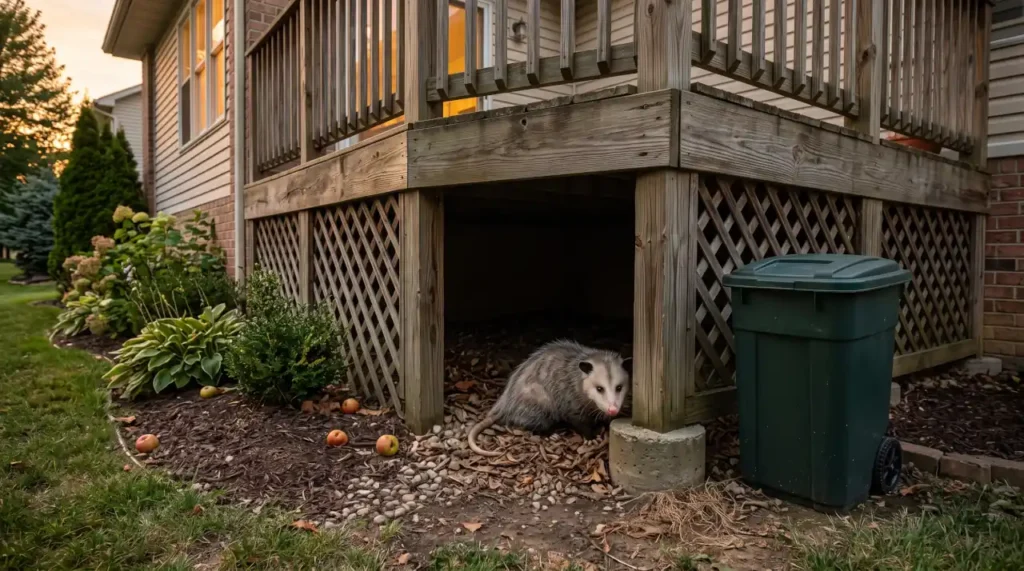
Once they’ve settled into a space, you might notice matted insulation from nesting material, a musty odor, or droppings in the area they’re using. They can also damage garden beds while foraging for grubs and insects, though usually nowhere near as aggressively as a raccoon digging up a lawn. The bigger practical issue is usually the entry point itself. An opossum that got into your crawl space found a gap somewhere, and that same gap can let in other, less polite wildlife later.
In an attic or crawl space, the bigger concern is often contamination rather than structural destruction. Repeated urination or defecation can create persistent odors and soil insulation or other materials. Nesting material can also make inspection and cleanup more difficult, particularly if the animal has been using the same sheltered area repeatedly.
When Opossums Become a Safety Concern
Most opossum sightings don’t require intervention. The situation deserves more caution when an animal repeatedly approaches people, appears unable to move normally, is severely disoriented, is unusually aggressive, or cannot get away from a person or pet. Daytime activity alone isn’t enough to conclude that an opossum is sick or rabid.
If you encounter a female carrying young or discover young inside a den, don’t approach or attempt to handle them. The presence of dependent young can complicate exclusion work, and separating a mother from her young can create a bigger wildlife problem inside the structure. In any of these cases, the right move is to give the animal space, keep kids and pets back, and let a wildlife professional or animal control handle it rather than trying to manage the situation yourself.
Preventing Opossum Problems
The good news is that opossums are drawn to your property for very predictable reasons, and most of those reasons are fixable. Secure your trash cans with locking lids so they can’t be knocked over or pried open. Bring pet food and water bowls inside at night, clean up fallen fruit from trees, and keep food scraps covered rather than exposed.
Before sealing an opening, make sure an opossum isn’t currently using it. This matters most from late winter through spring, when females may be caring for young. Sealing an occupied den can leave babies trapped inside or separate them from their mother. If you’re unsure whether a structure is occupied, get the situation assessed before permanently closing the entry point.
Trim back branches and dense vegetation that provide easy access to the house, particularly around rooflines and attic openings. Also inspect attic vents, soffits, roof returns, chimneys, and other openings for damage or gaps that wildlife could exploit, and make sure damaged vent screens are repaired with wildlife-resistant material.
Also remove or tidy up brush piles, stacked lumber, and other sheltered areas close to the house where an opossum could hide during the day. If you have fruit trees, clean up fallen fruit regularly so it doesn’t become another nighttime food source.
When to Call a Professional
If an opossum has gotten into an attic, crawl space, or another enclosed part of the house, or if repeated visits continue despite removing food and shelter sources, that’s a good time to contact a qualified wildlife professional. The immediate goal should be to determine how the animal got in, whether young are present, and how the animal can be excluded without trapping wildlife inside. Local wildlife regulations may also affect what can legally be done with the animal.
Professional help is especially appropriate when an opossum appears sick or injured, is behaving aggressively, or is in a location where attempting to remove it would put you or your pets within biting or scratching distance. A qualified wildlife professional or local animal-control agency can advise on the safest next step.
Dangerous Opossum Myths vs. Reality
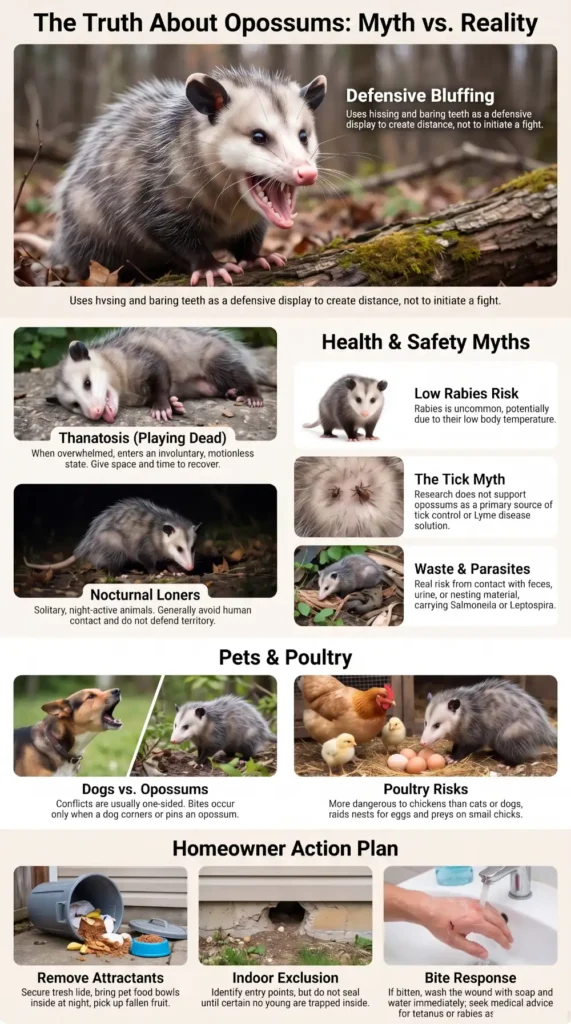
A lot of the fear around opossums comes from myths that sound believable but don’t hold up. The idea that opossums are usually rabid is misleading. Rabies has been documented in opossums, but it is uncommon. Their lower body temperature has been proposed as one factor that may help explain the low frequency of infection, but it should never be treated as proof that an individual animal cannot carry rabies. The claim that they’re aggressive predators looking for a fight is another myth. Their typical defensive behavior centers on avoidance, intimidation, and playing dead rather than actively pursuing a confrontation.
On the flip side, the popular idea that opossums are eating thousands of ticks a week and single-handedly protecting your family from Lyme disease has also been walked back by more recent research. The truth sits in the middle: opossums are neither the menace nor the miracle worker they’re sometimes made out to be. They’re just an ordinary, mostly harmless nocturnal visitor doing what nocturnal visitors do.
Living Safely with Opossums
Most homeowners do not need to remove an opossum simply because they see one in the yard. If it has a clear way to leave and is not showing abnormal behavior, giving it space is usually the safest approach.
Avoid feeding or handling opossums, and keep pet food and other attractants secured. Supervise pets around wildlife, particularly dogs that may try to corner or chase an animal.
Also Read:
If opossums repeatedly return, focus on removing the food and shelter that are attracting them. Secure garbage, clean up fallen fruit, and block access to suitable denning areas only after confirming no animal or young are inside.
The goal is not to chase every opossum away. It is to make your property less attractive while avoiding unnecessary contact with wildlife.
Final Thoughts
So, are opossums dangerous? For most homeowners, an opossum passing through the yard is a relatively low-risk wildlife encounter. They’re generally more interested in finding food and shelter than confronting people, and most will retreat when given a clear escape route.
The situations worth taking seriously are straightforward: don’t corner or handle an opossum, don’t let pets chase it, and don’t ignore a bite or scratch. If one gets inside a structure, look for the entry point and make sure there aren’t young present before sealing it. And if an animal appears seriously ill, injured, or unusually aggressive, keep your distance and contact local animal control or a qualified wildlife professional.
In other words, there’s no reason to panic when you see an opossum. Give it space, remove the food and shelter that’s attracting it, and treat any actual wildlife exposure—not the animal’s appearance—as the thing that deserves your attention.