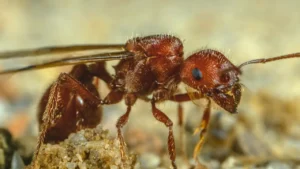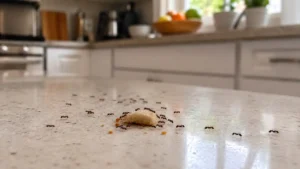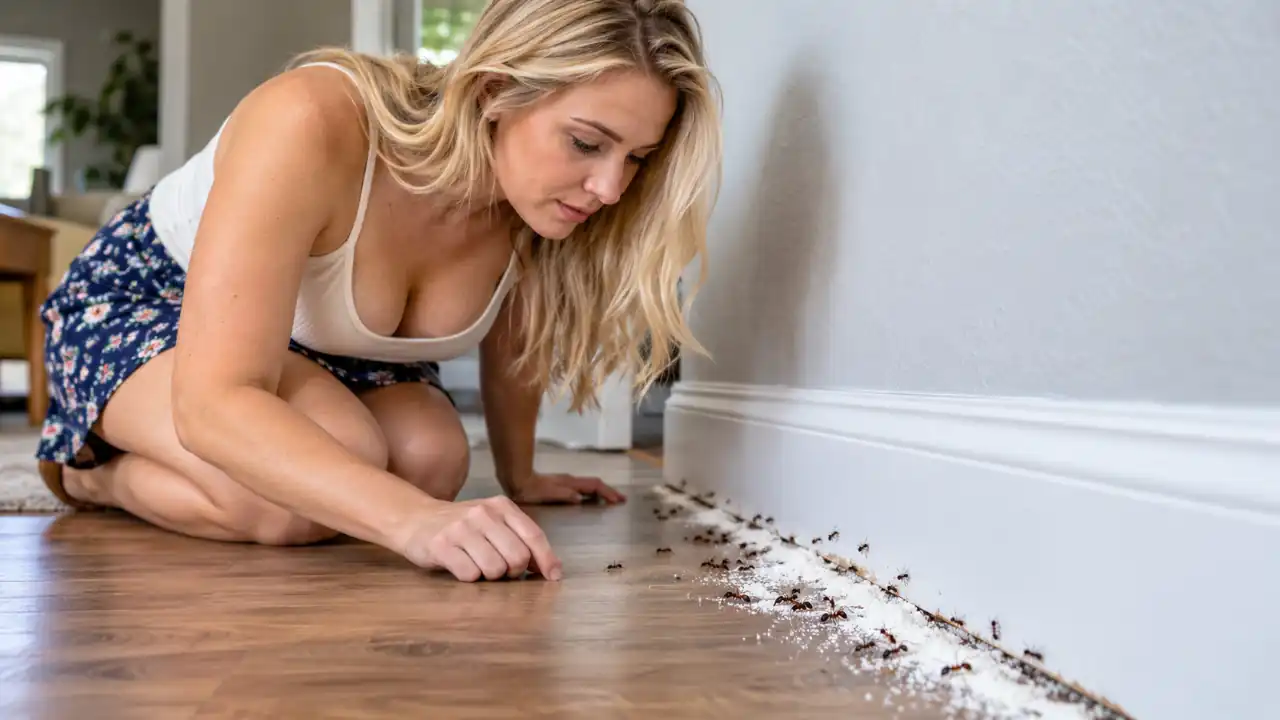
You spotted a trail of ants crossing your kitchen counter, and now you’re eyeing that bag of diatomaceous earth in the garage. Does diatomaceous earth kill ants? Yes, the ones that touch it. The nest is another story. After 18 years in pest control, I can tell you where this powder shines, where it falls short, and how to use it so it actually works.
Also Read: How To Get Rid Of Harvester Ants Fast (Simple 4-Step Fix)
Quick Answer
Yes, diatomaceous earth can kill ants that come into contact with the dry powder. It works by damaging and absorbing oils from the ant’s protective outer layer, increasing water loss and eventually causing dehydration. DE usually kills individual ants rather than the entire colony, so hidden nests may require bait or another control method.
What Is Diatomaceous Earth?
Diatomaceous earth, usually shortened to DE, is a fine white powder made from the fossilized remains of diatoms. Diatoms are tiny water algae that lived in oceans and lakes millions of years ago. When they died, their hard silica shells settled on the bottom and piled up over time. Today, companies mine those old deposits and grind them into dust.
Rub a pinch between your fingers and it feels surprisingly soft. Under magnification, though, the particles are abrasive and have a large surface area. That combination is important because DE can damage or remove the waxy material on an insect’s outer surface while also absorbing oils and moisture.
Not all DE is the same, and this matters more than people think. Food-grade DE is commonly sold for household uses, but if you’re using DE for ant control, choose a product labeled for the intended pest-control use and follow its directions.
The National Pesticide Information Center explains that most diatomaceous earth consists of amorphous silicon dioxide, rather than crystalline silica. However, the silica composition alone doesn’t determine whether a particular product is appropriate for pest control or safe to use in every situation.
One important distinction: “food grade” does not automatically mean a product is approved or labeled for use as a pesticide. Check the product label before using DE for ants, and avoid creating airborne dust because fine particles can irritate the respiratory system.
One important distinction: “food grade” does not automatically mean a product is approved or labeled for use as a pesticide. If you’re buying DE specifically for ant control, check the product label and use it only in the manner permitted by that label. Regardless of the grade, avoid creating airborne dust because breathing fine particles can irritate the respiratory system.
Pool grade DE is a different product. It’s heat treated, and that process raises the crystalline silica content. It’s made for filtering pool water, not for your baseboards. Don’t substitute pool-filter DE for a product intended and labeled for household pest use.
Does Diatomaceous Earth Kill Ants or Repel Them?
Here’s the honest answer. Diatomaceous earth kills ants. It does not work like a repellent spray that makes ants turn around and leave. Ants may cross a light application of DE rather than immediately avoiding it, which gives the powder an opportunity to contact their bodies. If ants consistently avoided the treated area, the powder would have much less opportunity to contact them.
But there’s a catch. Ants will sometimes go around a thick, heavy pile of powder. It isn’t because they’re scared of it. It’s because a deep drift is physically hard to climb through, like trying to walk through a snowbank. A light dusting gets picked up on their legs and bodies. A mountain of the stuff just redirects them to another path.
So the real picture looks like this. DE kills the individual ants that cross it, especially foragers, the workers you see marching around your kitchen. It does not reliably wipe out the whole colony, because the queen and most of the workers are sitting in a nest you can’t see, often outside, under a slab, or inside a wall.
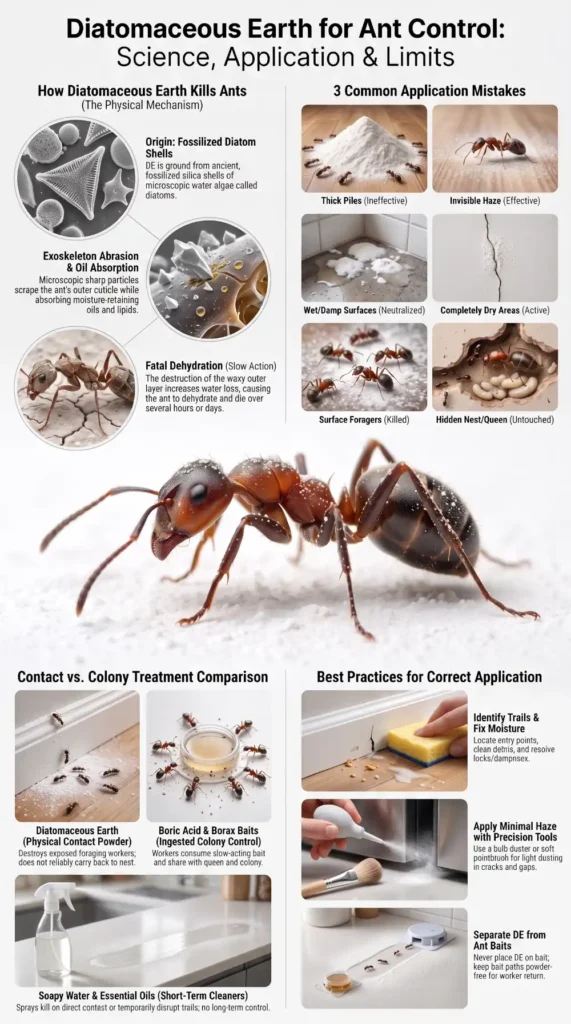
Quick Tip: Think of DE as a contact treatment, not a colony treatment. If you’re using ant bait, place the bait where ants are actively foraging and keep the bait area free of DE. The goal is to let workers find and feed on the bait and carry it back to the colony. DE can be useful in separate cracks, gaps, or entry points where contact treatment makes sense.
How Diatomaceous Earth Works on Ants
Diatomaceous earth is not a poison, and that’s the part people find surprising. It doesn’t attack the ant’s nervous system the way most insecticides do. It works by physical damage and dehydration.
Every ant has a protective outer layer that helps limit water loss. When an ant moves through DE, the abrasive particles can damage or disrupt that outer layer while also absorbing oils and other lipids from the insect’s surface. The result is increased water loss, eventually leading to dehydration and death.
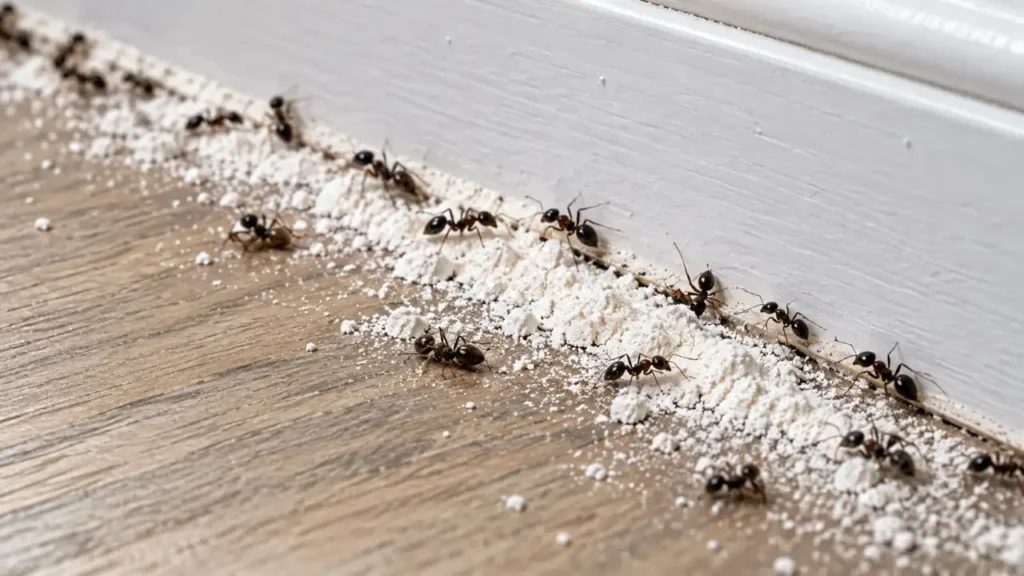
That’s why DE isn’t an instant killer. An ant that crosses a treated area may continue moving normally for a while before the effects become obvious. Seeing live ants shortly after applying the dust does not necessarily mean the treatment has failed.
The important distinction is that DE works only when the insect makes contact with enough dry powder. It isn’t a toxic bait that gets carried through the colony, and it doesn’t provide the same colony-level effect as a slow-acting ant bait.
There’s one real upside to this method. Because DE works through physical properties rather than targeting a specific biological pathway, it isn’t subject to insecticide resistance in the same way many chemical insecticides are. That makes its mode of action fundamentally different from conventional insecticides.
Some websites claim ants carry DE back to the nest and eliminate the entire colony. A little powder may be transferred on a worker’s body, but in my experience, that effect is too unreliable to depend on. Most of the colony remains protected in the nest, where the powder may never reach it. Treat DE as a contact treatment for exposed ants, not a dependable way to eliminate a colony.
How to Use Diatomaceous Earth for Ant Control
Using DE is easy, but small details decide whether it works. Start by finding where the ants are actually walking. Watch for a few minutes and note where they come in and where they go. Ants follow scent trails, so they often take the same route repeatedly—along baseboards, under sinks, behind the stove, or through a crack near the door. In the kitchen, following that trail and removing the food source can be just as important as treating the ants you see; the same principle applies when getting rid of ants in the kitchen.
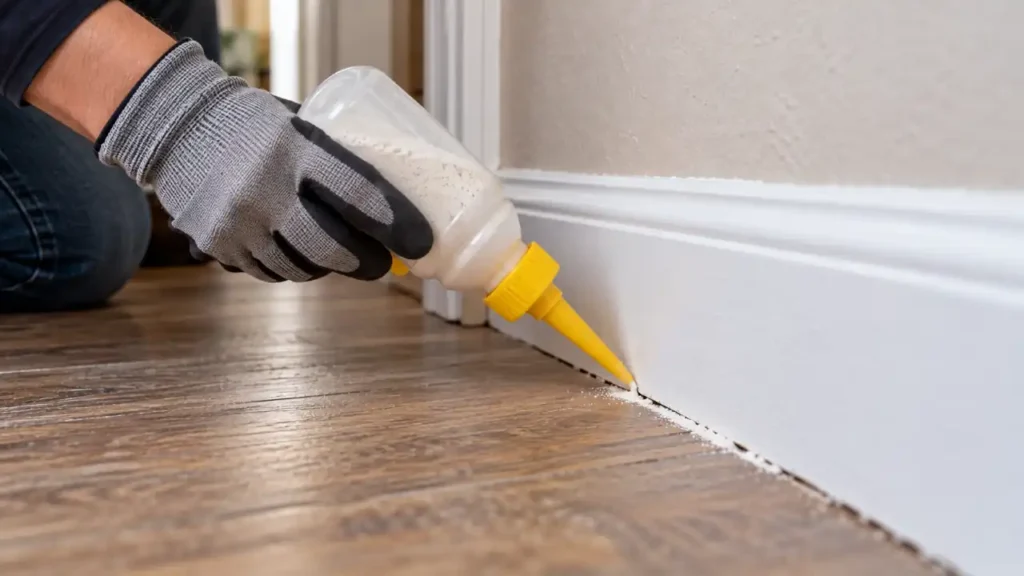
Wipe the area clean first. Remove crumbs, grease, and spills, and make sure the surface is dry. Then apply a very thin layer of a DE product labeled for the intended pest-control use, following its directions. You want a light dusting, almost like a haze, so you can still see the surface underneath. A powder duster or a clean, dry squeeze bottle gives you much better control than pouring from the bag. A soft paintbrush also works well for getting powder into tight corners.
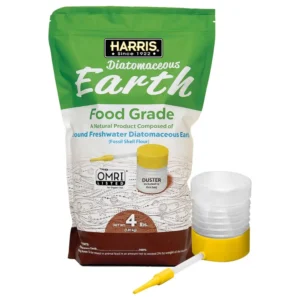
Good spots indoors include along baseboards, behind appliances, under sinks, inside the gap at the base of cabinets, and around pipe entry points. Outside, focus on specific entry points, cracks, and dry areas where you’ve actually observed ant activity rather than coating the entire foundation. If the ants are nesting in the lawn instead of entering the house, the problem calls for a different approach. Keep outdoor DE applications limited to uses permitted by the product label, especially where wind or rain could move the dust.
Because DE is a fine particulate dust, avoid breathing the powder or creating airborne clouds during application. Follow the product label for protective equipment and application instructions. Apply only a small amount where needed, keep unnecessary people and pets away during application, and avoid applying loose dust to areas where it can easily become airborne.
Never assume that “food grade” means safe to inhale. If someone in the household has asthma or another respiratory condition, minimizing airborne dust is especially important.
The Type of Ant Matters More Than Most People Realize
Not every ant problem should be handled the same way. Some ants are simply foragers coming inside from an outdoor nest, while others may be nesting inside wall voids, around moisture-damaged areas, or in other protected parts of the structure.
That’s important because killing the workers you see doesn’t necessarily solve the problem. If ants are nesting inside the building, you need to think about where the colony is located and what food or moisture is supporting it.
Carpenter ants are a good example. They can be associated with damp or damaged wood, and seeing large ants indoors shouldn’t automatically lead to a DE treatment. Seeing carpenter ants indoors does not automatically mean they are nesting inside the house. They may be traveling in from an outdoor nest, but repeated activity around damp wood, wall voids, or structural openings deserves closer investigation. Finding and correcting the moisture or structural condition contributing to the infestation can be just as important as killing the workers.
The practical rule is simple: identify what kind of ant you’re dealing with before deciding that DE is the right tool. A contact powder can help with exposed foragers, but the biology and nesting habits of the species determine what will actually solve the infestation.
What I See in Real Homes
One of the most common DE mistakes I see is treating the powder as if the visible ants are the whole problem. A homeowner will dust the trail running along a kitchen baseboard, watch the activity drop, and assume the colony is gone.
Then the ants show up again a few days later—often from a slightly different crack.
That’s usually the clue that the powder did its job on the workers that contacted it, but the colony was never addressed. At that point, I stop looking at the individual ants and start following the trail back toward the entry point. Is there moisture under the sink? A gap around a pipe? A nest outside along the foundation? Or are the ants disappearing into a wall void?
That change in thinking matters. DE can be useful, but killing the ants you can see isn’t always the same thing as solving the infestation.
3 Mistakes That Make Diatomaceous Earth Fail
I’ve seen the same three mistakes ruin DE treatments again and again.
Mistake 1: Putting down a thick layer
This is the big one. People think more powder means more killing power, so they pour a heavy line across the floor. Ants walk around it, or the powder clumps and doesn’t cling to their bodies. A thin, almost invisible dusting works far better than a thick white stripe.
Mistake 2: Using it where it’s damp
DE works best when it stays dry. Moisture can make the powder clump and reduce its effectiveness as a contact treatment. Applying it under a leaky sink, on a damp patio, or just before rain can make the application less useful. Fix the moisture problem first, and follow the product label if reapplication is needed after the area gets wet.
Mistake 3: Expecting it to kill the nest
Many homeowners dust a trail, see fewer ants for a week, and assume the problem is solved. Then the ants come back, because the colony was never touched. DE only works on ants that cross it. If you don’t deal with the nest and the thing drawing the ants in, such as a food source, you’ll be dusting forever. Clean up food and moisture sources first. If you’re not sure what’s drawing the ants inside, look at the common things that attract ants to your house before deciding on your next treatment.
Get those three right and DE becomes a much more dependable part of your plan.
How Long Does Diatomaceous Earth Take to Kill Ants?
Don’t expect instant results. DE generally works more slowly than a contact insecticide, and the time it takes for an exposed ant to die can vary with the amount of exposure, environmental conditions, and the species involved. More importantly, seeing ants for several days does not necessarily mean the treatment has failed. If fresh ants continue appearing, the colony may simply be replacing workers that have been killed.
Moisture is the bigger concern. DE needs to remain dry and in contact with the ant. Once the powder becomes damp or wet, it can clump and become much less useful as a contact treatment. In kitchens, bathrooms, and outdoors, check treated areas more often because condensation, splashes, cleaning, and rain can disrupt the dust.
The size of the colony matters too, because a big, active nest keeps sending out new foragers to replace the ones that die. And your placement matters most of all. If the powder isn’t on the path the ants actually use, nothing will cross it.
Ants may also change routes when an established trail is disrupted. If activity continues, check whether ants are crossing the treated area and whether the dust remains dry. If they keep using another route or new workers continue appearing, reassess the entry point and consider whether bait or another control method is more appropriate.
Quick Tip: Check your dust lines regularly during the first week. If the powder has been wiped away, disturbed, or gotten damp, correct the problem and follow the product label before reapplying. If steady ant activity continues despite a properly placed, dry application, don’t keep adding more DE. Follow the ants to determine where they’re coming from and consider whether bait or another control method is better suited to the species and situation.
Diatomaceous Earth vs Other Natural Ant Killers
DE isn’t the only natural option, so let’s compare it to the other common ones.
Boric acid and borax baits work differently from DE. Instead of relying on direct contact with a powder, a properly formulated bait allows workers to consume the active ingredient and potentially transfer it within the colony. That’s why bait can be a better option when the goal is colony control. If you’re considering a borax-based approach, here’s how borax works for ant control.
Don’t treat boric acid or borax as automatically harmless just because they’re common household compounds. Concentrated products and bait formulations can be harmful if swallowed, particularly by children or pets. Follow the product label and use tamper-resistant bait stations where appropriate.
Soapy water and vinegar have useful but limited jobs. Soapy water can kill ants that are directly sprayed, while wiping an ant trail can remove the scent cues that help workers follow an established route. Neither method eliminates the colony. If you’re using DE, don’t spray liquid directly over the treated dust. Moisture causes DE to clump and reduces its effectiveness. Clean the trail first, allow the surface to dry completely, and then apply a fresh, thin layer of DE where appropriate.
Cinnamon, peppermint oil, and other spices get recommended all the time. They can make ants avoid a spot for a little while, but they don’t kill the colony, and the effect fades fast. I treat them as a short-term nuisance fix at best.
Diatomaceous earth has a different safety profile from conventional insecticide sprays because it works through physical action rather than a toxic mode of action. That doesn’t make the dust harmless, particularly when it becomes airborne.
DE can remain effective as long as it stays dry, undisturbed, and in place, but there is no universal “months” timeframe. Foot traffic, cleaning, humidity, rain, and other disturbance can remove or reduce the treatment much sooner.
Check treated areas periodically and reapply only according to the product label. DE and bait may have separate roles in an ant-control plan, but don’t put DE on the bait or where it interferes with ants reaching it. Use DE only in appropriate, labeled locations, and place bait where ants can find and feed on it. This allows the bait to do its job without the dust getting in the way.
If the ants keep coming back after all of that, or you see them in large numbers inside walls, a licensed professional can find the nest and treat it directly. Some nests are simply inaccessible with DIY methods, particularly when the colony is inside a wall, under a slab, or in another protected location.
Also Read:
When Diatomaceous Earth Isn’t Enough
DE makes the most sense when you can identify a dry area where ants regularly travel and you need a contact treatment. It becomes much less useful when the colony is hidden, the treated area stays damp, or new ants are constantly entering from somewhere you can’t reach.
Look for a bigger problem if you are seeing ants repeatedly emerge from wall voids, ceilings, electrical or plumbing openings, or other inaccessible areas. Large numbers of ants appearing day after day are another sign that you’re dealing with an active colony rather than a few wandering foragers.
At that point, stop adding more powder and start looking for the source. Follow the ants, identify the species if possible, and look for moisture or food sources. If the nest is inaccessible or the infestation keeps returning, it may help to understand what an ant exterminator checks and does before deciding how to proceed.
Conclusion
So, does diatomaceous earth kill ants? Yes, it does, but only the ones that walk through it, and it does it slowly. It works through abrasion and removal of oils from the insect’s protective outer layer, increasing water loss and eventually causing dehydration.
The three mistakes to avoid are piling DE on too thick, applying it where it will become damp, and expecting it to eliminate a hidden colony by itself. Clean up food and moisture sources, identify where the ants are coming from, and use a properly placed bait when colony control is the goal.
Start with a thin application in a dry area where ants are actually traveling, then monitor what happens. If activity continues because new workers are replacing the ones you’ve killed, don’t keep adding more powder. Follow the ants back toward the source and change your strategy if the colony is out of reach.