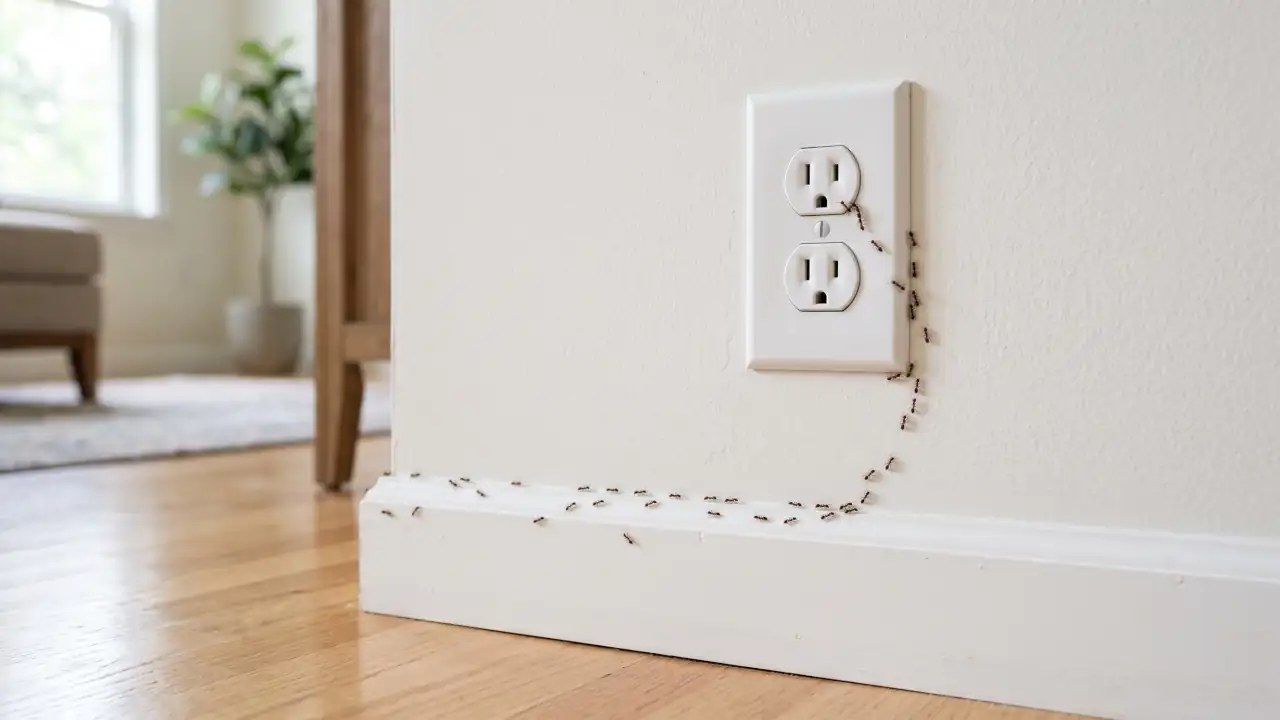
You flip on a lamp or go to charge your phone, and there they are: a little stream of ants crawling out of the outlet like it’s their personal front door. It’s unsettling and honestly a little scary once you realize wires and electricity are involved. The good news is this is fixable, and you don’t need to panic or call an electrician just yet.
Let’s walk through why it’s happening and how to shut it down for good. If you’re wondering how to get rid of ants in an electrical outlet, the solution is to safely eliminate the colony, remove the scent trails they’re following, and prevent them from getting back into your walls. The same approach also works if you’re dealing with ants in multiple electrical outlets, since they’re usually connected to the same hidden nest or travel routes inside your walls.
Also Read: How to Get Rid of Ants in Carpet: Simple Steps That Work Fast
Quick Answer
To get rid of ants in an electrical outlet, first turn off power to the outlet at the breaker. Then use an electrical-safe ant dust or bait to eliminate the colony, clean away pheromone trails, and seal entry points to prevent reinfestation. If you notice warm outlets, flickering lights, or a burning smell, stop using the outlet and have it inspected before treating the ants.
Why Are Ants Coming Out of Your Electrical Outlet?
Here’s the thing most people don’t expect: ants aren’t randomly wandering into your outlets. They’re choosing them for a reason. Outlets and the wall cavities behind them are warm, dark, dry, and almost never disturbed. Even a small amount of condensation around exterior-facing walls or nearby plumbing can make these hidden spaces even more attractive to ants looking for reliable nesting conditions.
For a small colony of ants, it’s an ideal nesting site. The slight heat given off by wiring and electrical components mimics the kind of warmth ants naturally seek out when they’re nesting, especially during cooler months when they’re hunting for a cozy spot indoors.
There’s another interesting reason we’ve noticed over the years as well. Certain ant species, sugar ants and odorous house ants in particular, seem to be drawn to electrical fields themselves.
Researchers have observed that some ant species frequently infest energized electrical equipment, although the exact reason remains under study. One widely accepted explanation is that ants shocked by electrical current release alarm pheromones that attract additional workers to the same location. Other ants pick up on that scent and rush toward it thinking there’s a threat to deal with, and instead they just walk straight into the same outlet. That creates a cycle where one shocked ant can unintentionally attract dozens more.
On top of the warmth and the electrical pull, outlets give ants a direct route into your wall voids. In many homes, ants first enter through small foundation cracks, utility penetrations, or gaps around doors and windows before eventually finding their way into wall cavities and electrical boxes. Electrical outlets aren’t the only places ants invade. They’re also commonly found in electrical boxes, switch boxes, and occasionally around breaker panels, since these enclosed spaces provide the same warmth, shelter, and low level of disturbance that ants look for when expanding a nest.
Whether you call it an electrical outlet or a wall socket, the underlying problem is usually the same: ants are using hidden spaces behind the wall to travel between their nest and the rest of your home. Once they’re behind the wall, they have access to insulation, wood, and quiet pathways that lead them all over your house. An outlet isn’t just where you’re seeing them, it’s usually the doorway to a much bigger highway system running behind your drywall.
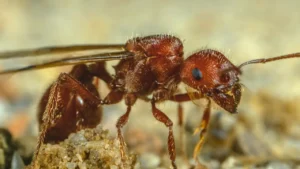
It also helps to know which ants you’re actually dealing with, since it changes how urgently you should act. Odorous house ants, the small brown or black ants that give off a faint rotten-coconut smell when crushed, are the most common species showing up in outlets across most homes. Small household ants commonly referred to as “sugar ants” behave similarly and are attracted by the same combination of warmth and shelter.
In some parts of the country, fire ants are the bigger concern, and they’re notorious for swarming electrical boxes and equipment outdoors before working their way inside. Ants can also invade electronics, not just outlets. If you’ve found ants in a laptop, gaming console, or another device, the cleanup is a little different than dealing with an outlet. None of these species are dangerous to handle, but fire ants do bite and sting, so a bit more caution is warranted if that’s what you’re seeing.
Quick Tip: If you’re seeing ants at one outlet, don’t assume it’s an isolated spot. Check the outlets in adjoining rooms, especially ones that share the same wall. In larger infestations, you may even hear faint rustling or movement inside the wall, especially at night when household noise is lower. While not common, it’s another sign the colony extends beyond the outlet itself. Ants traveling through wall voids will often pop out wherever there’s an opening, and outlets are far from the only one. If you’ve already dealt with ants in your walls before, this is usually the same colony finding a new exit point.
Why You Should Get Ants Out of an Electrical Outlet Quickly
It’s tempting to brush this off as a minor annoyance, something you’ll deal with eventually. But ants in an outlet are a different category of problem than ants on your kitchen counter, and it’s worth treating it that way.
First, there’s the electrical risk. Ants can chew through thin wire insulation, and when enough of them die inside an outlet or a junction box, their bodies and the moisture from their decomposition can actually create a path for electrical current to arc or short. This isn’t a common outcome, but it does happen, and it’s the kind of thing that turns a pest problem into a fire hazard or a costly repair bill. Flickering lights, an outlet that feels warmer than it should, or a faint burning smell near the wall are all signs that things have gone past “just a few ants.”
Second, an outlet infestation almost always means there’s a bigger colony living inside your walls, not just a handful of stragglers. Ants you can see are usually a small fraction of the total colony. By the time they’re confident enough to march in and out of your outlet in broad daylight, they’ve likely already established nesting sites somewhere close by, possibly in more than one wall.
Third, and this one surprises people, ants release pheromone trails as they travel. The longer they’re allowed to come and go from that outlet, the stronger and more permanent that trail becomes. Other ants, even from different parts of the colony, will start using it too. Acting early isn’t just about convenience, it genuinely makes the whole problem easier and cheaper to solve.
There’s also a practical money angle worth mentioning. Electrical repairs caused by pest damage aren’t always covered by homeowners insurance, since many policies treat it as a maintenance issue rather than sudden accidental damage. Replacing a damaged outlet or a section of chewed wiring is a manageable cost on its own, but if the issue goes unnoticed long enough to cause a breaker problem or scorched wiring behind a wall, the repair bill climbs fast. Catching this early, while it’s still just a handful of ants at one outlet, is by far the cheapest version of this problem you’ll ever deal with.
In our experience, homeowners often assume the outlet itself is the source of the infestation, but it’s usually just the most visible exit point. The actual colony is commonly established deeper inside a wall void or entering from an exterior gap elsewhere on the home.
How To Get Rid of Ants in Electrical Outlet
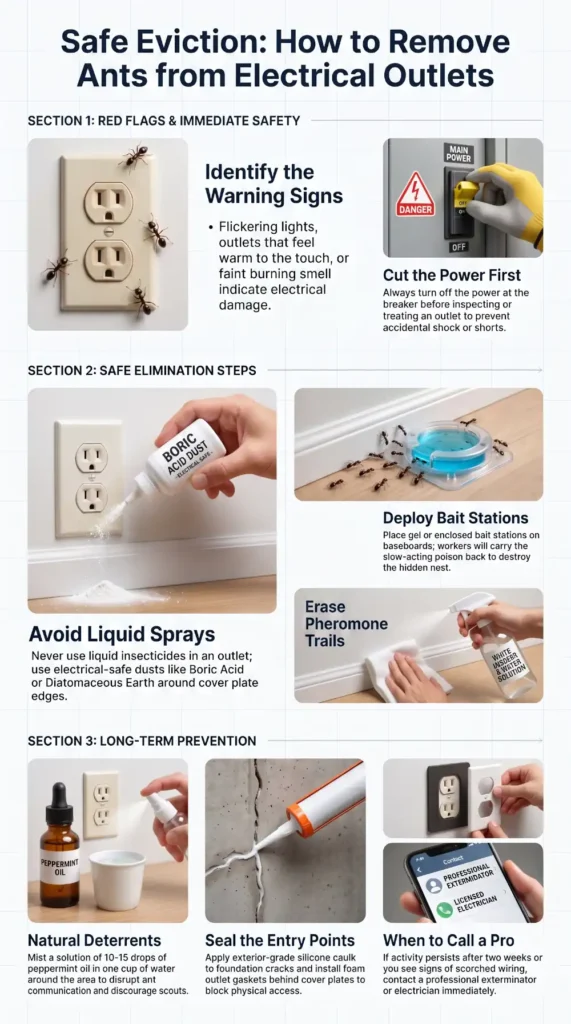
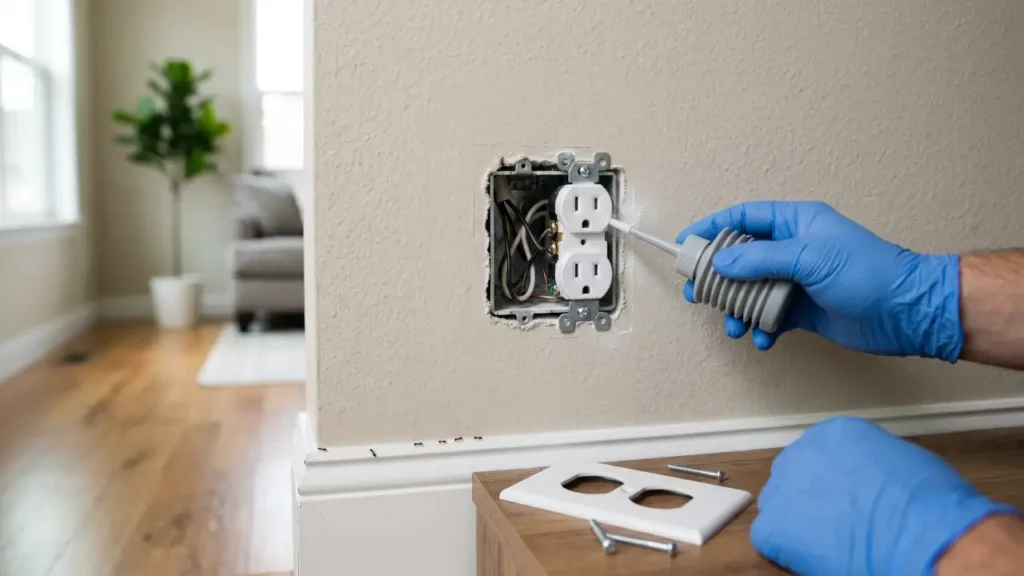
Before you do anything else, turn off the power to that outlet at the breaker. Turning off the breaker is the safest first step whenever you’re working near an electrical receptacle. The U.S. Consumer Product Safety Commission recommends disconnecting power before inspecting or working around household electrical outlets to reduce the risk of shock or injury.
This step is more important than many homeowners realize. You’re about to be working near wiring, possibly removing the cover plate, and you don’t want to be doing that live. Once the power’s off, here’s how to actually clear the ants out.
Use Insecticide Sprays
This is the step where most people want to be careful, and rightly so. Spraying liquid insecticide directly into a live outlet is a bad idea, it can damage the wiring and create a genuine shock or fire risk.
Instead, look for a dust-based or aerosol insecticide that’s labeled safe for use around electrical components, these are formulated specifically so they won’t conduct electricity or leave behind moisture. Unlike liquid sprays that work mainly on direct contact, many dust formulations continue working after application, helping control ants that emerge from the wall void over the next several days.
If the infestation feels bigger than a DIY can or a few sprays can handle, or if you’re not totally confident working around the breaker box, this is a good moment to bring in a professional ant exterminator. Avoid using expanding foams, flammable aerosol products, or excessive amounts of insecticide inside wall voids, as these can create additional safety hazards around electrical components. They have access to treatments and application methods that go further than what’s sold at the hardware store, and they can treat the full colony rather than just the ants you can see.
If you’re shopping for a dust product yourself, look for one with boric acid or diatomaceous earth as the active ingredient. Both are commonly used in pest control specifically because they’re effective against ants without the moisture or conductivity risk that comes with liquid sprays.
Diatomaceous earth works mechanically because it’s abrasive to an ant’s exoskeleton. Boric acid works differently. It’s a slow-acting stomach poison that worker ants carry back to the nest. Either one applied sparingly around the outer rim of the cover plate, never inside the slots, does the job without putting your wiring at risk. If you’d rather make your own bait than buy one, we’ve also put together a guide explaining how borax baits work and when they’re actually worth using.
Set Up Ant Traps
Bait traps work differently than sprays, and honestly, for a colony living inside your walls, they’re often more effective long term. The idea is simple: worker ants find the bait, think it’s food, and carry it back to the nest to share with the rest of the colony, including the queen. A few days of patience usually does more damage to the colony than instant-kill sprays ever could, because sprays only get the ants you can see in the moment.
Place gel or bait stations near the outlet, but not directly on or in it. A spot on the baseboard a few inches away works well, since ants will pick up the trail without needing to crawl through the outlet itself. Give it some time. Bait traps are a slower method, but they’re working on the actual source of the problem instead of just the symptoms.
If you’d rather use a ready-made bait instead of mixing your own, an enclosed bait station is one of the easiest options for most homeowners.
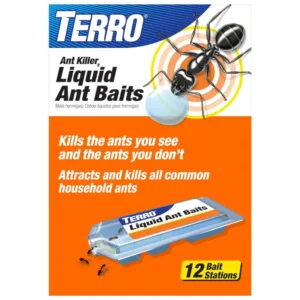
Gel baits and pre-filled bait stations both work on the same principle, but they suit slightly different situations. Gel is easier to apply precisely along a baseboard or crack, which makes it a good fit when you can see exactly where the ants are traveling.
Enclosed stations are a better choice if you’ve got kids or pets in the house, since the bait stays sealed inside a plastic housing the ants can enter but nothing else can. Either option is fine for this situation, it mostly comes down to where you’re placing it and who else lives in the house. If one bait isn’t attracting ants after several days, try switching to a different formulation. Some species prefer sugary baits, while others are more attracted to proteins or grease.
In many of the homes we’ve dealt with, homeowners assume the ants are nesting directly inside the outlet. More often, the outlet is simply where workers are emerging, while the nest is tucked farther back inside the wall and the colony is simply using the outlet as a travel route.
Eliminate Trails
Ants don’t wander randomly once they’ve found a food or shelter source, they lay down a scent trail using pheromones so the rest of the colony can follow the exact same path. If you only deal with the ants you see and skip this step, new ants will keep showing up at that same outlet for weeks.
Wipe down the wall, baseboard, and outlet cover with a mix of white vinegar and water, or a basic soap and water solution. Some homeowners reach for bleach because they assume it’ll solve the problem faster, but that’s not always the case. If you’re thinking about trying it, it’s worth knowing what bleach actually does—and doesn’t do—to ants. Either one breaks down the pheromone trail effectively. Do this every day or two for about a week, even after you stop seeing ants, just to make sure the scent path is fully gone and new scouts don’t pick it back up.
This step gets skipped more than any other, and it’s usually why people end up dealing with the same problem again a couple of weeks later. Ants don’t need to see the original colony members to follow a trail, the scent alone is enough instruction for a brand new scout to retrace the exact same route days or even weeks after it was first laid down. Treating the outlet and ignoring the trail is a bit like mopping up a leak without turning off the tap, you’re managing the visible mess while the actual path stays wide open.
Use Peppermint & Cinnamon
This one feels almost too simple, but it genuinely works as a deterrent, especially as a follow-up to the sprays and traps. Ants strongly dislike the smell of peppermint oil and cinnamon, it overwhelms their sense of smell and disrupts their ability to follow trails or communicate with the colony.
Mix about ten to fifteen drops of peppermint essential oil with a cup of water in a spray bottle and lightly mist around the outlet cover, baseboards, and any cracks nearby (again, avoid spraying directly into the outlet itself). Ground cinnamon sprinkled along the baseboard works the same way and has the bonus of being something most people already have in the kitchen. Neither of these will wipe out a colony on its own, but they’re a great natural layer to add on top of the other steps, and they keep new scouts from wanting to come back.
Ways To Prevent Them from Getting into Your Outlets
Getting rid of the ants that are already there is half the job. The other half is making sure you’re not doing this again in three months. A few habits go a long way here.
Keep Your Home Clean
Ants are opportunists, and crumbs, spills, and unsealed food are basically an open invitation. Food isn’t the only thing drawing them inside, though. Moisture, warmth, and even tiny entry points around the house can all play a role, so it’s worth understanding what attracts ants in the first place if you want to stop the problem from coming back.
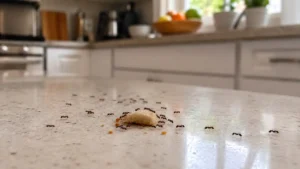
If there’s a steady food source somewhere in your home, ants will keep sending scouts out looking for new routes to it, and an outlet near a kitchen wall is an easy target. Wiping down counters, sweeping up crumbs, and storing food in sealed containers removes the incentive for them to be exploring your walls in the first place.
This matters most in rooms where food and moisture are common. If you’ve had ant trouble before, it’s worth checking out our guides on getting rid of ants in the kitchen and getting rid of ants in the kitchen sink, since kitchens are by far the most common starting point for an infestation that eventually shows up somewhere unexpected, like an outlet in another room. Bedrooms aren’t immune either, especially if there’s food, spilled drinks, or pet bowls nearby, so it’s worth a look at our piece on dealing with ants in the bedroom if that’s where you’re noticing activity too.
Quick Tip: Don’t forget about pet food bowls. They’re one of the most overlooked ant magnets in the whole house, and they sit right at floor level, exactly where ants are already traveling.
Seal All Potential Entry Points
Ants are remarkably good at finding gaps that are barely visible to us. Cracks around window frames, gaps where pipes or cables enter the wall, small spaces around baseboards, all of these are potential doorways. Walk around your home, especially near exterior walls, and look for anything you could fit a piece of paper through. Caulk or weatherstripping seals these up cheaply and takes an afternoon at most.
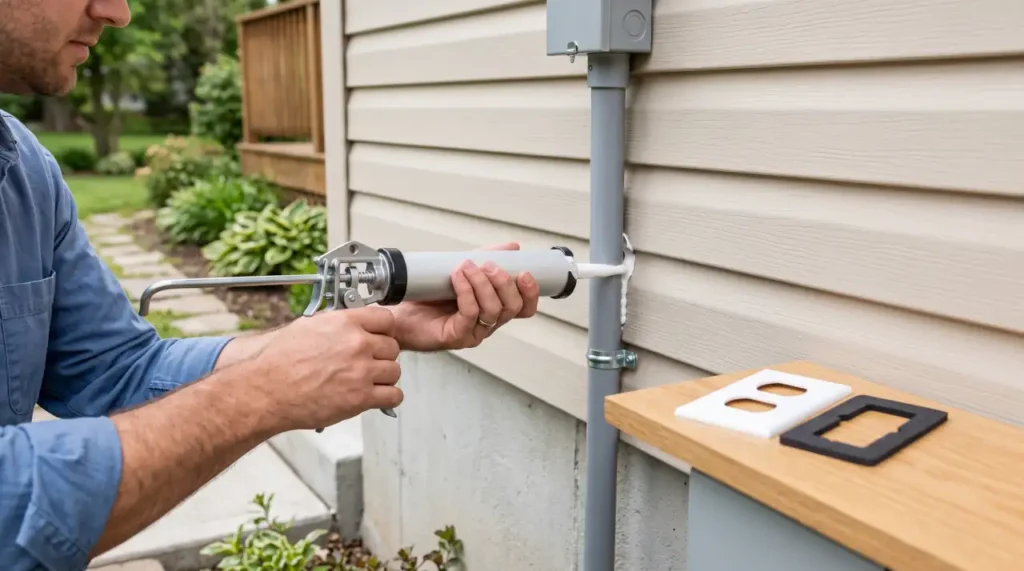
For the outlet itself, foam outlet gaskets (the kind sold for energy efficiency) double as a barrier against ants and other small pests slipping in around the edges of the cover plate. It’s a small fix that solves two problems at once.
It’s worth doing a proper walkthrough rather than a quick glance. Check where utility lines, cable, and pipes enter the house from outside, these gaps are often larger than people expect and rarely get sealed properly during construction. Look at the corners where your foundation meets the siding, and check weatherstripping around doors that lead to a garage or basement, since both are common staging areas ants use before working their way toward the warmer parts of the house. A tube of exterior-grade silicone caulk and an hour on a weekend is usually all it takes to close off the main entry points for good.
We’ve found that sealing exterior utility penetrations and installing inexpensive foam outlet gaskets often prevents repeat infestations after the colony has been eliminated. Treating ants without addressing these access points frequently leads to the same problem returning during the next warm season.
If you have outdoor electrical outlets, inspect those covers as well. Ants often enter through exterior electrical boxes before spreading into wall cavities inside the home.
Apply Repellents Regularly
A one-time treatment rarely keeps ants away for good, especially if your home backs up to trees, mulch beds, or anywhere ants naturally nest outdoors. Reapplying a natural repellent like the peppermint mix every couple of weeks around entry points, window sills, and exterior walls keeps new scouts from establishing a trail back into your home in the first place.
Also Read: How To Get Rid of Flying Ants Before They Spread
If you live somewhere with a heavy ant population nearby, it’s worth treating the perimeter of your home seasonally, not just reacting once you spot a problem indoors. If ants keep returning despite repeated treatments, scheduling a professional pest inspection can help locate hidden nests, identify overlooked entry points, and determine whether multiple colonies are entering your home from different locations. Prevention is genuinely the cheapest and least stressful part of all of this.
Once you’ve eliminated the colony, continue checking nearby outlets over the next two to three weeks. Seeing no additional ant activity during that time is usually a good sign that the infestation has been successfully eliminated.
Final Thoughts
Ants in an electrical outlet look alarming the first time you see it, and honestly, that reaction is fair. But it’s a problem with a clear cause and a clear fix. Cut the power, treat the area safely with the right products, break the scent trail they’re following, and follow up with prevention so they don’t simply come back through a different outlet—or begin appearing in other electrical outlets throughout your home.
Most of the time, a few days of consistent effort clears this up completely. If you’ve gone through these steps and you’re still seeing ants, or if you’re noticing signs of electrical damage like warm outlets or a burning smell, that’s the point where it’s worth calling in a professional rather than continuing to DIY it. A bigger colony hiding deep in your wall voids sometimes needs more than store-bought sprays and traps to fully clear out, and there’s no shame in bringing in help once it’s gone past the basics.