Seeing carpenter ants in a tree usually does not mean the tree is the problem by itself. More often, it means the tree already has soft wood, moisture, decay, or an old wound the ants can exploit. That is why this is worth paying attention to. A tree infestation can stay local for a while, but it can also become the first clue that ants are traveling close to your house.
Also Read: How To Get Rid of Grease Ants Quickly and Safely
Quick Answer: Why Are Carpenter Ants in Trees?
Carpenter ants in a tree usually mean the tree already has moisture damage, decay, hollow areas, or old wounds the ants are using for nesting. They do not eat wood like termites, but they can worsen existing damage and sometimes use nearby trees as pathways into homes. Finding the nest and correcting moisture problems are the most important steps for long-term control.
Signs You Have Carpenter Ants in Your Tree
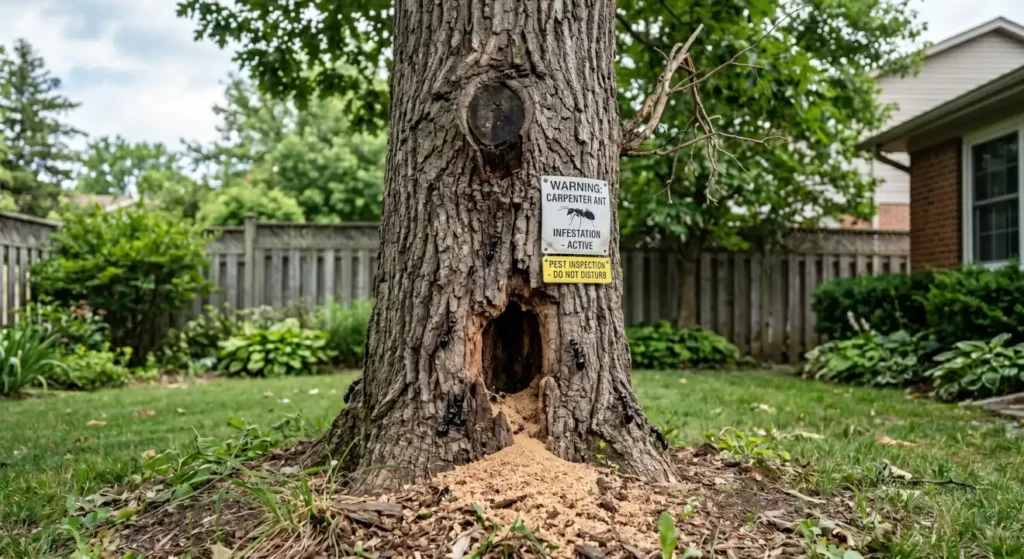
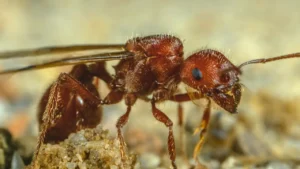
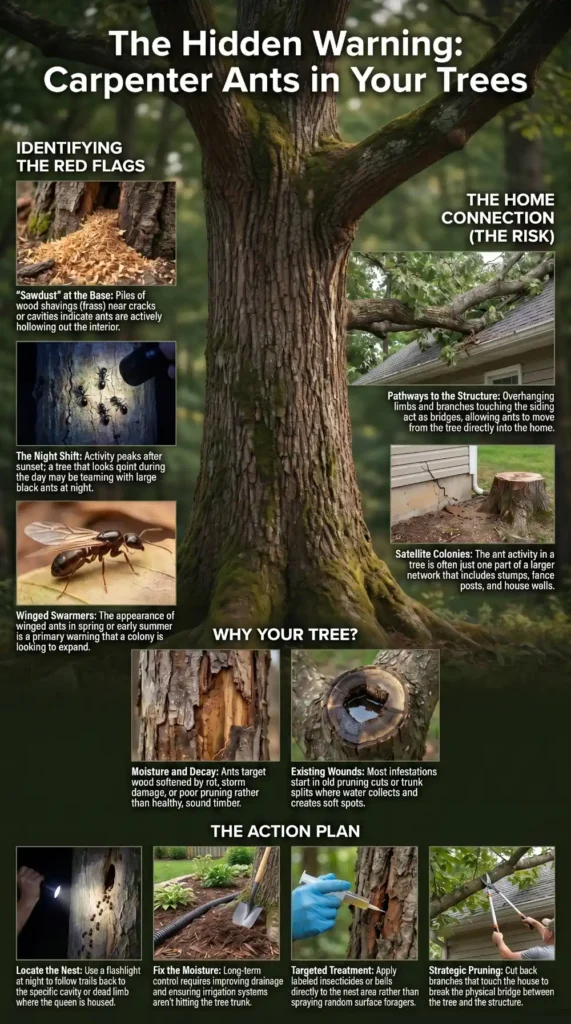
The easiest clue is usually the mess at the base of the tree. Carpenter ants do not eat wood like termites do. They chew it out to make galleries and tunnels, which leaves behind sawdust-like material or small wood shavings. If you see a pile of that material near a crack, a cavity, or a wound in the trunk, that is a strong sign you should look closer. Large black ants coming and going, especially in the evening or at night, are another big clue.
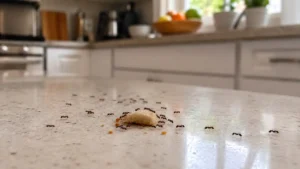
A lot of people miss the timing. Carpenter ants are often most active after sunset, so the tree can look quiet in daylight and busy later on. If you notice winged ants in spring or early summer, that is another warning sign, because that is when new colonies often spread. If the ants seem to be moving between the tree and nearby wood, branches, fence posts, or even your home, that raises the risk from a simple tree issue to a house issue. If you are already seeing ant trails leading toward the house, carpenter ants may be using the tree as a pathway, which is when ant exterminator options become more relevant.

Another sign is damaged or weakened bark around the entry point. Carpenter ants usually take advantage of wood that is already wet, rotted, or cracked. So the ant activity is often the symptom, not the original problem. The tree may still look alive from a distance, but up close you may notice soft spots, hollow-sounding sections, or old pruning wounds that never really closed properly.
Quick Inspection Checklist
Why Carpenter Ants Are in Your Tree
Carpenter ants are in your tree because it gives them what they want most, which is protected, moist, weakened wood. They are opportunists. They do not need a perfect tree. They need a section of wood that is already easier to hollow out, and they often find that in dead limbs, rot pockets, hollow trunks, old storm damage, or areas where water keeps collecting. They also feed on sweet foods, pet food, and other insects, including honeydew from aphids and similar sap-feeders. So if the tree is near aphids, scale insects, or other food sources, that can help support the colony too.
Field experience note: In homes I have inspected over the years, carpenter ants rarely showed up in perfectly healthy trees. Most infestations started around storm wounds, old pruning cuts, water damage, or cavities that stayed damp for long periods. The ants were usually exploiting an existing problem rather than creating one from scratch.
One example involved a homeowner who thought ants were coming from the siding around a back porch. After tracing activity at dusk, the main movement was actually coming from an old cavity in a maple tree about twenty feet away. The tree itself was not the whole problem; it had become a staging point the ants were using to reach the structure.
Quick Tip: If your tree has a scar, split, cavity, or fungus growth, inspect that area first instead of wasting time on the healthy-looking bark. Carpenter ants usually go where the wood is easiest to work, not where it is strongest.
It also helps to think about the tree the way an ant would. A tree with moisture problems is basically a long-term shelter. That is why carpenter ant activity around trees often points to a larger moisture issue nearby, such as overwatering, poor drainage, irrigation hitting the trunk, or decaying material left at the base. In winter, the colony does not disappear. They are not really hibernating in the winter, they are usually tucked into protected spaces and become less visible until conditions improve.
Activity usually becomes easier to notice in spring and summer when carpenter ants increase foraging and colonies begin expanding. That does not necessarily mean the infestation started recently; many colonies have been present much longer before homeowners notice them.
How To Get Rid of Carpenter Ants in a Tree
To get rid of carpenter ants in a tree, locate the nest, reduce moisture problems, apply treatment where ant activity is concentrated, use bait where ants are actively foraging, and inspect nearby trees or structures for additional colonies.
The goal is not just to kill the ants you see. The real goal is to find where they are nesting, cut off the conditions that support them, and make sure they do not spread to nearby trees or your home.
Guidance from the National Pesticide Information Center (NPIC) consistently emphasizes that locating the nest and correcting moisture conditions are major parts of long-term carpenter ant control, not simply killing visible ants. Finding the nest is often the most important step, and moisture control matters just as much as any treatment you use.
Locate The Nest
Start with the signs you already found. Look for sawdust piles, small entry holes, bark cracks, soft wood, dead branches, and areas where ants are entering and exiting repeatedly. A flashlight at night can help because carpenter ants are often easier to spot after dark. If you can follow their trail, you may be able to narrow down the nest faster than by just scanning the whole tree.
Do not assume the biggest pile of ants is the nest itself. Sometimes the main colony is in the tree, but sometimes the tree is only a satellite nest. Carpenter ant colonies often work as a network rather than a single nest. The parent colony usually contains the queen and developing young, while satellite colonies may spread into nearby trees, stumps, landscape wood, or structures around the property.
That matters because you may kill the visible ants and still miss the main colony nearby. That is one reason pest pros often spend time tracing the trail before they apply anything. You get better results when you know whether the tree is the main target or just one part of a larger ant network.
Use Commercial Insecticides Directly on the Nest
Once you have a clear nest location, a labeled insecticide can help, especially when the infestation is concentrated in one cavity or on one tree section. Extension guidance generally recommends following the label carefully and choosing a product meant for the situation. If you treat the wrong spot, you waste time and may only scatter the ants. If you treat the right spot, you can knock the colony back much faster.
Quick Tip: Do not disturb the nest right before treatment. If the ants feel threatened, they can shift activity or move deeper into the wood, which makes the job harder. Also, always read the label and keep pets, children, and non-target wildlife away from the treated area. Avoid drilling large holes into trunks or aggressively chopping open cavities to reach ants. I have seen homeowners create bigger tree-health problems by damaging structural wood while trying to reach a hidden colony. That approach helps reduce unnecessary exposure and avoids creating additional problems around the tree.
For homeowners who are comparing slow-acting bait style approaches, borax can be part of a bait strategy in some situations, but only when the bait is placed where ants are actually feeding and the surrounding treatment does not interfere with it. The bigger point is this, if you spray in the wrong place and shut down the trail, you may reduce your chances of getting bait back to the colony.
Place Ant Bait Around the Base of the Tree
Baits usually work slowly because worker ants have to carry material back through the colony. They work best when ants are actively foraging and moving regularly along established trails. Around a tree, bait can help when you suspect multiple colonies or are not completely sure where the primary nest is located. The goal is to let worker ants carry bait throughout the colony so it eventually reaches hidden sections of the nest.
Place bait where you see traffic, not randomly all over the yard. If you put bait out and then flood the area with repellent spray, you may make the ants avoid it entirely. The cleaner and calmer the placement, the better the odds that workers keep feeding and sharing the bait. This is also why a bait strategy works best as part of a larger plan, not as a stand-alone fix.
Spray The Tree with a Peppermint Oil Mix
Peppermint oil is a light, natural option some homeowners like because it can make the area less inviting. It is not usually the strongest answer for a serious nest, but it can be useful as part of a broader push, especially if you are trying to reduce surface activity while you inspect the tree and surrounding area. Think of it more as a helper than the whole solution.
For larger infestations, nest removal and correcting moisture conditions usually matter much more than essential oils. Surface repellents may reduce visible activity temporarily, but they rarely eliminate colonies hidden inside damaged wood.
The practical way to use it is to apply it where the ants travel, especially near the base and along obvious routes. Reapply after rain or irrigation because light treatments do not last forever. If the infestation is deep inside decayed wood, peppermint oil will not fix the root issue. It can help with pressure on the surface, but the nest still has to be addressed.
Check To See If the Ants Have Infested Nearby Trees
This step matters more than people think. Carpenter ants do not always stay in one tree, especially if there are other damaged or moist trees nearby. If one tree is a good host, the next tree over may be just as attractive. Check the nearby trunks, the lower limbs, any deadwood, and the spots where branches touch each other or rub against structures.
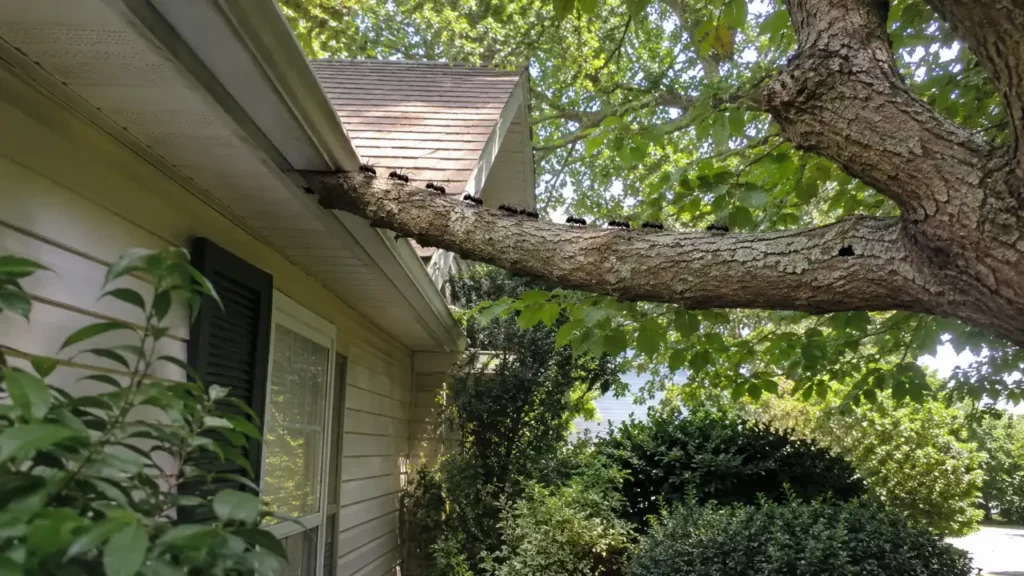
One pattern I regularly saw during inspections was homeowners focusing only on the heavily infested tree while missing nearby stumps, landscape timbers, or fence posts. Those secondary locations sometimes turned out to be where the main colony was actually established.
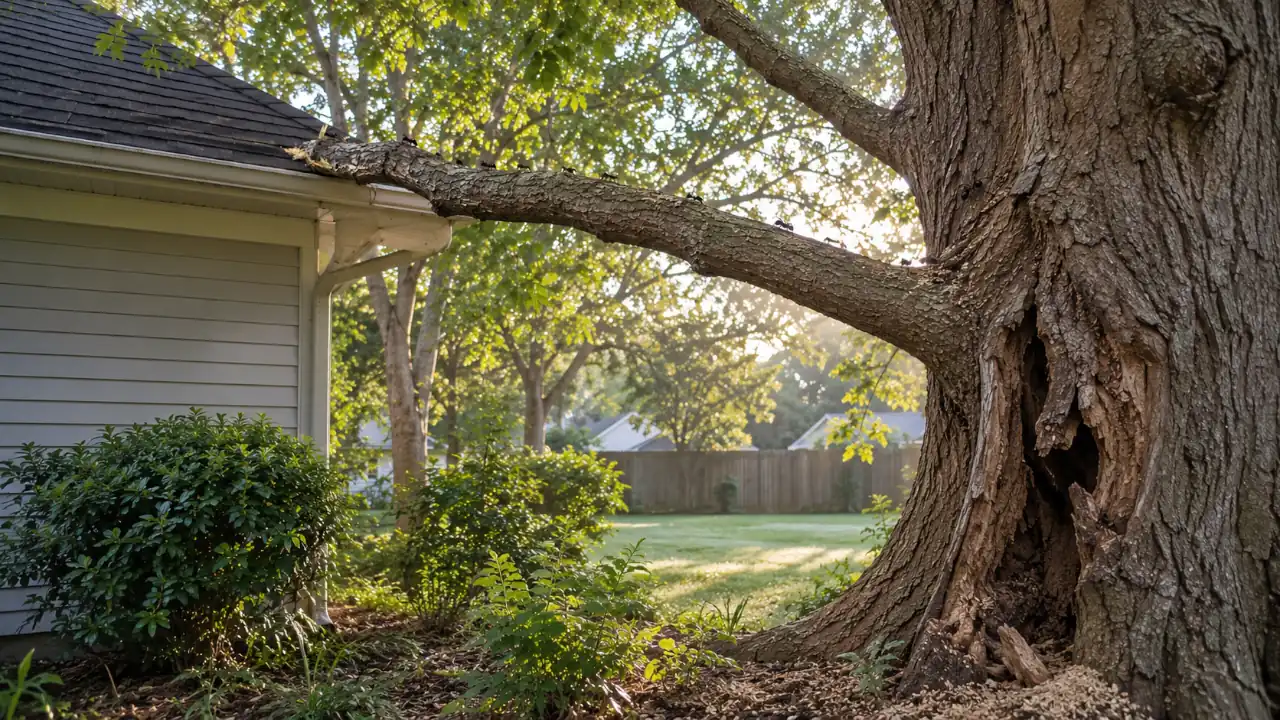
This is also where your home can become part of the picture. Carpenter ants can travel from tree limbs into buildings, which means overhanging branches, roof contact, and wood touching wood all matter. If a branch reaches the siding or roofline, the tree is no longer just a tree problem. It is now part of a possible pathway into the house.
Ways To Prevent Carpenter Ants from Coming Back
Prevention is mostly about making the tree less comfortable for ants. The biggest lever is moisture control. Carpenter ants prefer damp wood, so anything you can do to keep the tree, the ground around it, and nearby wood structures drier will help. That means fixing leaks, improving drainage, trimming limbs away from the home, and not letting firewood or rotting wood sit nearby.
Pruning is important too, but not because pruning magically kills ants. It helps remove dead, damaged, or rubbing limbs that create easy entry points. It also reduces contact between tree branches and your home, which matters because ants can use that as a bridge. Clean gutters, good airflow, and proper irrigation all help more than most people realize.
If the tree is already badly decayed, you may need to decide whether it is still worth keeping. Not every infested tree has to come down, but a tree with major hollowing, repeated infestation, or structural instability can become a safety problem. The key is to be realistic. A healthy tree with a few ants is one thing. A hollow tree that is also leaning, cracking, or dropping limbs is a different story.
One more practical habit, keep the area around the trunk clear. Do not stack mulch too deeply against it, do not leave old stumps or dead limbs lying around, and do not ignore soft spots that get wetter every season. The less decaying material the ants have to work with, the less likely they are to settle in again.
Common Mistakes Homeowners Make
One of the biggest mistakes homeowners make is assuming carpenter ants automatically mean the tree needs to come down. In many cases, the ants are using an existing cavity or moisture problem rather than destroying a healthy tree. Another common mistake is spraying visible ants repeatedly without locating the nest. That can reduce surface activity while leaving the main colony untouched. Ignoring overhanging branches and nearby damaged wood is another issue because carpenter ants often use those areas as travel routes.
How Much Damage Can They Cause?
Carpenter ants usually do not damage healthy trees by themselves because they do not eat wood. They typically move into trees that already have moisture damage or decay, although their tunneling activity can worsen structural weakness over time.
This is where a lot of people panic too early or wait too long. Carpenter ants do not eat wood the way termites do. They excavate it. That means the real damage comes from the fact that they are hollowing out wood that is already softened by moisture, decay, or prior injury. In many cases, they are more of a warning sign than the original cause of decline.
That said, the warning still matters. If the tree already has rot, carpenter ant galleries can add to weakness in limbs or trunk sections. They are usually not the reason a healthy tree suddenly becomes unsafe, but they can make an already weakened tree worse. That is why tree health, water control, and decay management matter so much here.
The bigger risk for homeowners is not always the tree itself. It is what the tree can lead to. If the ants are already in a tree that hangs over the roof, touches siding, or sits next to a vulnerable structure, the colony has a pretty easy route indoors. Once that happens, you are no longer dealing with a simple yard issue. You are dealing with a structure issue. That is why wood-boring insects are worth thinking about as a category, not just as a tree problem.
When Professional Help Makes Sense
Some tree infestations stay localized, but certain situations deserve faster attention. If the tree has extensive hollowing, multiple nearby nests, heavy activity moving toward the home, or signs of structural weakness, a professional inspection may save time and prevent larger problems. I have also seen cases where homeowners treated the visible ants repeatedly while the main colony remained hidden elsewhere on the property.
Should You Remove a Tree with Carpenter Ants?
You do not always need to remove a tree with carpenter ants. If the tree remains structurally sound, treatment and moisture correction may solve the problem. Trees that are severely hollow, unstable, heavily decayed, or threatening nearby structures may require removal.
Species Of Trees That Carpenter Ants Like the Most
There is no single tree species that carpenter ants always prefer in every region. The condition of the tree matters more than the name on the tag. Still, some studies have found associations between carpenter ant nesting and certain hardwoods such as red maple, Norway maple, and red oak. That does not mean those trees are doomed. It just means they have shown up often enough in research to be worth watching closely when they are damaged or decaying.
Also Read: Is Terro Safe for Pets? The Risk Depends on Where You Put It
In real life, carpenter ants are most drawn to trees with moisture, wounds, hollows, rot, or old structural damage. So a healthy oak is usually less interesting to them than a maple with a split trunk and a damp cavity. Likewise, any tree with dead limbs, fungal decay, or repeated storm damage becomes more attractive than a perfectly sound tree of the same species.
If you want the simplest rule, think condition first and species second. Hardwoods may show up often, but carpenter ants are not selecting trees based on species alone. They are choosing opportunity. The more damaged and moist the wood, the better the nesting spot.
Final Thoughts
Carpenter ants in a tree are not something to ignore, but they are also not a reason to panic. Most of the time, they are pointing to a tree that already has moisture damage, decay, or an opening they can exploit. That means your job is bigger than killing ants on sight. You need to find the nest, inspect the nearby trees, reduce moisture, and make sure the ants are not using the tree as a route to your home.
If you catch the problem early, you may be able to keep the tree and stop the ants from spreading. If you catch it late and the tree is hollow, unstable, or connected to your roofline, the better move may be more aggressive treatment or tree removal. The better approach is to look at the whole picture, not just the ants you can see on the bark.