If you are staring at a line of ants and a dog or cat walking around the house, the question is probably the same one you typed into Google: is Terro safe for pets? The honest answer is that it depends on the product and where you place it. TERRO liquid bait can be used in pet homes, but only when you put it where pets cannot reach it and follow the label exactly. Terro ant dust is a different story and needs more caution.
That is the real answer most homeowners are looking for. Not a yes-or-no slogan, but a practical way to use ant control without creating a pet problem at the same time.
Also Read: Carpenter Ants in a Tree Could Mean Bigger Problems Around Your Home
Quick Answer: Is Terro Safe for Pets?
Yes, TERRO liquid ant bait can be used in homes with pets when it is placed where dogs and cats cannot access it. The biggest risk comes from pets reaching, chewing, or licking bait stations. TERRO ant dust requires additional caution because pets can contact or ingest the dust more easily than sealed bait products.
Many homeowners specifically want to know whether TERRO ant bait is safe for dogs and cats or what happens if a pet accidentally gets into a bait station.
What Is Terro Ant Bait?
TERRO ant bait is a slow-acting ant control product built around a simple idea: let the ants take the bait back to the colony. The liquid bait is designed to attract foraging ants, and the active ingredient in TERRO liquid bait is borax, listed on the product as sodium tetraborate decahydrate. The bait gives ants both a food source and a water source, which is why the foragers keep coming back to it until the colony is affected.
The liquid bait contains sweet ingredients that attract foraging ants, which is one reason dogs sometimes show interest in spilled bait or damaged bait stations.
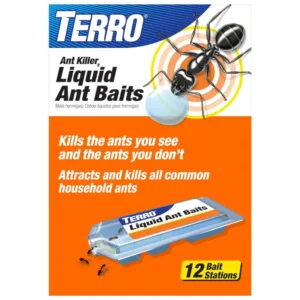
That slow action matters. A bait is not supposed to knock down every ant the second it touches them. It is supposed to be eaten, carried, and shared. That is why bait works so well on many household ant problems and why it also needs to be handled carefully around pets. If a dog or cat can reach the bait station, the same thing that makes it attractive to ants can also make it interesting to a curious pet.
Is Terro Safe Around Dogs and Cats?
For most homeowners, the question isn’t whether TERRO can be used around pets. It’s whether pets can get to it. In my experience, the actual risk usually comes from poor placement rather than the product itself. A bait station hidden behind an appliance or inside a secured cabinet is a completely different situation than one sitting out in the open where a dog or cat can investigate it. That’s why both TERRO and the product label emphasize keeping bait out of reach of pets and children.
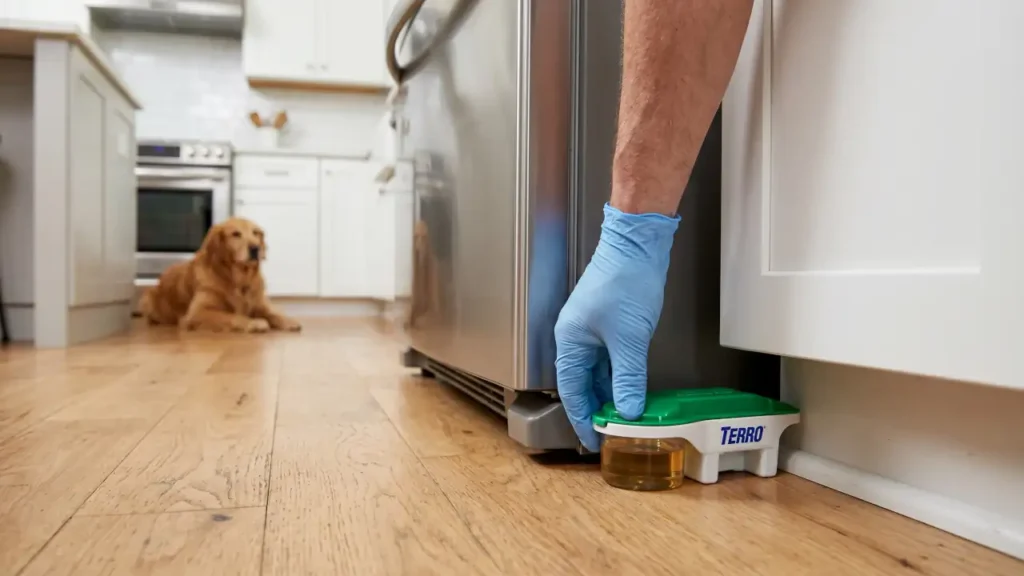
That tells you the real-world rule. TERRO is not something you throw on the floor and forget about. It is not a pet treat. It is not a surface spray you can splash around a feeding area. It is a bait product that can be useful in a pet home only when it is sealed, hidden, and placed with care.
A lot of homeowners get tripped up because they hear the word borax and assume every TERRO product carries the same level of risk. In homes where I’ve dealt with recurring ant problems, the biggest mistakes usually happen when homeowners focus on the ingredient and ignore the product design. A sealed bait station tucked behind an appliance presents a very different exposure risk than an ant dust applied where pets can walk through it. Liquid bait, granular bait, and ant dust all behave differently, and each one brings a different level of exposure risk.
The safest way to think about it is this: the container matters, the placement matters, and the type of product matters just as much as the active ingredient.
How It Affects Dogs
Dogs are usually the bigger concern because many of them investigate with their mouths first and ask questions later. A dog can knock over a bait station, chew through a container, lick a spill, or drag a station to another room. If that happens, the issue is not automatically an emergency, but it does become something you should take seriously. TERRO says to consult a vet if a pet comes into contact with liquid bait, and the ASPCA notes that borax can cause stomach upset and irritation in pets, with higher exposures potentially causing kidney injury.
In plain English, a small accidental lick may cause mild digestive trouble, while a larger amount can be more serious. The exact reaction depends on the amount eaten, the size of the dog, and whether the product was liquid bait or dust. Puppies, toy breeds, and very small dogs may be affected more quickly than larger dogs because even a small amount represents a larger dose relative to their body weight.
That is why you should not judge risk by the word safe alone. You judge it by exposure. A bait station tucked behind a refrigerator is very different from a station beside a dog bowl.
In actual service situations, I’ve found that dogs rarely have issues with properly hidden bait stations. Problems usually start when stations are placed in open areas where curious pets can investigate them. Placement mistakes cause far more incidents than the bait itself.
Dogs that seem to have gotten into TERRO may drool, vomit, act unsettled, or stop eating for a bit. Those signs are not unique to TERRO, but they are a reason to watch closely. If you know the dog had access to the product, do not wait around for a perfect answer from the internet. Contact your veterinarian or a poison helpline and keep the package with you. The label and active ingredient matter a lot when someone is deciding whether treatment is needed.
How It Affects Cats
Cats are different, but the concern is still real. A cat may be less likely than a dog to chew a bait station, but cats are curious, they lick their paws, and they squeeze into places where people rarely look. That means a cat can still brush against ant dust, step in a spill, or decide that a bait station is a toy. The risk is lower when the bait is hidden well, and higher when it sits in open areas or along pet routes.
Kittens deserve extra caution because their smaller size can make them more sensitive to accidental exposures than healthy adult cats.
With cats, the biggest mistake is often assuming that out of sight means out of reach. A cat can reach under appliances, behind furniture, and along baseboards better than most people realize. If a cat gets liquid bait on fur or paws, the worry is not only the direct dose. The cat may groom the area later and ingest more of it that way. That is why TERRO’s own advice to keep liquid bait away from pet access is not just legal wording. It is practical advice.
The warning for cats is even stronger with dust products. Dust can cling to fur and skin, and TERRO’s ant dust FAQ says the product is harmful if absorbed through the skin and that ingested dust should be discussed with a veterinarian. So if your home has cats, dust should be handled with extra caution or avoided entirely in reachable areas.
What About Terro Ant Dust?
Terro ant dust is not the same thing as the liquid bait, and I would treat it as the more concerning option in a pet home. TERRO’s own FAQ says the dust is harmful if absorbed through the skin and that if a dog ingests it, you should contact your veterinarian or CHEMTREC. That is not the kind of language you want to brush aside.
Dust products are useful for cracks, voids, and hidden spaces where ants travel, but they are much easier for pets to contact by accident than a sealed bait station placed inside a cabinet. A little puff of dust in the wrong place can land on paws, noses, bedding, or toys. Once that happens, the risk is no longer theoretical. It becomes a cleanup and exposure problem.
If you need to use ant dust in a home with pets, the safest mindset is not how much can I use? It is where can I use it so no pet can touch it? The product label should guide every step, and any area with food bowls, sleeping spots, litter boxes, kennels, or play space should be treated as off-limits. In many homes, that means bait stations are a better fit than dust.
For homes with young pets, I generally prefer contained bait systems over exposed dust applications whenever practical. Dust has its place in pest control, but it requires much more attention to placement and exclusion.
How To Use Terro Ant Bait When You Have Pets
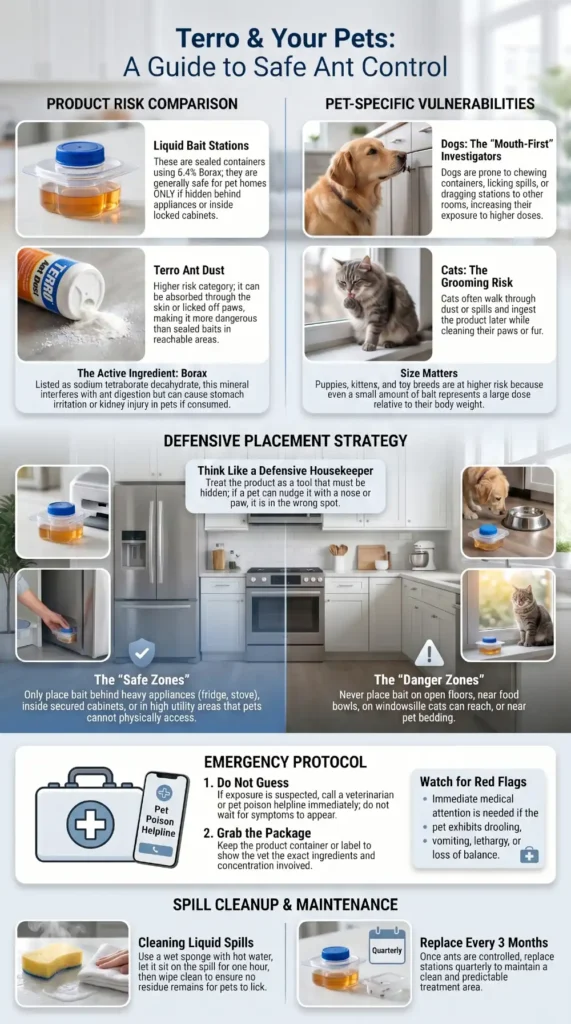
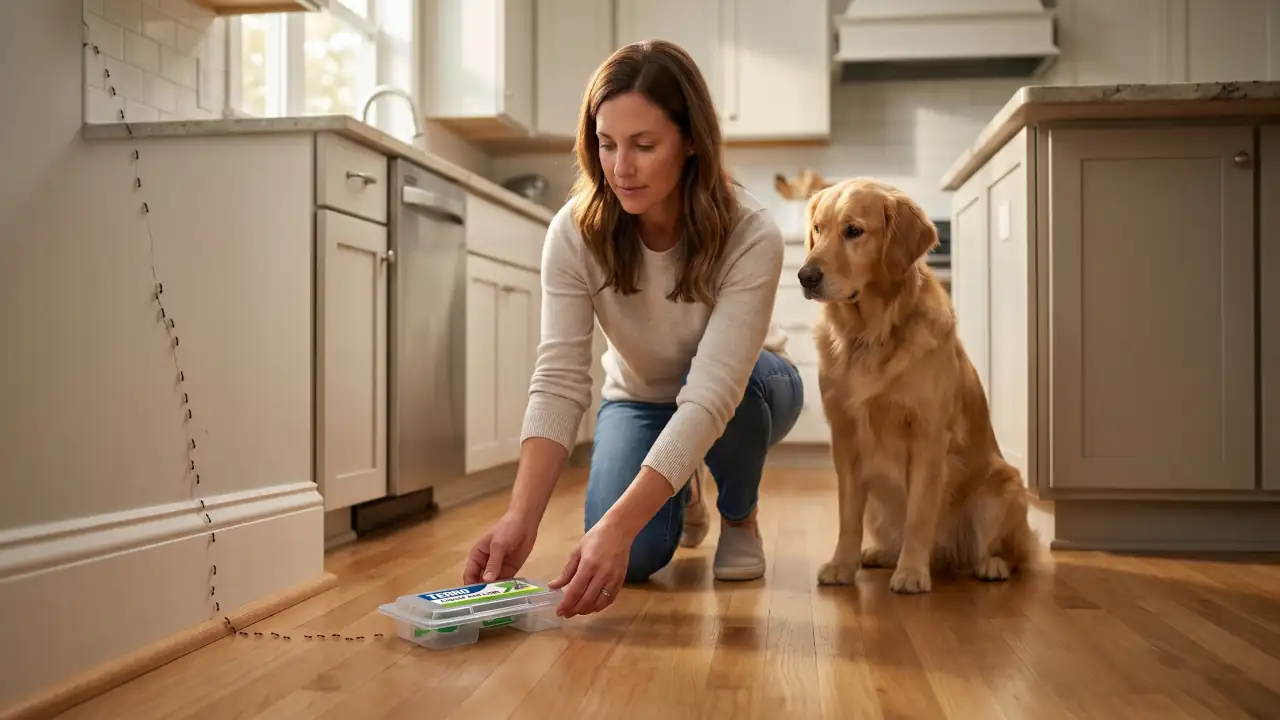
The safest way to use TERRO around pets is to think like a defensive housekeeper, not like somebody trying to spread bait everywhere. TERRO says the bait should remain as undisturbed as possible while ants feed on it, and its placement guidance says to put it where children and pets cannot access it. That means hidden, protected, and checked often.
Ants often enter through gaps around doors, windows, utility penetrations, and small cracks in foundations or siding. Following ant trails back toward these entry points can help you place bait more effectively.
In a real home, the best spots are usually behind appliances, inside a closed cabinet that pets do not enter, in high utility areas, or in places blocked by furniture that a pet cannot move. The worst spots are open floors, beside food bowls, near pet beds, on windowsills that a cat can reach, or anywhere a dog can nudge the station with a nose or paw. The more boring and unreachable the placement, the better.
One homeowner I worked with kept replacing bait stations because they kept disappearing. It turned out their Labrador was finding them under a kitchen cabinet and carrying them into another room. Once the stations were moved behind the refrigerator where the dog couldn’t reach them, the ant problem improved and the bait remained undisturbed. Situations like that are a good reminder that placement matters as much as the bait itself.
You also want to reduce competing food sources. Some ant species are heavily attracted to sugary baits, while others prefer proteins and greasy foods. If you’re dealing with ants that seem uninterested in sweet bait, learning how to identify and get rid of grease ants can help explain why bait performance sometimes varies from one infestation to another.
Check the bait station regularly, but do not keep opening or moving it around. TERRO says complete control may take up to two weeks, and the baits should be replaced every three months once ants are controlled. That means patience matters. Moving the station every time you see activity can make things messier for both the ants and your pets. Keep the treatment targeted and predictable.
One more practical tip: do not spray contact killers near the bait. TERRO points out that contact killers are not for use around kids and pets and that residues can remain after application. If you spray over the bait area, you may end up breaking the ant trail or creating a second safety issue without solving the first one. The same issue happens when homeowners rely solely on contact treatments that kill visible ants without reaching the colony. In pest control, a clean bait setup is usually better than a mixed-chemical war zone.
What Should I Do If My Pet Eats Terro?
First, do not panic. Second, do not guess. If you think your pet ate TERRO liquid bait or got into ant dust, call your veterinarian or a pet poison resource right away and have the package in front of you. TERRO says to consult a doctor or vet if a pet comes into contact with liquid bait. If you suspect exposure, contact your veterinarian or the ASPCA Animal Poison Control Center immediately for guidance.
If the exposure is recent and your pet is awake, calm, and able to swallow normally, follow the guidance you are given by the vet or poison expert. Do not start random home remedies unless a professional tells you to do so. People often assume water, milk, or food will dilute a pesticide exposure, but that advice can be wrong depending on the situation. The label and the product name help the professional decide what to do next.
Watch for vomiting, drooling, diarrhea, unusual tiredness, wobbliness, or a pet that stops acting normal. If the pet is having trouble breathing, collapsing, or having seizures, treat that as an emergency and go to a vet clinic immediately. Even when the symptoms seem mild, it is still smart to call because small pets can react more strongly than large pets after the same exposure.
If possible, keep the container, station, or package so you can tell the vet exactly which TERRO product was involved. Liquid bait, ant dust, and other ant killers are not interchangeable. The product type changes the risk and the treatment plan. That small detail can save time when minutes matter.
What Is Terro Ant Bait Made From?
TERRO liquid ant bait uses sodium tetraborate decahydrate, commonly known as borax, as its active ingredient. In TERRO liquid bait, that active ingredient is present at a concentration of 5.40%, which is enough to affect ants while still allowing them time to return to the colony and share the bait. The reason it works is simple: ants eat it, carry it back, and share it within the colony, where it interferes with digestion and slowly kills the ants.
That same slow-kill feature is why baiting works better than random spraying for many ant problems. The reason TERRO works so well is that it taps into the same food-seeking behavior that brings ants indoors in the first place. If you’ve ever wondered why ants suddenly show up in kitchens, pantries, or around pet food bowls, understanding what attracts ants makes the baiting process much easier to understand.
Many homeowners are surprised that ants don’t die immediately after feeding on TERRO. That’s actually part of the strategy. The delayed action is one reason many DIY remedies fail to eliminate entire colonies because products that kill ants too quickly often prevent the bait from spreading through the nest.
The active ingredient needs time to spread through the colony, which is why understanding how borax eventually kills ants helps explain why bait products often outperform quick-contact sprays.
One more important point: natural does not mean harmless. Borax occurs naturally, but it can still irritate pets if ingested in enough quantity. That is why the label instructions and placement matter more than the word natural on the box.
When Ant Bait Isn’t Enough
If ants keep returning after several weeks of baiting, the issue may be larger than a simple foraging trail. Multiple colonies, hidden nests inside walls, moisture problems, or outdoor nesting sites can all make control more difficult.
In some cases, the source colony is actually outside the home and repeatedly sends foraging ants indoors. If that sounds familiar, addressing ants in the lawn or yard may be necessary before indoor baiting can produce lasting results. In those situations, it may be worth having a pest-control professional identify the species and locate the source of the infestation before applying additional products.
Also Read: What Attracts Ants to Your House: The Complete List
Final Thoughts
So, is Terro safe for pets? The best honest answer is that TERRO liquid ant bait can be used in homes with pets, but only if you place it where pets cannot get to it. The product itself is not designed to be pet-friendly in the sense of being something animals can touch or eat safely. It is designed to be hidden from them. TERRO ant dust deserves even more caution because it can be harmful through skin contact and ingestion.
If you remember nothing else, remember this: hidden bait station, clean house, no spill, no pet access. In most homes, the pet-related issues I’ve seen were not caused by the bait itself. They happened because the bait was left where a curious dog or cat could reach it.
That is the real formula. Once you start treating TERRO like a tool that needs a setup, not just a bottle that needs to be opened, the risk drops and the results usually improve too. For most pet owners, the safest ant control plan is careful placement, steady monitoring, and fast cleanup if anything goes wrong.